
Science
‘A purple darkness’
Over a 100 years ago, Professor Kavasji Naegamvala, founder director of India’s first modern astrophysical observatory in Poona, observed and photographed a total solar eclipse, a report of which was published in 1902
This article is reproduced in part from the FEZANA Journal, Winter 2008 issue, Vol 22 No 4, pages 60-62 by special permission.
While researching a totally different area of science at the University of California at Davis, I stumbled upon the exploits of a very extraordinary Parsi gentleman who happened to be a lecturer in physics at Bombay’s Elphinstone College but with an endearing personal interest in astronomy. The culmination of his career was dictated by a celestial event: the total eclipse of the sun. Prof Kavasji Dadabhai Naegamvala (1857-1938), wrote the book Report on the Total Eclipse of January 21-22, 1898, as observed at Jeur in Western India and had it published in 1902 by the Department of Education and printed at the Government Central Press, Bombay. This is his story.
Armed with a Rs 5,000 grant from Maharaja Takhtasinghji of Bhavnagar (in Gujarat) and a matching amount from the Bombay Government, Naegamvala established an observatory at the Government College of Science (now College of Engineering), Poona where he worked as its first and last director after several years at Elphinstone College. The chief instrument at the Takhtasinghji’s Observatory at Poona (1888-1912), the first modern astrophysical observatory in the country, was a 16½ inch aperture silver-on-parabolic glass Newtonian with a 4-inch finder attached. This telescope manufactured by the well-known Grubb’s of Dublin, Ireland along with the £ 250 observatory dome was inspected at the British Government’s Lambeth Observatory in 1887 or 1888 before being sent to Poona, where it was installed in 1890. The Observatory was closed down in 1912 on Naegamvala’s retirement and the instruments were transferred to the observatory at Kodaikanal.
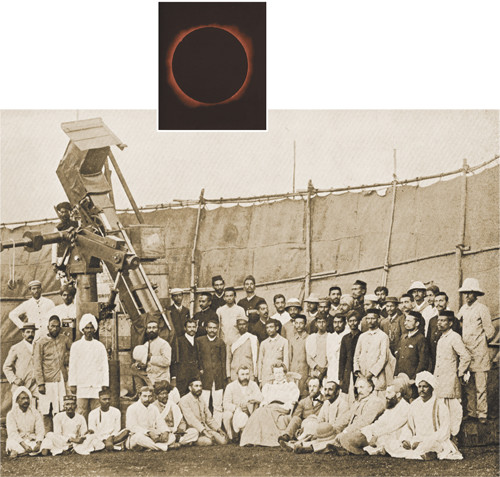
(Above) The Indian team led by Prof K. D. Naegamvala (seated 4th from right). Observe Parsi students and assistants in black caps and a pugree. (Top) The total eclipse of the sun on January 22, 1898 lasted just 2 minutes and 4 seconds, ie, from 13 hours, 20 minutes and 0 seconds to 13 hours, 22 minutes and 4 seconds
On February 23, 1896 Naegamvala, as director of Takhtasinghji’s Observatory, wrote a letter to the governor of Bombay of the need to prepare in time for the total solar eclipse which was to take place on January 21-22, 1898. Naegamvala estimated that he would need Rs 10,000 to purchase the latest equipment to observe and photograph, for the first time in India, the rare eclipse. He, however, offered to raise half that sum through private sources. He also proposed that he be allowed to proceed to Norway to participate in observing the total eclipse of the sun there on August 9, 1896 in order to familiarize himself with the latest methods and instruments employed.
The British Government sanctioned Rs 5,000 to Naegamvala and agreed to bear his expenses for a trip to Scandinavia as a member of the Royal Society’s and the Royal Astronomical Society’s joint expedition to Vadsö, Finland. But as luck would have it, clouds on that day prevented the team from making any observation at all. But all was not lost for Naegamvala had the opportunity to examine closely the numerous instruments that were brought together by five different observatories in Europe. Naegamvala was strongly urged by Sir Norman Lockyer, of the South Kensington Observatory, London, to add if possible one more prism to the Cooke prismatic camera in order to obtain twice the dispersion ever attempted till then.
On his return to India arrangements were made for him to purchase the necessary instruments. In November 1896 Naegamvala once again approached the Government for permission to raise an additional sum of Rs 3,000 if the Government would raise its grant by Rs 2,000 to a total of Rs 7,000 which would include the second prism as suggested by Lockyer. In the end, all the instruments that he desired to obtain were sent to him, but some reached him only 10 to 15 days before the event. Had he received them earlier he would have been able to make adjustments to the camera with much greater precision and the results would have been far superior to what was ultimately obtained.
The site selected for making the observations was four miles from Jeur station (Sholapur district) on the Greater Indian Peninsula Railway (GIPR) which was extremely close to the center of the "Path of Totality” of the eclipse. This site was ideal as it was hilly, affording many points for observation, well-supplied with water, and less affected by clouds that would drift by from the north-east monsoon. However, the bubonic plague was raging at that time in Bombay as well as in the village of Karad (which was also located as favorably as Jeur) and hence basing other teams there had to be abandoned. In addition to Naegamvala’s team there were two American teams and one Japanese team but Naegamvala’s site was perceived to be the best out of the lot.
Dr A. W. Thomson (DSc) who was a professor of engineering at the College of Science ably took over all the administrative duties of the camp leaving Naegamvala to concentrate on scientific matters. Assistant surgeon Dr P. P. Mulla, of the Bombay Civil Medical Establishment, was in charge of sanitary arrangements at the camp. K. R. Godbole, executive engineer of Sholapur district was deputed by the Government to erect pillars, huts, etc for the camp. And T. J. B. Thatcher, district superintendent of police, was brought in to keep the crowd of curious villagers away and in particular to draw a cordon at Jeur station on the day of the eclipse. This was very important as the teams needed absolute concentration without any disturbance for all of the two minutes that the total eclipse would last. Additionally local assistance for manual labor, water and food supplies was to be provided by Rao Saheb Patankar, the mamlatdar.
Days were spent setting up the instruments and rehearsing the parts to be played by various persons in the Indian team. Naegamvala had 13 delicate instruments to calibrate and set up and make sure everything went according to clockwork for the total eclipse would last for only two minutes and another chance might not come his way during his lifetime. A partition of hessian cloth (goon-paat) and bamboos was erected all around the campsite to protect the expensive instruments and prevent any disturbance from wind or animals during the crucial period of the total eclipse. A number of students from the College of Engineering and the Elphinstone College were on hand to render assistance, among them there were 20 Parsis! In all nearly 50 persons were working under Naegamvala’s direct supervision on January 21-22, 1898.
As observed by P. T. Pavri and R. D. Naegamvala (Kavasji’s brother), several cattle from the nearby villages were especially brought close to Naegamvala’s observation post and allowed to graze in the pastures north of the camp. Soon after the eclipse began and six minutes before totality it was reported that the crows started to caw loudly and the village dogs began barking and moaning in alternation. The chickens too began to cackle and the pigeons to coo incessantly. No other birds were visible in the sky. The few kites that were circling above had descended on land. But the cattle continued to graze normally. During the two minutes of total eclipse there was a purple darkness and total silence from all birds and animals, including the cattle who had stopped their grazing. However, after totality the birds began chirping as if it was morning and the kites began to soar once again. Prof Woodrow observed that the Leguminosae plants had closed their leaves before totality mistaking it for sunset. The tarwad tree (Cassia auriculata) had already closed its leaves 40 minutes before totality and the Crotolaria juncea plants also did the same. Also, there was a drop in temperature of 4oF. However 30 minutes after total eclipse things began to revert to normal.
As it was over 90oF during day time, the photographic plates could only be developed after 1 a.m. and until sunrise when the temperature came down to 43oF. Naegamvala’s team’s photographs had come out exceptionally well as were those taken by the team from Lick Observatory under Prof W. Wallace Campbell who was assisted by his wife Elizabeth as both of them were on a round-the-world trip by boat. This was the first total solar eclipse witnessed by Campbell. However, his arrival at Jeur did not augur well at first. Worn down by long travel of two months by boat from San Francisco via Hawaii, Japan, China, Singapore, Ceylon, and finally Bombay, the heat at Jeur, tension, unagreeable food, and strange customs, he could not determine the exact latitude and longitude of the site to the last decimal point. This upset him so much that he had a temporary nervous breakdown and began ranting that he would not succeed after having come so far. Alarmed at this turn of events Elizabeth gave him a massive dose of the finest whiskey and put him to bed at the camp. In the morning Campbell felt much better and he was able to determine his exact position which was only two miles off the center of the approximately 50-mile wide path of totality. Luckily, Naegamvala does not report any medical problems to himself or to any members of his team.
Naegamvala was so highly respected for his knowledge of astronomy that after he retired they could not find anyone to fill his shoes and the observatory that he directed for all of 24 years was shut down and the instruments moved elsewhere. After retirement in 1912 Naegamvala lived for 26 more years during which he continued to pursue his own interest in astronomy and published more papers. He died in 1938 at the ripe old age of 81.
Associate research geneticist at the University of California, Dr Ardeshir B. Damania’s area of interest includes biodiversity conservation issues, early agriculture, crop domestication and plants of economic and medicinal values. His early career was with the Food and Agriculture Organization of the United Nations and he subsequently worked with the International Center for Agricultural Research in the Dry Areas.
◆ ◆ ◆
From the archive