
Books
Richly researched record
Enduring Legacy. Parsis of the 20th Century. Volume I — Politics, Trade and Industry; Volume II — The Professions; Volume III — Arts and Culture; Volume IV – Sports and Cricket by Nawaz B. Mody. Published in 2005 by the author, 56A, Anita, Mount Pleasant Road, Bombay 400006. Pgs: 1,168. Current price: Rs 3,500.
The soundest advice given to the Parsis was by A. D. Shroff, an intellectual giant in his own quiet way, working for Tatas. In August 1947, a few days before Independence, at a Parsi National Conference in Bombay, Shroff emphasized that the community could secure a place in the India of tomorrow solely on the basis of merit and talent: "Numerically we are too insignificant to merit any attention. Instead of claiming all sorts of concessions as a minority, we should completely identify ourselves with Indians and make ourselves indispensable to the country.”
The Parsis’ genius for adaptability and their characteristic loyalty to the nation have indeed served the community well and have been its mainstay. So much so that the former attorney general of India Soli Sorabjee, usually not given to exuberance, commented: "The survival of the Parsis in the 21st century and their influence on the Indian polity and on the societies in which they live can well be regarded as a miracle, the eighth wonder of the world, or at least deserving of a prominent entry in the Guinness Book of Records.”
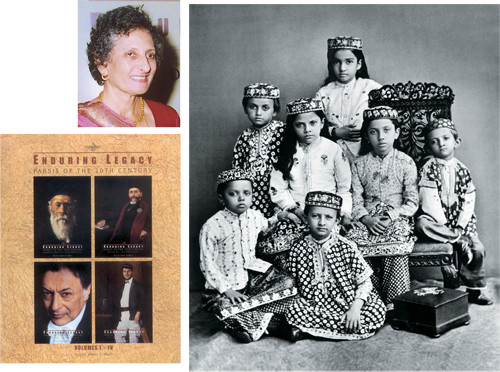
Above: montage of covers of four volumes; top left: Nawaz B. Mody; right; group of Parsi children
So many and so varied are the Parsi achievements that several books have been written on the subject. The earliest were H. D. Darukhanawala’s two volumes Parsi Lustre on Indian Soil (1939 and 1963), but these covered the community’s record only up to the middle of the 20th century. Much more recent (2002) was the deeply researched and extremely well-written and produced A Zoroastrian Tapestry: Art, Religion, and Culture, edited by Pheroza Godrej and Firoza Punthakey Mistree. The latest, the subject of this review, is Enduring Legacy, Parsis of the 20th Century in four volumes, edited by Nawaz B. Mody, as well researched and lavishly produced as the others.
Comparisons are odious. All I would like to comment upon is that Mody’s approach is diametrically opposite to Godrej and Mistree’s in that the duo present Parsi achievements in various fields and then proceed to the achievers themselves, whereas Mody presents the achievers first and then their achievements as seen through their eyes. The results are very much the same, except that there are certain achievements in the Legacy that are not mentioned in the Tapestry. To give an example, there is greater emphasis in the Legacy on the fact that Parsis interacted and prospered not only under British rule, but even more after freedom was won in the task of nation building. Just as there were Parsis who worked closely with the British, there were many like Dadabhai Naoroji who praised the British but condemned their doings in India as "un-British.” Other members of the community like Sir Pherozeshah Mehta, Sir Dinshaw Vacha, Madame Bhikhaiji Cama, Jamsetji N. Tata, Sir Ardesher Dalal and "General” Munchershah Avari not only fought against British rule but worked to make India industrialized, self-sufficient and strong.
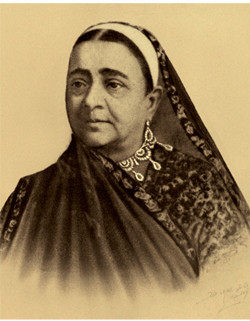
Lady Sakarbai Dinshaw Petit
In my youth I had vaguely heard of Sir Dhunjisha Bomanji Cooper, but wasn’t aware till I read in Legacy that this dynamic gentleman developed his political base in the Maratha-dominant territory of Satara and rose to become the first chief minister of Bombay in 1937. Similarly, the activities of Jamshed Nusserwanji Mehta of Karachi — it was said that Karachi was at its cleanest when he was its mayor-president for 13 years. The article in Legacy on Dr Manchersha Dhunjibhoy Gilder describes him as an outstanding human being and healer — a politician who devoted himself to his profession and to practising honest politics. Several other notable Parsis are mentioned, such as the much-misunderstood politician K. F. Nariman, the quintessential dissenter, and Minoo Masani, one of the drafters of the Indian Constitution and founder of the magazine Freedom First which survives to this day.
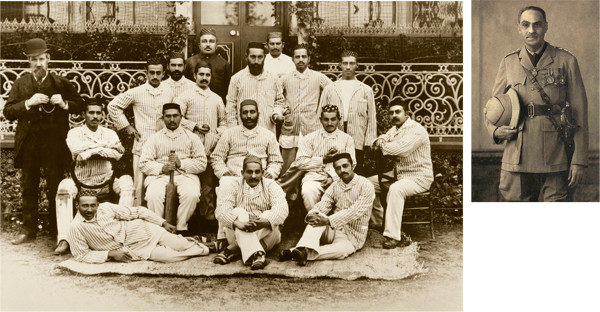
Above: Police officer Kavasji Petigara; left: The first Parsi cricket team which visited England in 1886
Highly individualistic were the Parsis of those days, espousing vastly different political ideologies — Homi Daji and Rustom Satin were ardent communists, Nasserwanji N. Sattha was founder member of the Peasants and Workers Party in Maharashtra, Naushir Bharucha was a Socialist committed to the Samyukta Maharashtra Movement, while the enterprising Feroze Gandhi was a parliamentarian who doggedly pursued every task he took up. Then there were Sir Homi Modi and his son Pilloo, extremely shrewd and talented, who brought a touch of humor to the rather sordid Indian political world.
It was in Enduring Legacy that I read for the first time the fascinating story of how Gandhi, a middle-class Parsi without any steady income, met and fell in love with the aristocratic Kashmiri Brahmin Pandit Jawaharlal Nehru’s daughter Indira, wooed her, and in spite of all the obstacles, married her on March 26, 1942, Ram Navami day, at the Nehru residence Anand Bhavan in Allahabad.
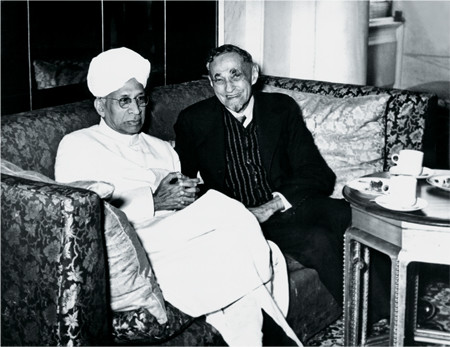
Sir Rustom Masani (right) with President S. Radhakrishnan
A highlight of Volume I is the recognition given, probably for the first time, to the trade union pioneer, S. H. Jhabvala, for the great man he was, in an article penned by his daughter Rehana. She recounts his philosophy of life: "I am only a seeker after truth and in the search thereof I am simply passing through various experiences of life. I undertook the work of organizing the masses simply from a humanitarian and philanthropic point of view. I had been dragged into the vortex of trade unionism simply because I felt largely for the poor toiling masses of the motherland.” The idea of trade unionism proved successful in Britain, Germany and other European countries as a practical measure to deal with the excesses of capitalism which are worse perhaps in India than in other countries.
Corrupt bureaucrats, get-rich-quick politicians, industrialists so wealthy as to afford giving luxurious airplanes or yachts as birthday gifts to their wives, can talk glibly about India Shining, their ears being shut to India Whining. Not so with Jhabvala. His aim of industrial organization was not to foster bitterness between employers and workers but to raise a common platform of understanding where both could meet at a healthy center of mutual peace and brotherly love. He wanted to venture into crowds of harassed, underpaid workers to give them an assurance that redemption was possible. "My work was the little unions, the starving individuals, the illiterate man, unclad woman, the foodless child.”
Times changed. Trade unions began to be politicised. The general strike in the textile industry in 1928 not only created bitterness but led to violence. In 1929, along with other trade unionists, Jhabwala too was arrested in what came to be known as the Meerut Conspiracy Case. Jhabvala argued his own case and was acquitted of all charges. A free man, he found there was no place for him in the politicised mainstream of the union movement he had founded! Disillusioned, he knew the virtue of acceptance, saying: "Like a humble planet, I go on revolving, offering to work in my own humble way in the direction I chose, namely alleviation of the misery of the masses.”
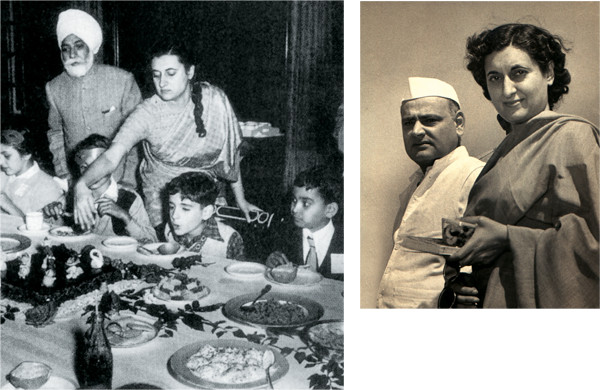
Above: Feroze and Indira Gandhi; left: Indira at a birthday party, photographed by Homai Vyarawalla
In the professions, too (Volume II) the community played a pioneering role — the illustrious roll call of judges and lawyers whose names became bywords for justice — Homi Seervai, profoundly learned, a man of honor and integrity, who never accepted more than one brief at a time, refusing other briefs until the one in hand had been worked out. Justice Bakhtavar Lentin, because of his impeccable conduct, was the first name to be sought whenever an independent probe was required into any malpractice. Karl Khandalawala who, the higher he rose at the bar, the greater grew his fame as an art critic and art collector. The one and only Nani Palkhivala, the humblest of men and the greatest among Indians, to whom full justice has been done in M. V. Kamath’s voluminous biography.
Then there were the administrative services — the visionary bureaucrat Shiavax B. Nargolwala, who built the steel frame of governance. Sir Rustom Masani who played many roles — the first Indian municipal commissioner, Vice Chancellor of Bombay University, one of the founders of the Central Bank of India — but whose worthiest role, under the influence of Mahatma Gandhi, was to do his utmost to prevent the division of our country into two, which has proved to be too heavy a price to have been paid for our freedom. In the police service, men like K. F. Rustomjee epitomised dedication to duty as did Field Marshal Sam Manekshaw with his distinguished record in the armed services. In the field of design and architecture, there were trusted builders like Shapoorji Pallonji.
Coming to the Fourth Estate, the first Gujarati newspaper and the oldest, the Mumbai Samachar was launched on July 1, 1822, by Fardoonji Marzban. It began humbly enough as a point of reference for Bombay merchants who were anxious to know when foreign ships arrived in India and what commodities they brought. From a weekly, it became a daily noted for the authenticity of whatever it published. Initially, it was a newspaper meant for all the communities in India. Marzban made it a point never to enter into unnecessary controversies, and to respect the feelings of all communities. But the paper also stood for social and religious reform. It was consistently critical of the Bombay Parsi Punchayet, the apex body of the Parsis, and its trustees for their conservative retrograde policies.
Sir Jamsetjee Jejeebhoy, the first Indian baronet, financed the Jam-e-Jamshed, and Dadabhai Naoroji was the inspiration behind Rast Goftar edited by Kaikhasroo Kabraji. Kaiser-e-Hind, Parsi Avaz, and Akhbar-i-Soudagar were other publications of note. Another outstanding publication that survives to this day, which Legacy refers to as "brilliant” is Parsiana, which too was originally a monthly. Parsis love controversy, second only to good food. It is therefore to the considerable credit of the Parsiana editors that with controversies raging around them all the time, they have never deviated from their balanced approach. The magazine has proved to be "the golden link between the Parsis of India and other parts of the world.” Journalists like Astad Gorwala and Cusrow Irani have their names carved in history for their courage in standing up for their rights during the tyranny of the Emergency.
Among the many Parsi social workers, special mention needs to be made of Avabai Wadia, the driving force of the direly needed family planning movement in overpopulated India.
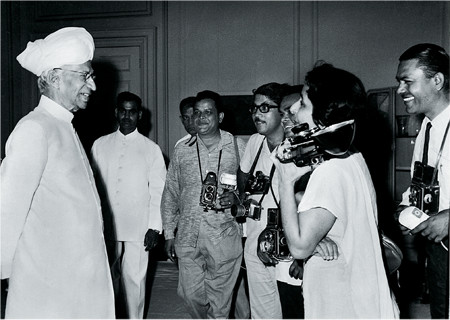
Homai Vyarawalla (r) with President S. Radhakrishnan
Who but the one and only Zubin Mehta could possibly have adorned the cover of Volume III, which deals with music, painting, dance, literature, theater and cinema? Fortunately, Mehta’s recently published autobiography The Score of My Life gives personal insights on how he made himself one of the world’s greatest conductors of western classical music and his enormous debt to his father, Mehli Mehta, also a great musician. Several photographs of Zubin in action are accompanied by a brilliant piece of interpretation by Sheryar Ookerjee, titled "Wielding the Magic Wand.”
Celebrated dancer Uttara Asha Coorlawala, jazz musician Cawas Khatau, artists Pestonjee Bomanjee (called the Rembrandt of India), M. P. Pithawala, Shiavax Chavda and Jehangir Sabavala are evocatively portrayed. In literature, the poetry of A. F. Khabardar and the writings of contemporaries like Rohinton Mistry and several others are mentioned. Theater personalities Adi Marzban, Pheroze Antia and Dr Jehangir Wadia are given due acknowledgment, as is that towering figure of Hindi cinema Sohrab Modi. Photography and cinematography are documented with a wealth of archival images.
Volume III climaxes with the visionary acumen of Dr J. J. Bhabha in the building of the National Centre for the Performing Arts (NCPA), his initiative and courage in seeking permission to build in the sea on Marine Drive because land was not available. Bhabha’s untiring efforts, his visits to various western cities, his talks with several acoustics professionals to ensure that the acoustics of the Centre’s main theater were as perfect as in the finest theaters in the world, have to be detailed to be believed. Sohrab Godrej and this reviewer were privileged to have Bhabha personally demonstrate to us that a whisper on the stage was as audible in the last row of the theater as it was in the first row.
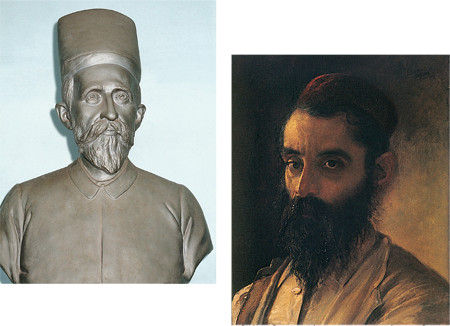
Above: Self portrait by Pestonji Bomnajee. Left: statue of Mancherji Khareghat
At the inauguration of the NCPA by Prime Minister Indira Gandhi, J. R. D. Tata gave the final accolade: "Over the years, Jamshed has devoted, with unrelenting persistence, untold anguished hours and sleepless nights, conceiving, studying, travelling, working for the benefit of this institution and I would like it to be publicly known how much the performing arts of India and the citizens of Bombay, who will enjoy the fruits of the job he has done, owe to the role he has played.”
Volume III ends on a moving plea by journalist Sarosh Bana to revive the unique heritage of Udvada, "a microcosm of living history, which should never be allowed to die out.” This village-city has been the most sacred pilgrim resort of the community and the last bastion of the Zoroastrian religion in India. Some steps towards this revival have been taken but they are too few. The youth wing of the World Zoroastrian Organisation (India) has prepared a consolidated programme for rejuvenating Udvada — to create the required infrastructure and to ensure the maintenance and conservation of properties so that the basic character and identity of this village-city remains unchanged.
The Legacy editor mentions "a certain obscurity” about Parsi contribution to sports. Her intensive research goes a long way to clarify and focus on the sizable contribution of the community to sports, particularly cricket and its associated requirements. Parsis are practical people. Their initiative was largely provoked by their belief that cricket would bring them closer to the British and thereby benefit them even more as a community. All the legendary Parsi cricketers who brought glory to India are mentioned, beginning with Dr Meherwanji E. Pavri and continuing with Polly Umrigar, Nari Contractor, Russi Surti, Farrokh Engineer and many others. Novy Kapadia, the writer, follows them on their foreign tours, particularly England, and mentions one occasion when the Parsi players, finding themselves in a tight corner, performed their kusti prayers to invite divine help and lo and behold, a thunderstorm broke out, stopping the play long enough to end the game in a draw!
Over and above their on-field performance, Parsis made a mark on selection panels, as umpires, authors, historians, statisticians and media personalities. A. F. S. Talyarkhan, "Bobby” to his million fans, became the greatest sports commentator India has produced, in a class of his own, unequalled to this day.
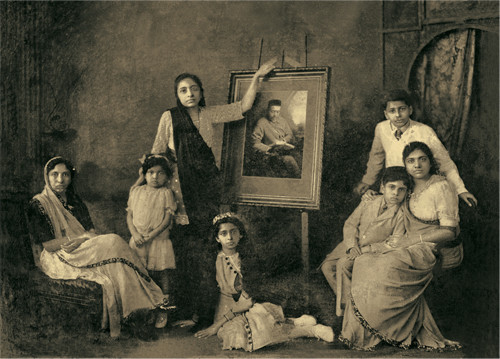
Cowasji Panday’s daughter Navajbai stands by her husband Sorabji Vatcha’s portrait, surrounded by Cowasji’s grandchildren
There was also women’s cricket, credit for which is rightly attributed to Aloo Bamji for her motivation and perseverance which led to women’s cricket acquiring status and prestige. Diana Eduljee came to be recognized as India’s best woman cricketer and among the most talented in the world.
The contributions of more than 60 writers, each an authority on what he or she has written, constitute the sturdy backbone of Enduring Legacy. In each of the four volumes, a number of rare archival photographs and illustrations bring this not so ancient legacy to light. An exhaustive bibliography and a comprehensive index to each of the volumes are included to foster research and inspire future generations. The striking cover photographs and the cover designs themselves, along with high production values, contribute to make Enduring Legacy a monumental publication.
It took this reviewer almost four weeks to go through the 1,168 pages of Enduring Legacy. Far from being bored, I felt considerably enriched, as a Parsi I felt like holding my head an inch higher. As a reviewer, however, I was constrained to drop more than half of the eminent names mentioned and confine myself strictly only to those names that were relevant to the context, lest this review be reduced to just a catalog of eminent names. At the same time, as a reviewer, I cannot resist commenting that each of the four volumes of Enduring Legacy deserves a separate review for itself — most certainly the fourth volume, the slimmest of the four, but the most richly researched, recording Parsi luster on the Indian sports field.
◆ ◆ ◆
From the archive