
Books
Scoring after a century
Parsi Cricket by M. E. Pavri. Reprinted in 2006 by The K. R. Cama Oriental Institute, 136 B Samachar Marg, Opp Lion Gate, Fort, Bombay 400023. Pp: xiv+196. Price: Rs 200.
For the 21st century reader, Parsi Cricket, first published in 1901, is a quaint and cherished chronicle. It records the achievements and failures of many a Parsi club cricketer, of a time when cricket was the first love of the Parsis, played with gusto from the schoolboy to the middle-aged man, Parsi topi on head, the white of flannels adorned by bow tie and striped jacket or wearing occasionally in practise the short white Parsi waistcoat of yore, with sudreh showing!
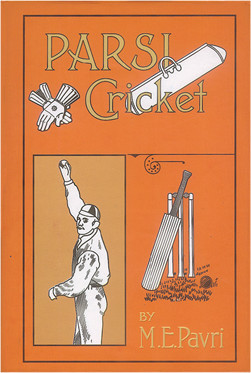
It is no secret that in the cricketing history of India the Parsis played a pioneering role. The first cricket club was started by the Parsis in 1848 in Bombay, wrote Pavri, and was styled the Oriental Cricket Club. It existed for only two years and was followed in 1850 by The Zoroastrian Cricket Club. "The bowling was then chiefly under-hand and the earliest round-arm bowlers (in 1867) were Navloo Mama and M. M. Poonegar (Jabooli)…” noted Pavri who was himself an accomplished allrounder and known as a great captain.
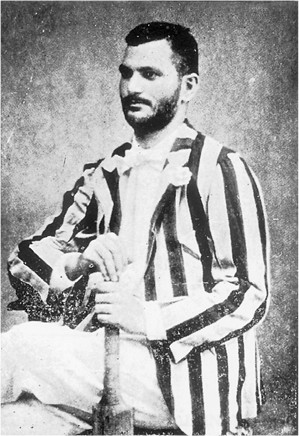
M. E. Pavri: medical man and successful cricketer
Parsi cricketers though had a rough ride in the early years in what was a colonial city. They were driven off the Oval (in Bombay) where they played every day, for an accidental injury done by a cricket ball to a police officer’s wife who was crossing the Oval! They did not have a good wicket to practise on, as polo players insisted on playing their game on the cricket field. "This makes the ground so rough and bumpy that the Parsi cricketers become apprehensive of a fractured rib, or a twisted nose, a black eye or loss of teeth,” the author observed.
Pavri intended his book to be more than a mere chronology or collection of facts and figures. He wanted it also to serve as a technical guide for the budding batsman, bowler, fielder, wicketkeeper or umpire and he explained carefully and concisely the laws of the game and the techniques of winning. The 27 illustrations in the book showcase some of the leading players of the era between 1848-1901. There are pictures of P. D. Kanga, "the successful and amiable captain of the second Parsi team that visited England in 1888,” B. D. Gagrat, B. Machliwala, D. N. Writer, D. Mody, R. E. Mody, R. D. Cooper, D. F. Dubash, J. M. Patel, D. D. Kanga, N. C. Bapasola, N. K. Bharucha, M. D. Kanga, K. M. Mistri, S. B. Spencer, D. Raja, J. M. Morenas, D. C. Pandole, Meherhomji… and D. B. Tapia, the Parsi umpire "acknowledged by native and English cricketers alike as the ‘model’ umpire.”
Pavri himself had been the man of the moment in many a match, being the only Parsi cricketer to make, among other records in India and England, over 1,000 runs and take over 100 wickets in a single season in the year 1900 at Eastbourne. Originally from Navsari, he was a doctor who went to England from Bombay for four years to further his medical studies. Among the other players serious about cricket and careers were a fair sprinkling of lawyers, a solicitor, an acting magistrate in the police court, medical practitioners, a tutor, a partner in a thriving aerated water manufacturing firm, a timber merchant…
Parsi Cricket was originally published at J. B. Marzban and Company’s Steam Printing Works, Ballard House, Fort. A magnanimous donation by the Zartoshty Brothers (Faridoon and Mehraban) Fund enabled the K. R. Cama Oriental Institute (KRCOI), that venerable storehouse of historical publications, to reprint the book, releasing it at a function chaired by KRCOI president Muncherji Cama on April 23, 2007 in the Dr Sir J. J. Modi Memorial Hall of the Institute.
Releasing the book and speaking on "Some aspects of cricket in India,” Fredun DeVitre, senior advocate and knowledgeable sports writer and commentator, peppered his talk with anecdotes. "The more things change, the more they remain the same,” he remarked, stating that modern menaces like matchfixing and gambling existed even in the early years of cricket! "It is a great pity that the pest of betting which is a great enemy of cricket and which leads to a great deal of unpleasantness to the detriment of the interest of this noble and manly game of cricket is being lately introduced amongst the Parsis, though not openly. I will strongly advise the Parsi cricketers to leave it alone,” Pavri wrote in 1901. DeVitre narrated instances in England where "the swing of the game suggested players had been induced!” The British government, he noted, solved the problem of gambling by the simple expedient of legalizing it!
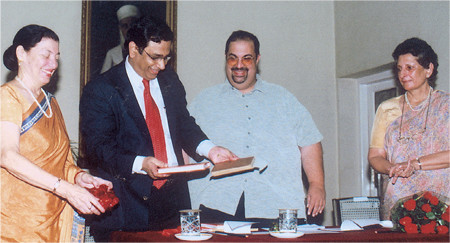
Releasing Parsi Cricket (from left): Homai Modi, Fredun DeVitre, Muncherji Cama, Nawaz Mody
Other observations in the book are remarkably relevant even 106 years later! "He (the captain) must be ready to bear indiscriminate abuse and ridicule; he must possess sufficient tact and cleverness to soothe carpers, cavillers and advisers and enough of resoluteness and firmness to act mostly according to his own judgment. The veriest greenhorn in the crowd who cannot distinguish between a fair catch and a bump-ball criticizes him…” wrote Pavri, quoting from Cricket of 1887.
The wise men of selection committees could perchance heed — caste, creed and quotas notwithstanding — Pavri’s advice of a century ago: "It is quite necessary that the captain should have the chief voice and share in the selection of men to play under him… It was the oneness created by peace and friendliness that was the chief cause of continual success of the Parsi team in India for nearly 10 years of my captainship.” Sink self and play for your side, Pavri had prescribed.
Like a true leader, the author showed honesty in his assessments. "They (the Parsis) must not forget, in the flush of the pride of victories, that the Parsi team is not yet capable of being classed with any first-class county of England… The elegant and masterly style which characterizes many a first-class English cricketer is sadly wanting among the Parsis,” Pavri recorded, quoting in part the words of M. K. Patel (Reflections on Parsi Cricket).
There were no less than 27 prominent Parsi cricket clubs in Bombay established between 1848-1891, though not all prospered. Parsi clubs were also set up in Poona, Ahmednagar, Baroda, Broach, Navsari, Surat, Indore, Mhow and Karachi. The Parsee Gymkhana was established in Bombay in 1885 "through the exertions of Messrs N. N. Wadia, J. N. Tata, K. N. Seervai, D. R. Chichgar, D. J. Tata and J. M. Patel…D. J. Tata (Dorab Tata) is the energetic honorary secretary of the Parsee Gymkhana which has the same status as the MCC (Marylebone Cricket Club) of England. The success of this club is due chiefly to his uninterested exertions…(he is) a great athlete and a thorough sportsman,” Pavri observed.
The middle section of the book with its technical explanations may not catch the interest of the layman, but the chapters on the growth of school and college cricket are eminently readable: "… it is the Parsi lad from school who, by his clamors and claps, by his shrieks and whistles from tree-tops and from behind the much outraged boundary lines, lends such life and such hullaballoo to the Presidency match that gradually all dignified Bombay comes out in wonderment to see what the maddening show is…school cricket is to be the recruiting ground from which stalwart soldiers are to be marched out to defend the name and fame of this great national game of the Empire.” Alas, with the era of Polly Umrigar, Nari Contractor, Farokh Engineer and Rusi Surti long past, Parsi cricket today seems a different ball game altogether!
◆ ◆ ◆
From the archive