
Observation
Sri Lanka scenario
The government is taking tentative steps to resolve the ethnic unrest between the Tamils and Sinhalese
With the demise of the LTTE (Liberation Tigers of Tamil Eelam) leader Velupullai Prabhakaran (known to his cadres as the "LTTE Supremo”), the backbone of the armed movement to establish an independent and separate state in the north of Sri Lanka, called "Tamil Eelam,” has been severely ruptured. The armed conflict was waged by Prabhakaran to secure the northern peninsula of Jaffna, which has been the traditional homeland of the Tamil speaking people of the country as a nation or a sovereign state apart from the remainder of the country which is inhabited mainly by the Sinhalese community.
In addition to the difference of racial origin, the two communities (each having a smattering of Christians) speak different languages and follow, by and large, different religions. The Sinhalese are disciples of Lord Buddha; the Tamils worship Hindu deities. Additionally, Sri Lanka has a not too large, but economically prosperous, Muslim population. Whilst scattered through the country, there is a fair concentration in the coastal areas of the eastern province.
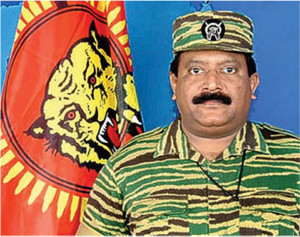
The land and coastal area of the peninsula of Jaffna (and an area in the mainland immediately south of it) which Prabhakaran sought to wrest from the central government comprises one-third of the land and coastal area of Sri Lanka.
The country has been governed as one entity since 1815 when the British unified the administration under their sovereign. It has continued to be so since Independence in 1948, with a parliament legislating for the entire nation, and a centralized administration. The mind-set of the greater majority of the people thus was, and is, against the demand of the LTTE for a separate and sovereign state.
The Muslim community has been content with the present constitutional, political and administrative set-up. But there exists a fear amongst the Sinhala population that if the LTTE demand is granted, the Muslim community also may make a similar demand in regard to a portion of the eastern province of the country.
The relationship between the Sinhala and Tamil communities has never been consistently cordial. The period of British sovereignty (1805-1948) was free of any violent communal eruptions because of the stamp of British authority. But, since 1948 the nation’s history sadly records periodic open and violent dissension between the two communities. The right-thinking members of both communities look upon this with dismay as being a great obstacle to the country’s economic, social and political progress.
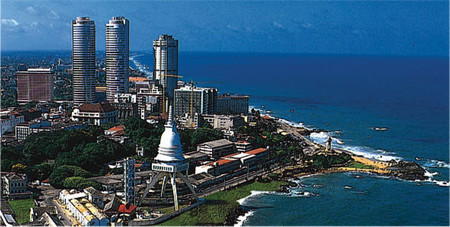
Colombo, capital of an island in turmoil and top, slain LTTE supremo Prabhakaran
The year 1959 witnessed the start, mainly in the urban areas. 1977 recorded a big setback, with communal riots spreading to the tea plantation districts in the hill-country where, from British times in the 19th century, Tamils of South Indian origin have been the main source of labor.
The worst was to come in 1983, again mainly in the urban areas. And with this commenced the 25-year-long armed conflict waged by Prabhakaran, which abated with his recent death.
And now, what of the future? Have the country’s woes ended with Prabhakaran’s demise? Has the cause he fought for (mistakenly by military means) died with him? Or will it continue to be a persistent sore in the country’s political and civic fabric?
The history of the strained ethnic relationship between the two communities is strongly indicative that the strained relationship will continue and erupt openly from time to time, unless permanently resolved. What is clearly required is a political solution, a firm political settlement reached by agreement between the Sinhala, Tamil and also the Muslim communities. And such agreement will then have to be reflected by enactment in the nation’s constitution. The administrative changes and structures necessary to give it effect in practical terms will also require to be put in place.
What should be the basic framework of such agreement and the new administrative structures and constitutional changes? Sri Lanka is perhaps both in land area and in economic productivity too small to be constituted as a federal state complete in every aspect of federalism.
Furthermore, the greatest economic activity and the country’s largest revenue and employment generation are in the western province. The capital city of Colombo and the main port are located in this province. The province also houses the seat of government — both legislative and administrative. It is populated mainly by the Sinhala community, with Tamils and Muslims also prominent, but in lesser numbers, in industrial, trade and professional activities. A strict federal structure could therefore create fresh problems such as a significant imbalance in employment opportunities and revenue production between the provinces. The country is not yet ready for a strict or traditional federal structure. In an attempt to put matters right, President J. R. Jayawardene enacted in 1987 the 13th amendment to the country’s constitution. By this amendment, a provincial council was established in each province. The provinces and the provincial councils mirrored the Indian states and state legislatures but with limited legislative and executive authority. Central legislative and executive control exists in larger measure in Sri Lanka than in India. To these provincial councils were devolved limited powers of legislation, directed towards local requirements, and executive authority to implement such legislative measures. This, however, did not satisfy the LTTE which wanted nothing short of a separate state; in the north it obstructed the establishment of a provincial council and continued the civil war unabated. The LTTE’s tentacles reached out to European cities to collect its funds, and the organization was considered the most deadly terrorist outfit internationally.
Twenty years have now elapsed since the solution mooted by President Jayawardene. Meantime, the desire for greater rights of self determination has grown and taken root deep into the soil in the north of the country. The history and lessons of the past have to be made use of without delay to forge a political solution on a firm foundation, before further catastrophes take place.
An overview of the present situation is that the government is taking tentative steps to solve the issue. This has become a slow process because the government is a coalition of several political parties having different shades of opinion on this issue in particular. The people will however have to wake up and find common ground for future peace. A quarter of a century has already slipped by.
The existing constitution creates a unitary state. A change to a constitution reflecting federal outlines appears a pressing necessity. Federalism is not a concept unknown to Sri Lankans. The British, during their regime, set up two Royal Commissions on the Constitution in 1930, and thereafter in 1948. Certain Sinhala and Tamil delegations which gave evidence before the two Commissions mooted a federal system. But since the majority of the Sinhala delegations opposed the idea, neither Commission recommended the same and continued the existing unitary system. The country may perhaps have to now rethink along these lines; the 60 years that have elapsed since Independence in 1948 show that this has become a political necessity.
President Mahinda Rajapaksa, in an attempt to find a solution acceptable to as wide a section of the population, set up the All Party Representative Committee (APRC). The Committee comprised Members of Parliament drawn from all parties represented in parliament, and chaired by a cabinet minister. Its mandate is to find a solution to the ethnic issue, acceptable to the majority of the parties and communities. Its report is being presently prepared. The drift of the discussions at the Committee was to enact a fresh constitution, which will replace the present rigid unitary system with a more flexible constitution based on federal lines, whilst maintaining control at the center. This will permit the inhabitants of each province to have a greater say in the decisions that affect them. In this way, it is generally believed, that since each province is by and large occupied by members of one of the three major communities — Sinhalese, Tamils and Muslims — there will not be space for dissension. Time will provide the answer — most hopefully, favorable.
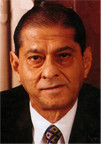
A member of the Sri Lanka Parliament, Kairshasp Choksy was the finance minister of the country from 2001-2004 and minister for constitutional affairs from 1993 to 1995 under the United National Party (UNP).
He was appointed President’s Counsel in 1981. He "successfully defended (as Senior Counsel) President R. Premadasa in the Election petition filed against him by former Prime Minister, Mrs Sirimavo Bandaranaike after the 1988 Presidential Election.
The hearing of the case took 525 days before the Supreme Court, and is referred to in the Guinness Book of Records as the longest case in history.”
◆ ◆ ◆
From the archive