
Cover Story
Glory for the ghazalkar
More than transitory fame, developing the art should be a singer’s aim believes Padma Shri awardee ghazalkar Penaz Masani
Accustomed to a "back-slapping ‘Hi Penaz’ greeting,” popular ghazal singer Penaz Masani now finds herself welcomed with a "folded-hands ‘Namasté ji.’” That’s the only perceptible difference the ghazalkar has noticed after she was conferred the Padma Shri, the nation’s fourth highest civilian award, by the President of India Pratibha Patil on March 31, 2009.
The only Zoroastrian to feature among the 93 Indians honored with a Padma Shri award this year alongside celebrities like Aishwarya Rai Bachhan and Akshay Kumar, Masani was decked in her gara and flashed her beaming smile and mop of curly hair as she walked up to receive the honor at the event at Rashtrapati Bhavan which was marked by a "lot of protocol, pomp and honor.” Declaring her commitment to the cause of women empowerment, Masani announced that she was dedicating the award to her mother Pillu who had passed away just five days earlier. "Losing mama was very difficult for us,” sums up Penaz. With her bags packed and all set to accompany her daughter to Delhi, her sudden demise and obsequies in Bombay required Penaz to forego the rehearsal of the final ceremony which awardees are expected to attend.
Being conferred the Padma Shri recognition "at a reasonably OK age,” Masani maintains, "One has to be happy with what they have. Respect and fame come at a lot of price, give and take.” Satisfaction "depends on your contentment level.”
Giving on an average 60 shows a year, when Parsiana interviewed Masani on May 20, 2009 she had just completed a concert in Jodhpur and was proceeding to Leh-Ladakh to perform for the Army at the end of the week. Some of the performances she gives are in support of an organization or cause while others are professionally undertaken like the recent tour for the Steel Authority of India Limited: "It’s not monetary gains all the time,” she declares. Besides, singing is a seasonal profession, with maximum invitations coming between September and March, the peak being in winter or during the marriage season.

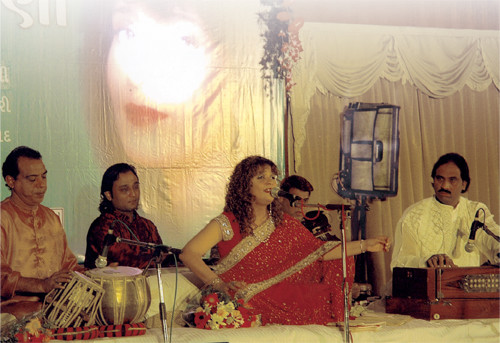
Penaz Masani (above and top) at a concert in Surat Photos: Tejash Dani
Sometimes she gives just one number at a function as in end April when the Federation of Indian Chambers of Commerce and Industry organized a meet in Delhi to felicitate 25 women achievers. Masani then sang Beti, a song against female infanticide. On March 21, 2009 at the Jamshedi Navroz function at the Dadar Gymkhana she rendered one of her numbers there too.
Prior to that she had done "a lovely show for my school (J. B. Vachha) where we raised over a crore of rupees.” Ever willing to sing for a community cause she declares, "I am always there for the community.” When she knows the audience will largely comprise Parsis she makes a deliberate effort "to sing simple stuff they’ll enjoy,” knowing they are "more into Beethoven and Mozart.” She has yet not forgotten a well-meaning Parsi lady (who could not differentiate between a ghazal and a qawwali) coming up to tell her "Mané taari qawwali ghani gaméch (I am very fond of your qawwalis)” or another one referring to flautist Hari Prasad Chaurasia’s impressive performance commenting, "Chaurasia é soo pèpoori vagaree (wrongly describing his flute as a squeaky plastic toy).” Sympathising with such endearing reactions, she admits, "I would have probably been the same had it not been for my dad [Doli, a vocalist, was a pupil of Ustad Faiiyaz Khan of the Agra gharana (school of music)]” thanks to whom she grew up listening to and appreciating Indian music.
Singers of her genre "are still in circuit because our base was very strong,” believes Masani. Just as she has come to be known as the ghazal queen she refers to her peers — Jagjit Singh being identified with ghazals and Anup Jalota with bhajans. "It is important to build an image,” she stresses in the context of new performers who gain fleeting adulation on television shows like "Indian Idol” and disappear from the stage in a short time. "They have no staying power… The exposure the youngsters are getting today is super. They have never had it so good. They should not concentrate on the celebrity status. They should try and cultivate the art,” recommends the songstress for whom learning is a lifelong process.
The first milestone in Masani’s musical sojourn had been the conferment of the national Sur Singar Samsad award at the young age of 15 and being patronized thereafter by the late music composer Jaidev. This was followed by performances on Doordarshan, Star TV and Zee TV. The young artiste completed her commerce graduation from Bombay’s Sydenham College but instead of pursuing a career in accounts or management, chose to opt for music "when offers started falling in my lap,” Masani had told Parsiana in an interview (see "A record high of ghazals,” February 1988). "Whenever I’m in Bombay I continue to train with Madhurani,” says Masani attributing her success to the blessings of Ahura Mazda, her parents, her gurus — initially Ustad Amanat Hussein Khan and subsequently Madhurani.
With 28 albums to her credit, she is one of the first ghazal singers to have been awarded a platinum disc in addition to the three gold discs that she received. Among the albums to her credit are Aap Ki Bazm Mein, Dilruba, Best of Penaz, Dhadkan, Dil Ke Kareeb, Pooja Ke Phool, Tu Hi Mera Dil-Tu Hi Meri Jaan and the more recent Yaadein and Peenaz Masani -- Life Story. A versatile artiste, she experimented with pop music too and her album Tu Dil De De topped the charts on Channel V and MTV, notes her website. Under the banner of Magnasound she cut an album Dil Mein Ankhon Mein where the music was western while the lyrics retained the traditional form of the ghazal to appeal to the new generation.
A playback singer who has lent her voice to over 50 Hindi films and sung in more than 10 languages she has performed under the banner of music directors like Jaidev, R. D. Burman, Usha Khanna, Chand Pardesi, Nadeem Shravan, Raaj Kamal, Rajesh Roshan and Anu Malik. She considers herself fortunate to have worked with leading music directors like O. P. Nayyar, Shantanu Moitra (of Parineeta and Lage Raho Munnabhai fame) and to have recorded under the banner of Music India, Universal and Magnasound.
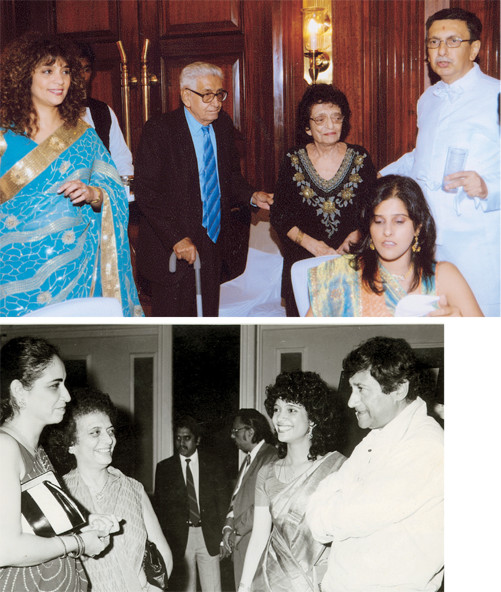
Top: Penaz Masani with parents Doli and Pillu, Firdaus Dadi and Jehangir Karkaria. Bottom (from left): Naazneen Sarkari, Pillu and Penaz Masani with Dev Anand
"The golden era of ghazals was in the ’80s, pop music came, mushroomed and went in the ’90s. Now ghazals have come back, with an elevation. Listening to good music is a status symbol. It is upmarket-ji,” she understands the mindset of the new members of the audience who have started patronizing her and inviting her to functions to lend a certain class.
Constantly in demand, she had not even spent half an hour with Par-siana, when two other visitors were ushered into her drawing room at her residence at the Dadar Parsi Colony. Despite their presence we sought her views on controversial issues confronting the community: interfaith marriage… continuation of dakh-menashini in the absence of vultures.
Often in the company of non-Parsis, Masani, who is single, candidly confesses that since marriage has not happened so far it is unlikely to now. Although she is not against interfaith unions she would have "preferred getting married to a Parsi for the simple reason that it is easier for the child” when both the parents are from the same community. Penaz’s sister Naazneen Dinyar Sarkari works for Citibank.
"Dakhmenashini should continue,” affirms Masani who on the recent passing away of her mother had spent time at the Doongerwadi where she felt the ambience was conducive "for bidai (parting) with a loved one.”
Going to a fire temple with devotion in one’s heart is good but what is more important to her is to "do really good deeds in keeping with the charitable nature of the Parsis… Helping people without advertising one’s deeds. One hand shouldn’t know what the other hand is giving,” she reiterates.
Whilst "iqtalaf (differences of opinion)” within a community is understandable, she believes, "each of us is given just one life. It is up to us to make the best of it… To live and let live and to really let love abound.”
◆ ◆ ◆
From the archive