
In Memoriam
The consummate counsel
In a trial that lasted 525 days between 1989 and 1992, and involved the examination of 911 witnesses before five judges of the Sri Lankan Supreme Court, Kairshasp Nariman Choksy as senior counsel succeeded in defending the nation’s then President Ranasinghe Premadasa against a legal petition to annul the presidential election. Choksy’s final address and submissions to court took 52 working days and he created history by conducting the longest trial as recorded in the Guinness World Records. Being Premadasa’s advisor and confidant until the President’s assassination in 1993, the respected jurist would be called early each morning to discuss the day ahead.
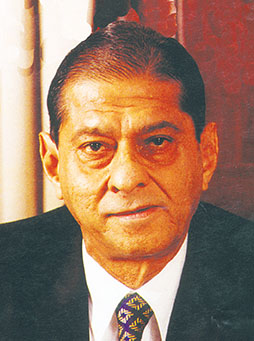
Kairshasp Choksy
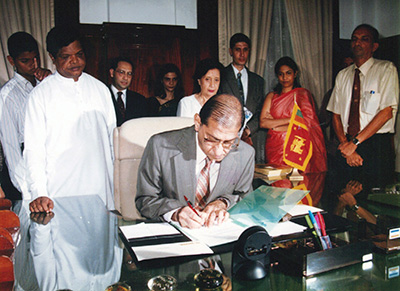
Kairshasp Choksy signing as minister
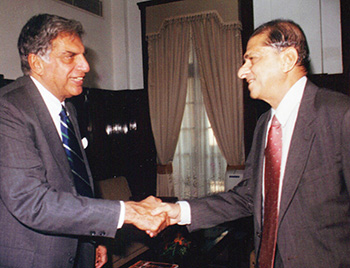
Kairshasp Choksy with Ratan Tata
.jpg)
Kairshasp Choksy with Freny, children and grandchildren
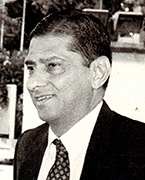
Kairshasp Choksy in his younger days
Choksy’s proximity to different heads of state was recalled on his passing away on February 5, 2015, two days prior to his 82nd birthday. Known for his astute mind, congenial demeanor and legal prowess, in 1981 President J. R. Jayewardene had appointed him President’s Counsel. During the Presidential tenure of D. B. Wijetunge he served as Sri Lanka’s first minister of constitutional and state affairs; and during the Presidential tenure of Chandrika Kumaratunga, as minister of finance because the country needed "an honest fiscal helmsman.” As finance minister he concurrently served as governor of the World Bank and of the International Monetary Fund.
"Economic disparity has always been the cause of civil wars within a country, rebellion and youth uprisings,” Choksy who was then finance minister was quoted by the Sri Lankan business magazine LMD of January 2004. Bridging the gap between the rich and the poor "is my major aspiration…for our people and our economy,” Choksy had then stated realizing that "revenue collection is highest in those countries where taxation is not high and there are certain uniformities of taxation.”
Altogether he served as Member of Parliament for 21 years until 2010 being on the national list of the United National Party. Since the Sri Lankan constitution makes provision for the professional and academic communities to be represented on the national legislature, Choksy never needed to contest any elections himself. A senior member of the Party, he served it in various capacities, guiding its choice of leaders and candidates for over two decades.
Having emerged as Sri Lanka’s preeminent constitutional attorney and constitutional thinker, he was offered an appointment to the Supreme Court in the 1980s which he preferred to decline because he "did not want to be removed from the daily action of Sri Lanka.” He was happy though to be included in Sri Lanka’s delegation to the United Nations General Assembly, addressing a session in New York in 1984.
"One of the true giants of the Bar, he had an aura and personality…that was unmatched,” noted a condolence letter from a fellow President’s Counsel Sanjeewa Jayawardena who recalled the "Saturday consultations and watching in amazement at how meticulous he was with our drafts, always crossing the ‘t’s and dotting the ‘i’s most fastidiously and teaching us that there was no substitute whatsoever for hard work.”
Immediate past Chief Justice Mohan Peiris commended "the great contributions he made to the life of the community and our country.” Many other members of the legal and educational fraternity had expressed their sympathies on the passing away of the legal icon in the special condolence book. Devoted to his country, Choksy rejected divisions of ethnicity, language and religion, believing that the small island country was better off due to the diversity and intermixing. Even when many relatives and friends chose to leave Sri Lanka with the introduction of the ‘Sinhala only’ policy, the Choksys opted to stay back.
The Choksy presence in Colombo, then the capital of British Ceylon, has been recorded since 1884 when Kairshasp’s paternal grandfather Kaikhusru D. Choksy arrived as an employee of Framjee Bhikhajee and Company from Surat and Bombay. Kaikhusru served as the firm’s bookkeeper and manager and finally as corporate attorney until his demise in 1938. His son Nariman (Kairshasp’s father) who was born in Ceylon entered the legal profession, became a renowned attorney and was appointed a Queen’s Counsel and subsequently elevated to the rank of puisne or regular judge of the Supreme Court. His wife Khorshed (née Lakdawalla) was a member of the mercantile family who in 1927 had donated land on which stands the fire temple called Navroz-Baug. Kairshasp was the fourth among six children, the elder three being girls and the younger three boys.
Referring to his father’s discipline, in his 1994 LMD interview Kairshasp had related how he had to spend "at least two hours in his chambers doing my own studies under his vigilance every weekend and even during school vacations. It certainly gave me useful training in learning to concentrate on the job at hand and do it as far as possible to perfection.” He believed "that atmosphere drew me into the law.”
Like his father, Kairshasp attended the Law College in Colombo although his early education was at St Thomas’ Preparatory School and secondary education at St Thomas’ College. After graduation and apprenticeship he was admitted to the Ceylon Bar as an advocate or attorney-at-law and subsequently qualified to appear from the British Bar. His family recalls that during those early years he would travel to work on his motorbike, his hair parted down the middle. Soon establishing himself as one of Sri Lanka’s leading civil attorneys, his clients included the Government of Sri Lanka, American corporations, Swedish contractors… For two years he served as chairman of the Law Committee of the Bar Association between 1980-82.
Like his father and grandfather, Kairshasp had also served the Zoroastrian community of Sri Lanka. He was initially a trustee and later officiated as president of the Ceylon Parsi Anjuman which administers the fire temple, priests, trust funds and aramgah. Realizing that "women more than men serve as transmitters of faith, tradition and customs,” Choksy believed that Zoroastrian women who have married out of the faith but continue to profess their religion, should be permitted to raise their children as Zoroastrians (see "Accent on accountability,” Parsiana May 2004). On the subject of the worldwide Zoroastrian population, Kairshasp who "loved reading Parsiana” had conveyed to the magazine, "It is possible…that rather than a decline in numbers, demographic shifts from one country to another have or are taking place. Sri Lanka witnessed this after the country’s political independence with a fair exodus of Parsis to Australia.” Referring to the Parsi presence outside of India, he commented, "We have enriched and contributed constructively to the host nations in areas such as business, industry and the professions.” No conflicts have taken place with the social customs of the host country, he pointed out.
He was of the view that "the community should explore relaxing certain prevailing rigid doctrinaire attitudes which are resulting in the shrinkage in numbers…without hurting our basics.” To Kairshasp who considered select rituals are "necessary for the articulation of the content of the Gathas,” the qualities associated with the Zoroastrian community are "integrity, discipline, education, ability, loyalty, dedication to work.” His three sons, Jamsheed, Khursheed and Vishtasp remember well their father impressing on them the "values of hard work, perseverance, honesty and integrity.” Vishtasp who is a highly respected attorney in Colombo remembers his father advising him "to do what is right and not to be afraid to die.” It was equally important for him "to earn correctly so that you can then enjoy that money.” Inherently kind to the poor, he impressed on his children "the values of our religion… kindness to humanity and all living beings.” "He always practised humility,” remarked Khursheed who is vice president for Turkey, Middle East and North Africa Affairs in the International Division of the US Chamber of Commerce in Washington DC. He further recalled his father’s "love of family, religion and consideration for those less fortunate.” "The loss of a father is like the disappearance of a mighty banyan tree whose shelter and comfort one has enjoyed for so long,” wrote Jamsheed Choksy, chairman and professor of the Department of Central Eurasian Studies at Indiana University. Kairshasp’s wife Freny (née Cooper) hails from Bombay where they had met when she was a student at the Law College.
Realizing the need to keep his mind and body alert, earlier he would regularly play tennis at the Sinhalese Sports Club and subsequently went on vigorous walks around the cricket ground there. As recalls his family, "Even when he physically suffered from the chikungunya virus which he contracted like so many other Sri Lankans, his mind remained absolutely alert and always interested in the legal and political matters of Sri Lanka and the world.”
The astute attorney is survived by his wife Freny, sons Jamsheed, Khursheed and Vishtasp, sister Threety and brother Pheroze.
◆ ◆ ◆
From the archive