
Books
Marginalized Maoists
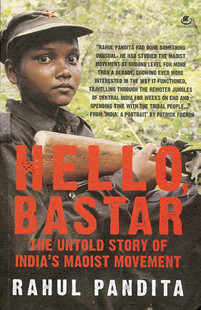
Hello, Bastar: The Untold Story of India’s Maoist Movement by Rahul Pandita. Published in 2011 by Tranquebar Press, an imprint of westland limited, Venkat Towers, 165, P. H. Road, Maduravoyal, Madras 600095. Pp: xi + 202. Price: Rs 250.
"Rahul Pandita has done something unusual,” writes author Patrick French in India: A Portrait. "He had studied the Maoist movement at ground level for more than a decade, growing ever more interested in the way it functioned, travelling through the remote jungles of Central India for weeks on end and spending time with the tribal people…”
In an interview in November 2010, Communist Party of India-Maoist leader Ganapathi (Mupalla Laxman Rao) told Pandita, "Only when the government forces come to attack us carrying arms do we attack them in self-defence.” Ganapathi deplored that the lower level personnel in the police and parliamentary forces turned their guns on their brothers and sisters instead of their real enemies thus serving the exploiting classes like slaves. "Don’t just think of your livelihood, please think about the people, think about the country.” He added that the state forces hit Maoists whenever they can and the Maoists hit back whenever they get a chance. "It is a bloody war out there.”
In an interview in November 2010, Communist Party of India-Maoist leader Ganapathi (Mupalla Laxman Rao) told Pandita, "Only when the government forces come to attack us carrying arms do we attack them in self-defence.” Ganapathi deplored that the lower level personnel in the police and parliamentary forces turned their guns on their brothers and sisters instead of their real enemies thus serving the exploiting classes like slaves. "Don’t just think of your livelihood, please think about the people, think about the country.” He added that the state forces hit Maoists whenever they can and the Maoists hit back whenever they get a chance. "It is a bloody war out there.”
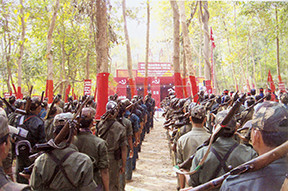
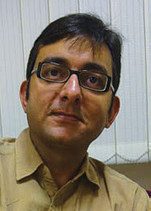
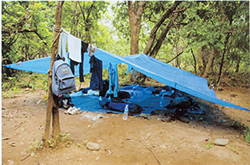
Above (left): PLGA fighters at the 2007 Maoist Congress held in the jungles of Bihar; author Rahul Pandita; a Maoist camp somewhere on the Maharashtra-Chhattisgarh border
It began when a handful of men and women who believed in the idea of revolution, entered Bastar in Central India in 1980 and created a powerful movement that New Delhi terms as India’s biggest internal security threat. The Maoist movement entrenched itself in about 10 states of India, carrying out deadly attacks against the Indian establishment in the name of the poor and the marginalized. How very poor and marginalized they are is detailed in the afterword appended to the book by Maoist leader Kobad Ghandy. Generally, according to the mainstream media, the issue is just that of violence. The book brings out that the question of violence is secondary; the key question is how to develop the country and its people. The Maoists have one method as reflected in their policies detailed in the book, while the established government has another, seen in their economic and political policies over the past years. The author is a senior special correspondent with Open magazine and the co-author of the critically acclaimed book on insurgency, The Absent State.
The question of India’s real growth must not be treated as an end in itself, but as an instrument of spreading prosperity to all. What the government does is to average out the billionaire’s income with that of a pauper and puts them in a common category. "This is particularly skewed in India where just a few families have a wealth equivalent to 25 percent of our GDP (Gross Domestic Product).” In the 2010 Global Hunger Index, India ranked 67th amongst 88 countries, it was 65th in 2009. On the recently developed UNDP (United Nations Development Programme) Multidimensional Poverty Index (MPI), it has 65 crore people who are poor, amounting to 55 percent of the population. Two-thirds of our women are anemic, according to the Right to Food campaign; the water is so polluted that, according to the United Nations, one lakh people die each year of waterborne diseases; the per capita food grain consumption has fallen from 177 kilos per year in 1991 to 151 kilos in 1998. "Such then,” concludes Ghandy "is the horrific condition of the people of our country — that too after six decades of independence. Add to this the massive destruction of our land, forest and water resources, the total degradation of the moral fabric (corruption, greed, nepotism). Is it not time to discuss various alternate models to better the policies of governance?”
What alternative do the people have? As Pulitzer Prize-winning novelist John Steinbeck asks in another context: "How can you frighten a man whose hunger is not only in his own cramped stomach but in the wretched bellies of his children? You can’t scare him, he has known a fear beyond every other.”
The hard-core strength of the Maoists is its 10,000 strong People’s Liberation Guerilla Army (PLGA) apart from hundreds of thousands of adivasi youth, including women. Hello, Bastar details the Maoist organizational structure, with its central committee, central regional bureau and various state committees, special zone and area committees. Its armies are well-equipped and extremely well-trained. Above all, they are deeply, almost fanatically motivated. Sad to say, our police forces, for all their faked encounter killings and their cruelties particularly on women comrades, are hardly a match for the Maoist forces. As a young Maoist commander told the author in Jharkhand in 2009, "We know we have faced severe losses in terms of leadership. But we are ready to don the mantle now. We are ready to take forward the legacy of GP sir.” (Ganapathi is referred to as GP sir by many Maoist guerillas.)
Ghandy, writing from Tihar Jail, recounts in his afterword the true incident of three upper caste men in Uttar Pradesh (UP) who tried to rape a Dalit girl returning from the fields. The girl resisted and screamed for help. The men fled, but before fleeing, they chopped off her ears with an axe and bodily damaged her. The inhumanity of that action would be unthinkable in any civilized society. But in UP, it was hardly noticed. Incidents like this are considered routine. In our highly patriarchal system, a girl’s life is cheap, less than a chattel in the prevailing upper caste system.
Ghandy’s late wife Anu-radha made a monumental contribution to the understanding of the caste/Dalit question in India and the significance of its resolution for the democratization of individuals, and with it society. Anuradha deplored the fact that even nation-building and national consciousness gets sacrificed at the altar of caste. "Caste consciousness,” she wrote, "supersedes national consciousness, identity, loyalty — everything.” Incidentally, as Ghandy points out, the release of Hello, Bastar coincides with the third death anniversary of his wife.
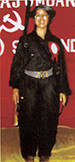

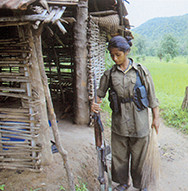
Above: Anuradha Gandhy and in PLGA uniform (right) A Maoist guerrilla.
At a Congress meet in 2007, the strategy and tactics document stressed that the country’s urban areas are "the strong centers of the enemy.” Taking a long-term perspective, it called for ways and means to intensify the class struggle in urban areas and mobilize the support of millions of urban masses for "the people’s war.” It said that the situation of the urban poor in slums and poor localities is worsening continuously. The slum population in India is over four crores, spread in more than 600 towns. Even the "maximum city” Bombay has 49 percent of its population living in slums!
This is no empty threat, although "people’s war” is an unfortunate expression. As Ghandy urges in his afterword: "Dialog between the government and the Maoists is an urgent necessity.” The government may feel this is like supping with the devil. But it has itself set the example. It put this other "devil” Anna Hazare in jail, then did an about-turn by successfully negotiating with him for the Lokpal Bill. That "devil” was non-violent while this "devil” is not. The latter’s fights have always been on the side of the abounding poor in the country. Besides, it has displayed convincing fighting skills. The pity and tragedy is that these skills have been used for destructive purposes. If dialog can change this, it would be well worth entering into.
Whatever decision the government takes, Hello, Bastar is an authentic book of reference on the Maoist movement, its growth and development and the threat it holds for India.
BURJOR K. KARANJIA
◆ ◆ ◆
From the archive