
Cover Story
“A risky business”
Predicting the outcome of national political elections is a tricky occupation, says pollster Dorab Sopariwala
"If I can do soaps, I can do elections,” says market researcher Dorab Sopariwala regarded by many as India’s leading psephologist. "All market researchers are not psephologists but most psepho-logists are market researchers,” observes the 30-year veteran in the field who correctly predicted a victory for the Congress party and its allies in the May 2009 national parliamentary elections in India. He projected around 216 seats for the United Progressive Alliance (UPA) on the basis of exit polls commissioned by NDTV 24x7. The political conglomerate beat all expectations and captured 262 of the 543 Lok Sabha seats.
"It’s very difficult to come on the spot… it’s impossible. You have (however) to get the winner right,” says Sopariwala. "Take a bow,” said NDTV anchorman Dr Prannoy Roy, also a psephologist while the predictions were being telecast on May 16, 2009. When Sopariwala declined to do so keeping his eyes on his laptop instead, Roy added that Sopariwala was being modest "because he is a Parsi.” To which when being interviewed by Parsiana on May 20 at the office of Draft FCB-Ulka Advertising where he is a consultant, the researcher commented, "That’s nonsense. It was a team effort.” He alone should not be singled out for the prediction, he averred.
In the 2004 national elections all the pollsters "got the winner wrong.” In Britain in the mid 90s also the pollsters got the victor incorrectly and in 2004 in the USA some polls showed the Democratic candidate John Kerry leading when actually he lost. "It’s a very hazardous, risky occupation... There is a bit of judgment involved. That judgment is based on past data… We panic when the results come out.” The fieldwork for the NDTV poll was conducted by GfK-MODE, a part of the German GfK Group.
In order to minimize chances, the NDTV poll was conducted in 188 constituencies, almost one-third of the total number in the country. Three teams of interviewers in each constituency had to cover four polling booths on voting days. After casting their ballots, voters were given a piece of paper with the names of the candidates and asked to put a cross next to the name of the person they had voted for and deposit the paper in a simulated ballot box.
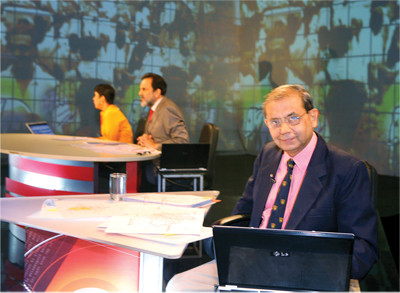
(From right) Dorab Sopariwala, news anchors Dr Prannoy Roy and Barkha Dutt at NDTV studio: Getting the winner right
People may be "reluctant” to verbally state which party they voted for hence the imitation ballot box approach ensures greater accuracy, says Sopariwala. "They are reassured of confidentiality.” In addition voters are asked their age, caste, religion and several other questions.
"All samples have a range of error,” says Sopariwala. The larger the sample, the lower the range of error. "It’s the law of large numbers. The closer you are to all the people the error comes down. The census of India figures are correct” because they approach everybody. But this pushes up the costs. "It’s always a trade off,” he observes.
Of the eight lakh polling booths in the country 2,256 were sampled for the exit polls. "We sampled 0.3 percent of the booths,” he says. In a diverse country like India that’s a tricky forecast to make. He cites the example of a sponge cake as versus a fruit and nut cake. If you eat a slice of a sponge cake you know what the rest of the cake will taste like. But in the fruit and nut one you may have to taste eight slices depending on the distribution of the fruit and nut component in the cake.
He terms it "the diversity of the universe.” For example, while the heights of people in three Scandinavian countries Sweden, Norway and Finland may be similar, in Kenya one has to contend with the lanky Masai as well as the diminutive Pygmies. So, you would take a larger sample in Kenya than in Scan-dinavia if you were measuring the average height of the people. "Nobody has samples as large as ours. Kerala and UP (Uttar Pradesh) are as different as Sweden and Italy.”
Opinion polls taken before voting are not as accurate as exit polls. There is a chance the voter "may change his mind. The person may not go and vote” and so on. "There are normal polls and there are proof-of-the-pudding polls,” says Sopariwala. In most polls verifying the authenticity of the research may be difficult but in an exit poll you know immediately whether the pollster got it right.
On counting day Sopariwala and the main NDTV anchors were on air by 7 a.m. "The results came in floods,” says the pollster. "People (viewers) want numbers. They want to know who is winning. By evening 98 percent of the results are in.” Votes are counted 16 machines at a time per table and there are several tables set up at a time, says Sopariwala. "In 70 percent of the cases the candidate who wins the first round is the winner.”
All the television channels employ one agency, the Indian Market Research Bureau (IMRB), to collect voter figures from the 1,100 counting stations in the country throughout the day, the data transmitted simultaneously to all the channels. The candidates are referred to by numbers and the software of the television stations converts the numbers to names. Then comes the tricky part of projecting the seats. Psephologists are the people who convert votes into seats. The term psephologist (pronounced se-fol-a-gist) came into being as late as 1952 and derives from the Greek word psephos or pebbles which were used "by the ancient Greeks in voting,” notes Webster’s Dictionary.
"We love a landslide,” says Sopariwala recalling the election of 1984 following Prime Minister Indira Gandhi’s assassination. The Congress won 404 seats against the divided opposition. This time the Congress and its allies garnered 38.4 percent of the votes capturing 262 seats to the Bharatiya Janata Party’s (BJP) and its allies toll of 28 percent and 159 seats. The third front got 21.2 percent and 54 seats, and the fourth front 6.6 percent and 28 seats.
"Our (Indian election) system is first past the post,” observes Sopariwala. Who gets the highest number of votes wins. "The winner takes all… votes don’t (necessarily) convert into seats.” For example the movie idol Chiranjeevi’s party in Andhra Pradesh received 17 to 18 percent of the votes cast but only got 18 seats. "You need a certain threshold of around 20-25 percent” or so to see returns, says Sopariwala.
He sees benefit in a system of proportional representation whereby a party would be allotted seats subject to the percentage of votes it attracts. But he concedes both systems "have merits… We don’t want more than four or five parties in parliament,” as this would provide "inherent stability.” He cites the example of Germany where political parties have to procure a minimum of five percent of the votes to be allotted seats in parliament. In Israel, by contrast, where there is no minimum percentage prescribed, the number of parties contesting for 120 seats in the Knesset is around 30. There are almost 40 political parties in the Indian Lok Sabha for this five-year term.
Why did the BJP and its allies fare badly? Was it Narendra Modi’s and/or Varun Gandhi’s image as Muslim baiters? Sopariwala points skywards. "Nobody knows,” he replies.
Could not the interviewers have asked the voters the reasons as they emerged from the polling booths? They ask "fewer questions so that more people can be interviewed,” explains Sopariwala. More questions means more time hence more costs. "The important thing is to predict the winner.” What about his gut reactions to the BJP failure? "The gut doesn’t exist. Why do a poll? Do I substitute my judgment” in place of scientifically collected data? he asks.
As Roy observed during the telecast, "Dorab doesn’t care who wins or loses, he’s only concerned his predictions are correct.” "That’s right,” Sopariwala told Parsiana.
A psephologist can also be a political adviser. "Before the TV era we did a lot” of polls for political parties. But now he doesn’t "like the idea of being associated with a political party. You can be seen as being partisan.”
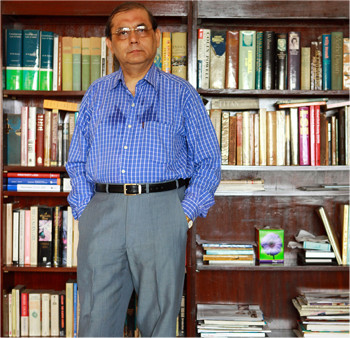
Sopariwala :"We love a landslide”
Photo: Cyrus Dastur
"Win the undecided”
How expensive would it be to have commissioned polls for the recent Bombay Parsi Pun-chayet (BPP) elections, we inquired. A sample of around 1,000 approximately would have been required, estimates Sopariwala allowing for a base of around 25,000 voters. He estimated a cost of three to four lakh rupees.
"The biggest cost is getting there,” says the pollster. Once the interviewer is with the interviewee, he/she could ask other relevant questions such as the person’s religious leanings and beliefs, views on interfaith marriages, dwindling numbers, alternate methods of disposal and so on.
Describing himself as a "practicing Parsi,” Sopariwala says he has no strong views on community issues, not siding with one extreme or the other. "Most people are in the middle,” says the market researcher. "The important thing (in any election) is to win the undecided. Most people are open and want to be convinced. Nobody wants extreme positions. (In Europe and elsewhere) the fascists and the communists are wiped out. In the US and the UK the battlefield is in the center.”
In the USA as voting is a state subject, "every kind of voting method is available, from electronic voting to paper ballots,” he notes. While in Britain, paper ballots are used with around 25 million votes being counted in one evening and most of the results being declared by 10 p.m. or 11 p.m., he remarks.
Are Parsis entering the field of market research, we ask. "I doubt it,” says Sopariwala noting it’s a growing field and approximates the market to be around 400 to 500 crore rupees. Aside from Katy Merchant formerly of the IMRB and the late Arnavaz Sethna (Pathfinders: Lintas) he cannot recall any other researchers of standing.
"Arni was more into qualitative research, not number based,” he notes. For this type of research a degree in psychology or sociology would be more suitable while for number crunching a Masters in Business Administration (MBA) would be more appropriate, he believes.
Sopariwala did a BCom from Syd-enham College in Bombay after graduating from the Billimoria High School in Panchgani. He then did a BSc from the London School of Economics (LSE).
His entry into research occurred by chance. After graduating from LSE he was in search of employment. A friend, who was working in a market research firm asked him to join organization. "That’s how I got in,” he recalls.
The company dealt with business-to-business research as versus consumer research. For example, cement companies researching consumers of cement. While in the UK there is specialization in the field, in India "all companies do everything.”
During his six year stint at the Metra Consulting Group, London, Sopariwala took one year off and did an MSc in operational research and management studies at the Imperial College of Science and Technology. "MBA (courses) did not exist then at Imperial College,” recalls Sopariwala. His course was a "mathematical type of MBA, not a liberal arts kind.”
In 1972 he returned to India. His parents, Rustomjee, a retired chief executive of the State Bank of Saurashtra (a subsidiary of the State Bank of India) and mother Piroja were keen he return. He has a brother Parvez who resides in the US. Another brother Sohrab, expired in 1989.
His great-great-grandfather, Dinshawjee Hormusjee Sopariwala ran a sopari (betel nut) business in Surat before leaving for Bombay around 1850, hence the surname.
The 67-year-old bachelor is on the board of trustees of Morgan Stanley Investment Fund, was past chairman of the Advertising Standards Council of India, is an advisor to the business channel NDTV Profit and other companies.
For most market research companies that conduct opinion polls, the work "normally constitutes no more than one to two percent of their business” but it constitutes "98 percent of their publicity.”
"Soaps, detergent, tea, cigarette” research constitutes the bulk of a pollster’s income. "This polling is just their advertising.”
◆ ◆ ◆
From the archive