
Books
Delightful dialogs
The compact booklet Plato’s Indian Connection, (all of 40 pages) is a compilation of three lectures delivered by Prof (Dr) Sheryar K. Ookerjee (former Head of the Department of Philosophy, Wilson College) at the K. R. Cama Oriental Institute (KRCOI), from March 16 to 18, 2009, as part of the Government Research Fellowship Lectures. It was published in 2010 by Homai Modi and Dr Nawaz Mody for the KRCOI (136, Bombay Samachar Marg, Fort, Bombay 400023). The first lecture is a fairly serious discourse on the concept of karma and the allied concept of rebirth, as expounded in Hinduism and in Plato’s Dialogues — Phaedo, Republic, Symposium and (a little more seriously) in the Meno.
It is believed both in Hinduism and in Plato’s philosophy, that the soul is trapped in the body and needs to be liberated. Both accept the view that good acts need to be rewarded and the wicked punished — for that alone would satisfy man’s inherent sense of justice. However, the span of life being short, it necessitates a series of rebirths so that the accumulated results of karma are played out. Hence the law of karma and the doctrine of rebirth go hand in hand; for if the good suffer and the wicked flourish like the green bay tree, says Ookerjee, tongue-in-cheek, it would be a miscarriage of divine justice!
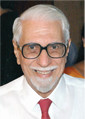
Prof (Dr) Sheryar Ookerjee: partial to Plato
However, the law of karma is impersonal and not routed through a divine being whereas in Plato’s philosophy the fruits of the action come via God who ensures that wicked souls are hurled into Tartarus where they may enter the bodies of wolves, kites and donkeys! Admirers of Plato (and obviously, Ookerjee is one of them) seem to be embarrassed and cannot believe that a rational, analytic philosopher like Plato could believe in such myths! For them all this comes as a "painful shock” and "blots his copybook,” feels Ookerjee. Perhaps an attempt is made to save Plato by maintaining that the mythical accounts appear, after he has argued strictly philosophically, his convictions about the moral life.
For believers, the law of karma is simply the principle of causation as applied to the moral world. One does not doubt or question the cause-effect relationship in the physical world because it can be experienced; however, the belief that its effects or fruits come in different births seem unpalatable to opponents of the theory of reincarnation. The doctrine of reincarnation will always remain a matter of faith. That the soul continues to exist even after the body perishes is an esoteric issue and there is a whole new branch of study — parapsychology — which can be read profitably and needs to be given some consideration.
Ookerjee’s second lecture is a delightful pseudo dialog (though admirers of Kautilya may not quite agree) between Plato and Kautilya, dealing with the institution of kingship, the qualities ideal rulers should possess and the guidelines along which the state ought to be governed. All the while Ookerjee skillfully brings out the contrast between Plato’s Republic and the statesman on the one hand and Kautilya’s Arthashastra on the other.
Both Plato and Kautilya reject democracy because how would ordinary men know to govern? The importance of the study of philosophy for the ruler king is also accepted by both; though Plato insists that philosophy is not just of ornamental value. A ruler has to be a genuine philosopher, having correct knowledge of what is right and wrong, and never doing the wrong intentionally and knowingly. Kautilya claims to be a down-to-earth pragmatist and is sceptical about Plato’s attempt to change the world by introducing new ideas. According to him, a ruler should also be a good warrior, exhibit courage, have a sharp intellect, be free of all negative emotions, be dignified in dress and behavior, be morally correct and capable of upholding caste distinctions in his kingdom. Philosophy, after all, is only a pleasant pastime — a royal accomplishment!
Plato is surprised at the qualities Kautilya thinks a ruler should possess because, for him, education for the rulers would be the most important factor. This would include a study of astronomy, mathematics and philosophy. The rulers would be philosopher-kings, so that governance of states in a rational manner would be ensured. Plato is very emphatic that the caste system can never be accepted. The class system which would comprise the philosopher-kings, soldiers and the artisans has the advantage that mobility is permitted, whereas the caste system is fixed and has a religious sanction. Both agree that the happiness of the citizens must be ensured, but differ in the concept of "happiness.” Kautilya thinks that happiness for the masses lies in permitting them to do what they like to do as long as they are not a threat to the ruler, whereas Plato feels that the citizens’ happiness lies in making them do what they "ought” to do, and which would also be good for them.
There is good-natured bantering that goes on occasionally and Kautilya’s inability to understand the essence of governance as envisaged by Plato tries the latter’s patience from time to time. His parting shot to Kautilya: "I cannot honestly say it has been great knowing you!” shows Ookerjee (who himself does not suffer fools gladly) openly avowing his partiality for his favorite Greek philosopher!
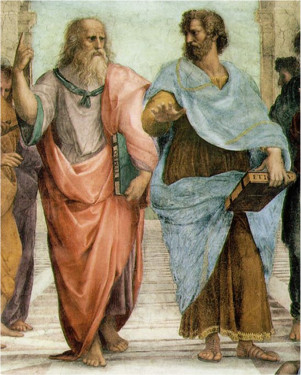
Plato (left) with Aristotle
In Ookerjee’s final lecture the bogey of reincarnation surfaces again, and Plato (unlike his master Socrates) is reborn around 1979 AD (probably to reap the fruits of his bad karma, accumulated in some of his past births!). He visits India and is interviewed by an assistant editor of The Times of India!
After lamenting the pathetic condition of the roads and the increased level of corruption, Plato emphasises the austerity to be practiced by people at the "top.” Since the finest people (the philosopher-kings) would be at the top, everyone’s happiness would be ensured, and people who are unfit to rule, would be automatically weeded out. Of course, to achieve this, the right kind of education is required which proceeds with ordinary "opinion” at the base, gradually moving up to "proper knowledge” and at the apex would be "philosophy.” This would ensure that the "top layer” is clean and the dirt does not percolate down.
(It is not clear whether Plato has reread his own dialogs in this new birth or whether in keeping with his theory of Recollection or Reminiscence, he has been able to recall — centuries later — what he had written in one of his previous births!)
The interviewer appears a little skeptical about the proposals in the Republic and the Laws, for they would not fit into the modern pattern, and Plato concedes that he would have to reconsider the entire system of education because today the rot starts from the "top.” But one thing Plato is sure about is that the state should be ruled by a wise and a good ruler.
Finally, the interviewer thanks Plato for sparing some time for him, hopes he will be around for long, and here (as against the conversation with Kautilya) Plato is quite pleased with the "good and appropriate” questions. His optimistic and heartening reply is: "I shall always be there!” Truly, like William Shakespeare, Plato has also become immortal through his works!
The booklet, Plato’s Indian Connection, is highly readable, neatly printed and Ookerjee, in very simple language, ingeniously brings out the essence of Plato’s philosophy. The publication, priced at Rs 100, can be read profitably both by serious students of philosophy (who would be inspired to re-read the dialogs and possibly from a new perspective) as well as by a lay person who may sometimes have to read between the lines and at others take it half in jest and half in earnest!
Dr RITA F. DOCTOR
◆ ◆ ◆
From the archive