
Business
Cooper’s choices
Gritty and resourceful, octogenarian Keki Cooper ventured into entrepreneurship in his 70s
He’s 82 years old — brisk, decisive, full of beans and still working. From childhood and early youth in Lahore in undivided India to a 50-year career in shipping in Bombay and Gujarat, entrepreneurship became Keki Cooper’s center of choice when he was in his 70s! He set up his own shipping company called Amfico Agencies Private Limited, currently representing in India Suttons International (UK) Limited, one of the world’s largest ISO tank (liquid cargo) container owners and operators, and Cooper Trading Private Limited, a distributor for products like Lays, Bisleri, Parle Confectionery, etc.
"Keki has had a very colorful life,” says his wife Kamal, a Vidal Sassoon School trained beautician who runs a chain of salons in Bombay, Baroda and Ahmedabad under the name of Kamal’s, the first salon having opened way back in 1968. "Our business portfolio is well-balanced. Overall business has shown an upward trend compared to the last fiscal, mainly due to new strategies, tie-ups and enterprises,” says their son Farhad, director, whom Keki terms his "right-hand man.” "Dad is still at the helm of affairs and has always been the foundation and pillar of our organization. No plan, large or small, is executed without bouncing the same off him. His vision and long-term approach to business growth and profitability is a strong constant in our organization,” states 37-year-old Farhad.
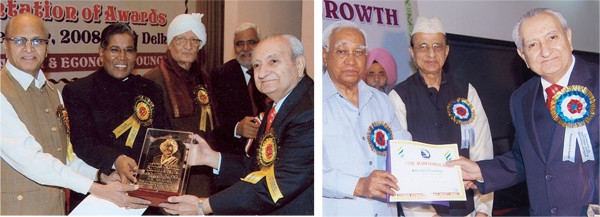
Acknowledging enterprise: Keki Cooper (extreme right) receiving awards
As Keki narrates to us the story of his life in several cities, Kamal and 23-year-old daughter Laisha listen intently. Casper, their champion Labrador whose huge size belies his friendly disposition, snoozes contentedly at their feet. "I love telling my stories graphically, with details,” Keki says. He describes his passage to India: "It was the last train to leave Lahore for Delhi and the date was July 29, 1947. I was 20 years old at that time. My mother Shirin had already left for her parents’ place in Secunderabad. There was martial law in Lahore. We could see the burning of houses. My father Byram had a friend who was with the railways. He gave us two tickets and warned us that there would be no trains from the day after tomorrow.” Sealing their big bungalow with its 20 ft ceilings as best as possible and leaving behind property and possessions, father and son transported whatever luggage they could, not in cars as it was unsafe, but in tongas (horse carts) to the station. "My father was a barrister. He knew the Superintendent of Police who helped us with passes and gave us a couple of armed policemen to transfer the belongings,” he continues. They shared a second-class compartment with a Viceroy’s Commissioned Officer, a Sikh, and locked themselves in. "The train was like a tin of sardines. There were people on the roof. It would stop every now and then, with people banging on the doors,” he narrates. Further shock awaited them at Delhi station: "There were four lines of corpses, in gunny bags or just covered with cloth which would fly in the breeze to reveal a hand or a leg. There was solidified blood on the footboards. Only seven people alighted from the train alive, four of them Britishers from the first class.”
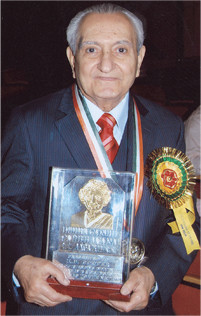
Keki Cooper with Indira Gandhi Sadbhavna Award in November 2008
Byram and Keki proceeded to Secunderabad where his maternal grandfather Pherozshaw Chinoy was the financial adviser to the Nizam of Hyderabad. A well-known personality, Chinoy had built a fire temple in Hyderabad as well as charitable blocks for the Parsis. For Keki, college admission proved to be a problem. "Sorry, your father is not a mulki (native of Hyderabad). We cannot accept a student of Punjab University (Lahore being part of undivided Punjab),” he was told. So the family moved to Bombay, where Byram’s sister Banoobai Dubash lived. Keki joined the Davar’s College of Commerce but was soon offered a job by the Dubashes as manager of a cold storage at Warden Road. "My salary was Rs 100. We worked on a margin of four annas per pound. I had to learn with the butcher how to cut meat, to differentiate between laal pani (stale) and safed pani (fresh) fish. There was just one cleaner to help.” Working from 6 a.m. when he picked up the bazaar to 10.30 p.m., Keki earned additional money by making chocolates at night: "They were known as Volga chocolates. I would make them; mother and father would wrap them. I employed two salesmen (to take them to customers).” "Even now, Dad makes the most delicious chocolate biscuits for the family,” Laisha chips in.
Living in cramped rented accommodation, Keki was determined to earn more so the family could soon see better days. "We had luxury in Lahore… pauperism seemed horrible,” he recalls. A stint as executive manager of Rogers and Company (makers of aerated waters) was followed by his entry into the shipping industry with Darabshaw B. Cursetjee and Sons (DBC Group). Keki acknowledges the role played in his career by his cousins Rustomjee and Pherozeshah Dubash. "The most fulfilling years of my life were from 1955-’58 when I was sent by the company to Kandla. It was just a salt port. Besides Cowasjee Adenwalla’s salt works, there was little else there. A desert area at that time, the locals used to catch snakes and sell them (to extract the venom)… Labor from the villages would be brought in trucks to work in the port. Those years made me well versed with shipping. I also made good contacts in various government departments.”
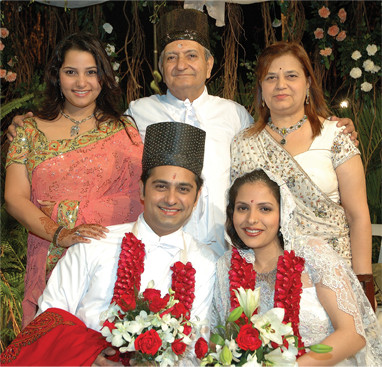
(From left, standing) Laisha, Keki and Kamal Cooper with Farhad and Monaz at their wedding
Horizons widened and Keki became president of the Kandla Steamship Agents Association, vice president of the Kandla Stevedores Association and was also appointed trustee of the Kandla Port Trust by the government. He was a member of the Port Advisory Committee of the Gujarat Maritime Board and was associated with the development of the ports of Kandla, Jamnagar, Bhavnagar, Magdalla, Dahej, Pipavav on the west coast and Kakinada on the east, states a summary of his achievements by the National Integration and Economic Council. Keki has received, among other awards, the Rajiv Gandhi Award for Shipping and Ports Management and the Indira Gandhi Sadbhavna Award bestowed on him on November 20, 2008. DBC had made him general manager of their operations at all Gujarat ports (based in Bombay). On behalf of the company he had received the National Dock Safety Award from Fakhruddin Ali Ahmed, the then President of India. He retired as executive director in 1999.
"Dad has a knack of identifying people who he believes can run businesses… His experience of having worked in a single establishment for over 50 years helps inspire and retain people…From the wonderful experiences that I have heard about him from his friends and colleagues, I believe a large part of his work and achievements in the shipping industry is still to be recognized,” asserts Farhad. Among the ideas and innovations Keki has worked on was the running of cars on a dual fuel system (petrol and liquefied petroleum gas), demonstrating the car to the former chief minister of Gujarat Chhabildas Mehta.
"Dad has a fund of stories of his life. Just listening to him is enchanting,” says Laisha, herself vivacious, gregarious and a storyteller in poetry! Writing since the age of 13, her book, soon to be released, is a work of fiction in the form of letters, diaries, jottings and rhyme. Actively involved with the beauty salons started by her mother who has now more or less retired, Laisha says they have started a new concept known as Hajam which provides the same services but at a lower cost. Kamal’s oldest parlor and head office is at Altamount Road; they have two salons in Bandra, two at Andheri and at Willingdon Club. With both unisex (family) and men’s parlors, a gamut of hair and beauty treatment is provided but "we do no kind of body massages. Women staff take only women customers,” adds Laisha who has learnt hands-on ("everything to everything, from cleaning the floor to pulling the curtains”) and attended courses, including an advanced course from L’Oreal Hair Academy. Kamal herself has traveled extensively, with regular visits to all her salons and constant client interaction. "Many girls trained by Kamal have successfully opened their own beauty parlors. This aspect of Kamal’s leadership in training individuals from all walks of life has been an important and generous contribution to our society,” states their website www.kamalsalon.co.in
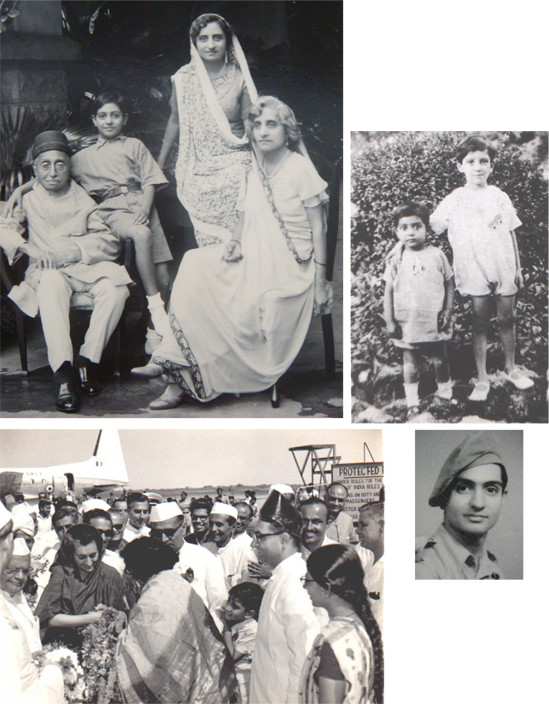
(Top left) Pherozshaw Nassarwanji Chinoy with young Keki and his mother Shirin (standing) and aunt Putlibai Maneckshaw Chinoy; (right) Keki with older brother, late Adi ; Bottom left: Greeting Indira Gandhi at the airport; Right: Keki as a corporal in the University Officers Training Corps in 1945-46
Laisha recalls their family visit to Lahore at the time of her navjote. "My paternal grandfather Ardeshir Behramji Liboowalla Cooper had 27 children! His first wife died after 17 children, his second wife bore 10 children. Not all children lived,” relates Keki. A self-made man, Ardeshir lost his parents as a lad. In Bombay his uncle helped him with food and education. Living comforts were rudimentary — under a staircase! His enterprising spirit took him to Lahore where he prospered as a businessman, with a brewing and sodawater business, an ice factory and vast property. He built a dar-e-meher in Lahore in memory of his wife Avanbai. Later on, the family built a large hostel for deserving students, encroached upon after Partition when they could no longer look after it.
"I do not think that business acumen in the community is any less today than it was before. It’s just that the competition is too much,” Keki avers. He attributes his own success to prayers, honesty and hard work. A keen sportsman, exercise is a must, even at this age! Predicting the future is among his several interests. "The best thing about Dad is that he is always laughing,” says Laisha. "He is a man about whom a complete book can be written,” Farhad asserts.
◆ ◆ ◆
From the archive