
Business
“With vision, mission, passion”
With super-specialty machines under production, Farrokh Cooper says his corporation will become an international company 10 years from now
Defeat may test you; it need not stop you. If at first you don’t succeed, try another way. For every obstacle there is a solution.”
"The graveyards of the world are full of indispensable people.”
Such adages and rules of living line the walls of the conference room at Cooper Corporation’s head office in Satara. The company’s quality policy and safety policy are unequivocally spelt out and conspicuously displayed in other parts of the building. Landmarks from international cities leap off the walls. A Swiss cow bell hangs strategically at the entrance to the atrium. On being questioned its significance Farrokh Cooper shrugs, laughs and rings the bell, a gift from a European customer.
"Politics and business don’t go together,” Cooper told Parsiana on being asked whether he had political ambitions like his great forbear. When we voice our dissent, pointing to the numerous scams hogging newspaper space, he notes, "India is going through a phase of cleansing like England did a long time ago.” These scams coming to the surface is a good thing, he says, because it shows that the people of India want a high standard of probity. He then explains the changes happening around him in the rural society of Satara.
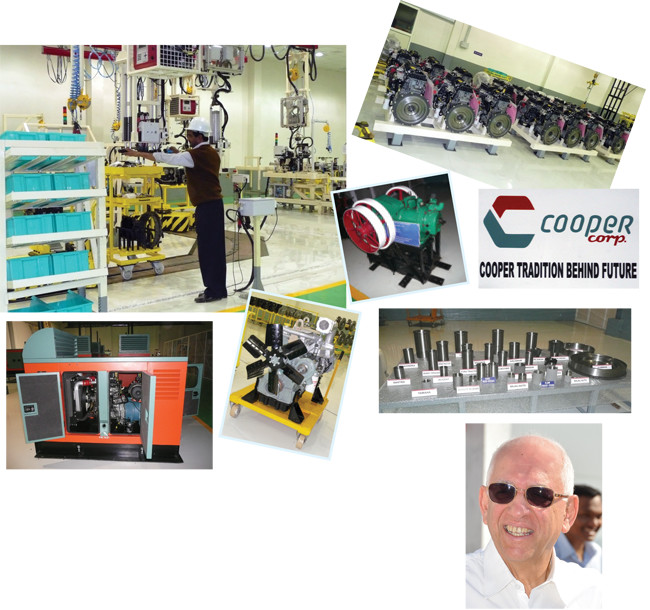
Above: Farrokh Cooper and the products of the Cooper Corporation
Photos: Jasmine D. Driver
"Education has changed peoples’ thinking. There is a new awakening. People want a better life, better products. They may be poor but they are not dumb. Everybody starts small,” says Cooper and goes on to relate how one of his workers, on a salary of Rs 10,000, educated his son who graduated as an engineer in organic chemistry, won a scholarship to Iceland and has gone there to do his doctorate. "There is a tremendous surge of talent, of awareness in India.”
Cooper’s social commitment comes through his company. He says he is aiming to make it an international company in the next 10 years. He believes he is the biggest paymaster in Satara with a profit sharing scheme to nurture more enterprises. He had seen how Osho Rajneesh’s foreign students used to spend nearly five lakh rupees a day in Poona when he was studying agriculture there. It helped to increase the income of Poona’s citizens. "Satara will become an engineering city providing employment to the local people. Then they will not need to migrate,” he notes.
Referring to the current high prices of agricultural produce in the cities as a result of unseasonal rains which have ruined all crops, Cooper, who continues to be an agriculturist/horticulturist on the side, nonetheless maintains that the farmer needs to be adequately compensated. "Eighty percent of the population lives in the villages… If you don’t want people in the streets of Bombay, if you don’t want starvation, if you don’t want Naxal terrorism, give them affluence… When you pay Rs 200 for a kilo of garlic, the farmer gets only Rs 100. I grow colored capsicums. I sell them at Rs 100 a kilo. In retail they fetch Rs 300-400... How do you rein that in? How do you give the farmer value for his product?… The kirana owner is the most highly networked trader, hoarding black money… This vicious circle needs to be broken. But the farmer is getting savvy. He wants his price; he is telling the middle man what to do.”
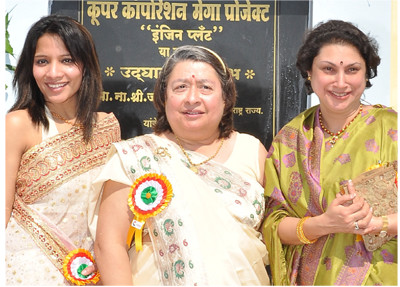
Feminine support: Manisha, Mahrookh and Kavita Cooper
As an illustration Cooper tells us how the poultry industry learned to manage its affairs. For a long time it was in the doldrums as three or four traders in Hyderabad set the price of eggs, "strangled the producers” in Cooper’s words. Finally all the poultry producers ganged up with Venky taking the lead and refused to supply eggs. "They declared they would supply eggs only if they got their price. There are signs of that happening with the farmers. The government realizes that unless this is done, the economy won’t swing. The farmers won’t sell their land, won’t allow development. That is why the government has said let the developer negotiate with the farmer.”
Cooper recalls that he was sent to school in England in 1955 and stayed alone there. "It gave me a sense of independence, fending for myself and learning to live with the world.” He came back and completed his BSc in agriculture from Poona University — without cheating, he told the amused audience in his welcome address. The family was running a small factory with 60 employees in 1968 when a road accident reduced his brother Saam to a state of complete dependence. "Mother said give it a try. I had worked with cowdung and soil. What did I know of millimeters and centimeters? But people are very straightforward. If you believe in yourself they believe in you.”
Cooper describes himself as a flexible, practical person with some attributes of leadership like transparency. "If you get to see what others don’t see, you get to convince others to accept what you think, take ownership of the decisions and move in one direction. Not all the days were good but step by step we made progress. In my life nothing has gone according to plan, there have been no systems. Chance meetings and suggestions have given tremendous opportunities. Being a little impetuous and eager to succeed, I don’t take the risk of letting opportunity go by!” he laughs.
Cooper said he had begun by selling his engineering products directly to his customers in Vashi, appointing no distributors. He took that approach a step further when the Indian economy was liberalized in the early 1990s. He started to go abroad to sell his products, Italy being his first port of call in 1994. "People said you can’t depend on Italians. They will cheat you. It’s almost two decades since I’ve been dealing with them. There’s been no problem,” he tells us.
When he went to America thereafter, it was a case of being "in the right place at the right time.” In Milwaukee he met an industrialist he had never met before. "I told him I make cylinder liners. I also told him that ‘your company is holding our company to ransom,’” Cooper recalls the conversation. "He took me to meet the president of a large corporation. He said you can supply me. No conditions were mentioned. I told him I’ll accept whatever you pay. He said he’d never heard this before! In eight days my project report reached him. That was my work policy.” The ensuing partnership of manufacturer and customer burgeoned. Cooper claims that four foundries in America and Germany "closed because of us.”
Expounding on his work ethic Cooper says, "We concentrate on technology, quality. In business you always have to keep investing. You cannot shrink, to grow. My banker told me, ‘We haven’t seen such a good balance sheet from anybody else. How do you manage it?’ I asked him, ‘Have you ever asked your children why they’re growing so fast?’ He was tickled by my reply!”
He says he has learnt that "in business you must put your ego behind you. Because of circumstances and the handicap that I’m not technically qualified, I’ve got the knack of finding and trusting people who do know their job and leaving them to get on with it.
"Many people pooh-poohed the idea of my making very high tech engines. They said it requires different marketing, different mindsets. But we said we’d do it. When we went to Ricardo, I was the youngest member of my group and I was 63. The others were in their 70s. Ricardo’s men were in their 30s! There was a generation gap and they wanted to know how seriously they should take us. As a formality we were taken to dinner with some senior people and when they realized we had mission, vision and passion, they gave tremendous help.”
Similarly, Cooper’s decision to make vehicles as the next step unleashed a barrage of skepticism: "Doomsday for Mr Cooper!” he chuckles.
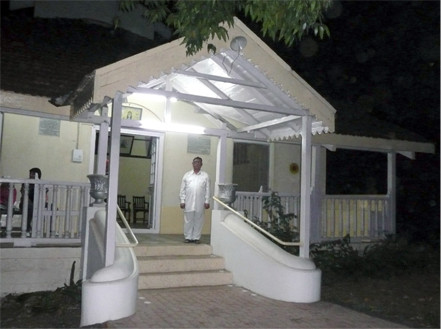
Ervad Yazdi Tarapore at the Bai Nawazbai Khan Agiary
Photo: Jasmine D. Driver
"If you want to do something, it happens; but you have to be transparent and behave the same with everybody, whether worker, customer or anybody else,” is his advice to anyone seeking to follow the enterprise route. The only Parsi in Satara speaks of his schemes for social welfare. The wives of the staff and workers supply uniforms and certain raw materials and accessories for the running of the factory through their mahila udyogs. The company supports a blind school in Satara, providing the daily morning breakfast and free medical checkup once a year. It has opened a number of libraries and donated computers to schools. They also help institutions that look after destitute children.
Cooper is married to Mahrookh (née Daruwalla) who had schooled in Panchgani, qualified as a histopathologist in England and worked in the Breach Candy Hospital’s pathology department under Drs Jal Dubash and Vatsala Doctor. Their daughter Manisha is studying business management at Sterling University in Scotland and is happy at the prospect of joining the business, says Cooper.
With Mahrookh’s and Farrokh’s unquestioned faith in Zoroastrian prayers and no one else to support and maintain Satara’s Bai Nawazbai Khan Agiary — a dar-e-mehr that is slated to celebrate its centenary this year — it is a duty they have willingly shouldered and regularly attend to all the nitty-gritties of its preservation. The family had a maachi there in thanksgiving for the inauguration of the new production unit which Parsiana had the privilege to attend. Their one complaint is familiar: they cannot find a second mobed so that the dedicated Ervad Yazdi Tarapor can occasionally proceed on leave.
Though not consciously mixing politics and business, Cooper says he is known to and has the approval of politicians and MLAs (members of the Legislative Assembly) from the area for employing so many local people and generating prosperity and there are occasions to interact. The Satara district is believed to be one of the backward areas of Maharashtra and the Mega Project was one of the government’s development measures to create employment and prevent migration by exempting industrialists who invest there from some of the state level taxes like the sales tax, VAT, etc. "The government of Maharashtra sanctioned eight mega projects last year, of which we are one,” notes Cooper with a measure of satisfaction. Sadly, according to a The Times of India (January 5, 2011) report, that policy may be aborted for want of funds.
◆ ◆ ◆
From the archive