
Business
Maritime merit
Two Zoroastrian names feature prominently in the list of awardees at the 6th All India Maritime And Logistics Awards held on September 4, 2015 at The Leela, Bombay. Ninety-three-year-old Russi Cooper was honored with a Hall of Fame award for his long years of service to the maritime industry while Capt Jimmy Sarbh, independent port consultant, was recognized for his achievements with a Special Jury award for outstanding contribution to privatization in the Indian ports sector.
Cooper told Parsiana, in an interview at a south Bombay club on October 20, 2015, "I cannot recognize the industry anymore.” Ships no more look like ships any more, he says, referring to the proliferation of container vessels. Practices also have "improved for the better, since the time I was active,” he states. The awardee began his career in the shipping industry in the same year that India became independent. Stating that his 12-year stint on the India board of ITIC, the international organization that provides specialised insurance for the marine industry, was one of the highlights of his career, he informs that he held the position till he retired as executive director from J. M. Baxi, shipping agents in 1994.
Founder-member and president of the Ship Agents Association of Bombay, he explains that the success of the Bombay body was instrumental in inspiring the founding of similar associations at other ports in India, which banded together into the Federation of Ship Agents Association of India, of which he held the presidentship too. A trustee of the Bombay Port Trust for six years, Cooper was instrumental in setting up the Narottam Morarjee Institute of Shipping, the objective of which was to conduct training programs for staff of shipping agencies.
Cooper told Parsiana, in an interview at a south Bombay club on October 20, 2015, "I cannot recognize the industry anymore.” Ships no more look like ships any more, he says, referring to the proliferation of container vessels. Practices also have "improved for the better, since the time I was active,” he states. The awardee began his career in the shipping industry in the same year that India became independent. Stating that his 12-year stint on the India board of ITIC, the international organization that provides specialised insurance for the marine industry, was one of the highlights of his career, he informs that he held the position till he retired as executive director from J. M. Baxi, shipping agents in 1994.
Founder-member and president of the Ship Agents Association of Bombay, he explains that the success of the Bombay body was instrumental in inspiring the founding of similar associations at other ports in India, which banded together into the Federation of Ship Agents Association of India, of which he held the presidentship too. A trustee of the Bombay Port Trust for six years, Cooper was instrumental in setting up the Narottam Morarjee Institute of Shipping, the objective of which was to conduct training programs for staff of shipping agencies.
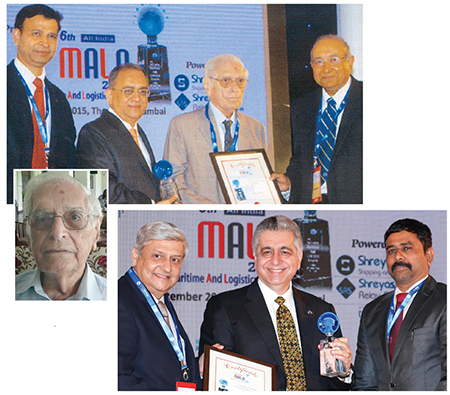
Clockwise from above: Russi Cooper; Vivek Kele, Mukesh Oza,
Cooper, S. Hajara; Ennarasu Karunesan, Capt Jimmy Sarbh, Capt Percy Master
The awardee does not remember fondly his 20 years as a member of the Indian Council of Arbitration, where he presided over at least 30 disputes, "some of which went on for years and years.” Too many procedural delays, he says shaking his head, letting on that it took 33 hearings in one case, merely to determine that a fan in a ship had indeed broken down.
The nonagenarian relates an interesting story about how he came to be in the shipping industry. Having completed his bachelor’s degree in economics and his law examination in the UK, he was looking for a passage back to India in 1947, only to be told that there were no berths available for six months. On approaching the managing director of Scindia Steam Navigation for assistance with the ticketing, 25-year-old Cooper was instead offered a job in their London office, with the condition that he parallelly study for a degree in marine insurance, on a part-time basis! After learning the ropes there he moved to India in 1954 with his wife June and held various positions in ship owners’ and shipping agents’ offices with increasing responsibilities till 1994 when he retired. He continued to work as a consultant to the Indian legal representative of ITIC till 1998.
A Bombay Presidency singles table tennis title holder in 1944, the still sprightly Cooper represented Parsis in the quadrangular cricket tournaments in 1942 and 1943 and the Ranji Trophy cricket tournament in 1944. He reveals that his brother Khatu, senior advocate of the Bombay High Court who passed away in 2004 was a leading table tennis player too.
Having been at sea for a considerable part of his growing years, first as cadet, then as second officer, chief officer and master, Sarbh had acknowledged, "My sailing experience has considerably helped me to understand the business: ships, ports, containers. By travelling to different parts of the world, you understand people, their values, their culture.” (See The challenging port-folio story, Parsiana, May 1999)
Speaking to Parsiana telephonically, en route to Dubai, Sarbh modestly states that he is very happy to have received the Special Jury Award. Was the award too late in coming? "In India everything happens slowly,” he laughs, and is "glad I received it in my life-time!” Describing himself as semi retired, the entrepreneur states that he still functions as a director on the boards of three ports in India owned by the Essar group - in Hazira, Paradeep and Salaya.
Instrumental in setting up Nhava Sheva International Container Terminal (NSICT), India’s first privately managed port, where the first 300 m quay length was opened for operation on March 21, 1999, Sarbh is widely regarded as a pioneer for the development and operation of container loading terminals in and around India. The P&O Ports-led consortium had won the project in 1997. In addition to serving as managing director of NSICT, Sarbh was regional director, South Asia and Middle East. He resigned as chairman of P&O Ports India in October 2005, having earlier stepped down as regional director (South Asia and Middle East) at P&O Ports in June 30 of that year.
"I have looked upon the NSICT as my third child,” he states, happy that he was instrumental in the privatization of ports not only in India, but also in Sri Lanka and Pakistan and that he "changed the paradigm of how container traffic is managed in India.” He wanted to change the efficiency paradigm too, he states. With NSICT, transshipment (shipment of containers to an intermediate destination say in South East Asia, then to Bombay) was not necessary and trade volumes grew faster.
"Ports are not a priority in India,” he moans, stating that the acts that govern the shipping industry – The Indian Ports Act, 1908 and Major Port Trusts Act, 1963 need overhauling to make them more contemporary, and in line with the current trends in the business.
Sarbh Maritime, his international port consultancy firm, serves clients in India and other developing markets.
Future plans for Sarbh include possibly owning equity in a container terminal. "I would love to design and manage a container terminal even now,” he states, hopeful that the Wadhwan port in Gujarat, for which he had started preparing the blueprint in his P&O days, and which was stalled due to what he terms eco-terrorism, should indeed go ahead.
◆ ◆ ◆
From the archive