
Cover Story
The rare repository
With her discerning eye Dilnavaz Mehta is able to source and supply antiquarian material
The sculptures and carvings at the historical Elephanta Caves (located on an island across the Bombay harbor) may in today’s age serve as a picturesque landscape for the festival of music and dance organized every winter. But even more than a century ago the prized monument seems to have been popular among the British overlords. A detailed illustration of the Prince of Wales at a banquet luncheon at the Elephanta Caves was among the rare images presented by Dilnavaz Mehta as part of her fifth exhibition and sale of original prints, old maps and antiquarian books under her Rare Finds banner.
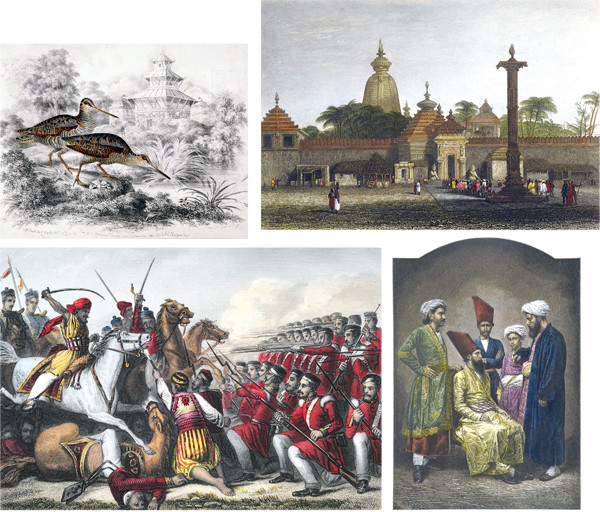
Clockwise from top left: a print from a series in Oriental Ornithology; temple of Juggernaut; Persians in Bombay; mutineer cavalry revolting at the Battle of Cawnpore.
"An exhibition is for people to look around and enjoy,” not necessarily as a sales promotion venture, says Mehta, delighted to share her fascination for archival material with new admirers. Since the exhibition from December 10-13, 2008 at the Cymroza Art Gallery was just a fortnight after the terrorists caused mayhem in the city, Mehta found that members of foreign consulates who had patronized her ventures in the past were absent this time because they were "scared and advised against visiting spots where crowds were likely to assemble.” Nevertheless the "public response was much larger than we could handle,” says Mehta referring to the unexpected presence "of mobeds (identified by their attire) from different agiaries.”
Besides the mailers and attention she garners from the media, Mehta believes that word-of-mouth publicity helps spread awareness of her nearly 2,500 interesting exhibits priced upwards of Rs 1,000. While individuals are always on the lookout "to add something more to their homes and weekend retreats, collectors and connoisseurs too keep coming back for more,” she observes. Of particular interest to the Zoroastrian community are "lovely maps of Persia bearing names which Parsis could relate to — Baku, known for its natural fire altars because of gas in the region, Zohak’s palace…”
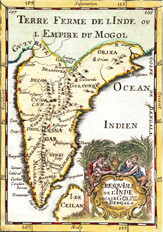
map of India during Moghul rule
A Parsi man praying at the seafront with book in hand, Bombay Parsis according a welcome address to the Prince, a Parsi lady’s stall at a bazaar in Bombay showing a Britisher with a Chinese doll in hand and Ming vases in the background, giving of alms to starving natives, a man relaxing on an easychair while his dog attacks the outstretched umbrella of the visitor are some of the pictorial exhibits in Mehta’s collection. Present and former residents of India would be intrigued with the view of Bombay and Poona belonging to the East India Company, an Indian railway station, one-tenth the length of the present ones, though as crowded, with many well-heeled passengers denoting that such a mode of travel was the prerogative of the privileged class. Cricket in India, depicting different views of the field, was then a game played largely by the British rulers and Parsis.
Under the East India Company conditions were very difficult for the professional artists to travel and live in India as the Company directors were not keen on subsidizing them. Hence a large number of prints and illustrations were drawn by army personnel and civilians working in India, as per the vignettes on original prints offered by Rare Finds. Although William Hodges is popularly credited as being the first landscape artist to visit India, Mehta’s research showed that Francis Swain Ward, whose aquatints of cities of Bangalore, Madras, Conjeeveram she had displayed, was the first British artist to actually visit the sites he drew of India instead of relying on observations and descriptions of travelers. His work though was printed much later in the years 1802-05. Sir Charles D’Oyly who painted Indian village life with a passion is credited with introducing the lithographic printing press in India. A series in Oriental Ornithology (1829) by D’Oyly and Christopher Webb Smith was part of Mehta’s collection too.
Such pictorial images were produced by processes like engraving, etching, lithography, mezzotinting whereby several copies of a single illustration could be produced. With these printing techniques having gradually fallen into disuse, each of these prints is now considered an original limited edition pictorial image that could serve as a rare décor or gift item.
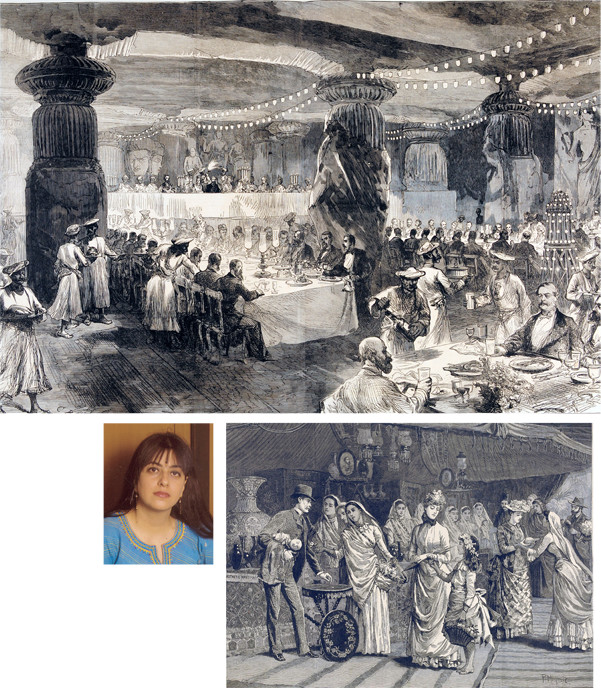
Dilnavaz Mehta’s collection includes prints of Ele-phanta Caves (top) and a Parsi lady’s stall
Unlike prints, maps were never produced in large numbers as they were needed only by traders or travelers. Cartographers (map makers) incorporated the latest information brought back by navigators and explorers and the master craftsmen drew, engraved, printed and colored the maps to increase their visual appeal. With improvement in accuracy of measurements earlier maps were periodically discarded, making them a rarity. Mehta’s collection of maps ranging in date from 1560 to 1930 depicted independent kingdoms of the Indian empire, the Asian continent, British and other European power territories, marine areas, town plans and geographical features. She found that in many maps of the British period, parts of India were marked as "unexplored territory.” Certain early maps show Sri Lanka as Taponicum, frequently larger in size than India!
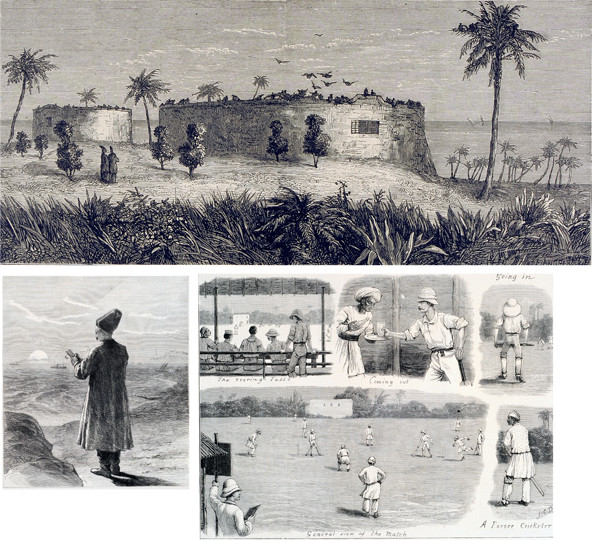
A dakhma, a Parsi at prayer and cricket in India;
The antiquarian books at the exhibition, uniquely presented and often with intricately decorated covers or illustrations, were published between 1750-1940 on a variety of subjects like travel, history, administrative records, personal diaries, scientific works and even fairytales for children. Books that evoked considerable interest were Ferishta’s History of Dekkan from the first Mahummadan conquests by Jonathan Scott (1794), The poetical works of Sir Walter Scott (1881), The Indian Mutiny of 1857 by Col G. B. Malleson (1898), Romantic tales from the Panjab by Charles Swynnerton (1903)…
Having extensively researched the subject of antiquarian material from the 16th till the early 20th century, Mehta is invited as guest lecturer for postgraduate studies at the Bombay and Benaras Universities. Invariably five days a month she is traveling, meeting clients, evaluating, sourcing and restoring valuable material, maintaining collections. Her masters degree in microbiology from the Bombay University coupled with a diploma in Indian aesthetics helped her better understand the nuances of restoration work.
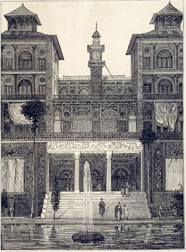
East front of the Shah’s palace in Tehran
"My work keeps me very busy,” maintains Mehta explaining that although she has three other staff members working for her, clients insist on meeting her even if it means waiting for a week to get an appointment! Besides being a storehouse of archival material Rare Finds also offers framing and mounting services to individuals and corporates who choose to preserve their paintings/letters/certificates and other such heirlooms in pristine condition.
At the 2008 exhibition Mehta was particularly happy that she had regained the confidence of some of her old customers who had been misled into thinking that she had started exhibiting "tacky, imported stuff from Bangkok.” She refers to the unfortunate incident in 2004 when her brand name, Rare Finds was unscrupulously adopted by another individual to showcase his wares of South East Asian artifacts on the ground floor premises of Cymroza Gallery (art exhibitions by reputed artists are usually held on the first floor of Cymroza). Although her exclusive rights to the name Rare Finds were restored to her after a legal battle, unsuspecting customers learnt of the truth much later. Mehta therefore is determined that "people carry a good impression each time.”
Dilnavaz Mehta of Rare Finds can be contacted on 24121347/9820222062, e-mail: dmmehta@vsnl.com or dmmehta. rarefinds@gmail.com
◆ ◆ ◆
From the archive