
Cover Story
The king is enthroned
Following two years of renovation the sacred Iranshah flame is restored to its original abode
At 10.10 p.m. the street lights in the lane abutting the Iranshah Atash Behram in Udvada were switched off. One by one houses along the narrow road put off their porch lights.
So began the shifting of the Indian Zoroastrians’ most sacred flame from the nearby Sir Dinshaw Petit Dar-e-Meher in the Iranshah compound complex to the reconsecrated Atash Behram structure. Barring the officiating priests none were allowed to enter the holy precincts till 1.30 a.m. By that time a crowd of around 100 worshippers had gathered at the closed doors of the fire temple.
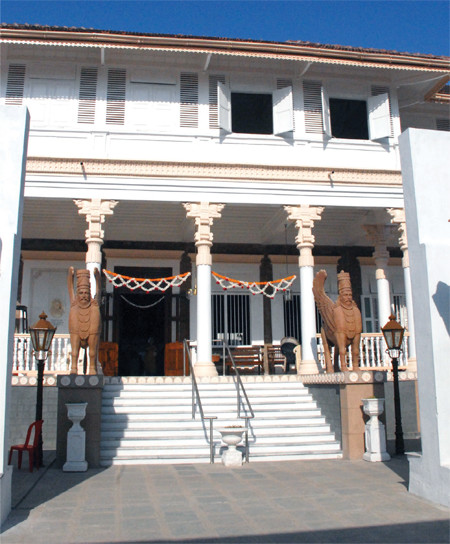
As the iron gates opened the parishioners flocked onto the temple grounds performing their obligatory kusti prayers in the newly painted and renovated foyer before climbing past two pink winged bulls that now stand guard at the building’s flight of stairs.
People thronged around the kebla where the yellow flames leapt over a meter high as a maachi was being performed. Then when the kebla bell was struck for the boi ceremony everyone stood in awed silence.
The shifting of the fire from the adjoining agiary to the main Atash Behram building took three hours, said Dastur Khurshed Kaikobad Dastoor, one of the two High Priests of the fire temple. The other High Priest is Dr Peshotan Hormazdyar Mirza. The ceremonies performed are not disclosed and are known only to the participating priests, he notes. Nine Yaozdathragar mobeds, who have undergone the cleansing nahan ritual participated in the shifting ceremonies. The nahan was taken nine days prior to the start of the ceremonies.
No one is allowed to witness the fire en route from one sanctum to the other as the fire is "dethroned” at the time. Once it is seated on its pedestal or throne, the laity may view it and pay homage, says Dastoor.
Extensive repairs were carried out to the Atash Behram building including placing of white marble in the main hall. In the kebla "Everything else was kept the same as before,” said Dastoor.
A welcome addition to the hall adjoining the kebla are wooden benches. These are for the benefit of worshippers who earlier either had to stand or squat on the floor, notes Homi Talati managing trustee of the M. N. Wadia Trust that owns the building.
The fiberglass guards at the Atash Behram gates and the winged bulls at the entrance to the building were added to lend a historic grandeur to the Iranshah, says Dastoor. "It looks (more) like a monument,” with these additions, he observes.
The fiberglass structures have been filled with concrete, says Cyrus Unwalla who was entrusted with the repairs to the building. A hall on the first floor has also been renovated. Unwalla spruced up the hall on being given to understand it would be used for functions.
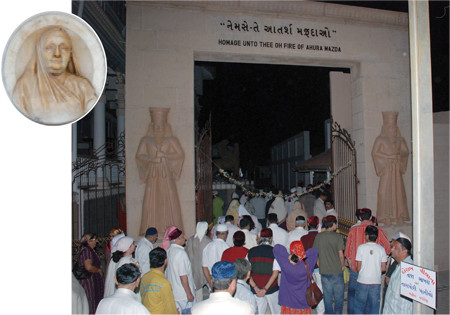
Worshippers at entrance to the Iranshah. Inset: marble bust of Motlibai Wadia
Photo: Sarosh Daruwalla
Dastoor noted that at one time navjotes and jashans were performed there but with the advancing age of the mobeds who found it difficulties climb up the flight of stairs, the ceremonies are performed in the main hall on the ground floor. Some lectures could be held on the first floor, he added. After the morning jashan, a ceremony was held in the upstairs hall to publicly honor all those who had contributed financially or otherwise for the renovation. The foundation’s chairperson Burjor Antia, a former Bombay Parsi Punchayet (BPP) trustee and senior partner in the noted law firm of Mulla and Mulla presented shawls to the contributors who included Arin and Percy Master, Homai Engineer, Zareer Bhathena Jer S. Joshi and N. J. Batliwala, the Trust’s secretary.
A ramp on the right side of the entrance to the main building will enable physically challenged people to have access to the fire temple. Bathrooms for pilgrims to bathe have also been constructed adjacent to the landing where kusti prayers are recited.
For two years the main structure that houses the holiest of holy Zoroastrian fires in India and probably the world, underwent extensive renovations. The last time the structure, originally erected in 1894 by philanthropist Motlibai Manockjee Wadia, was so repaired was in 1994. At that time a white commemorative marble bust of Motlibai was installed at the entrance of the fire temple. The fire is shifted once every three or four years to clear the soot from the umbrella shaped gumbaz (dome) above the fire, says Dastoor. Otherwise the blackened dust would fall on the fire. This work is carried out by Parsi volunteers and hence the purification ceremonies required are "not as elaborate,” notes Dastoor.
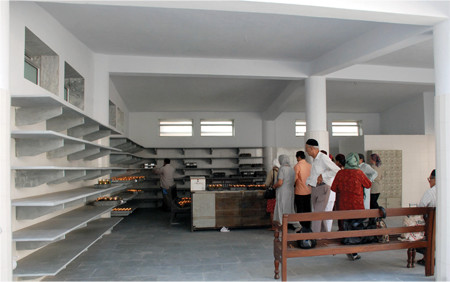
Foyer for reciting the kusti
The 100-year-old M. N. Wadia Trust "is very solid. The annual income is around two crore rupees,” explained Antia. Malcolm Baug in Bombay’s western suburb of Jogeshwari is run by the Trust and Antia proudly proclaims it is one of the most "well managed and well maintained” of the numerous Parsi/Irani colonies. Other assets of the Trust include the Jehangirji Wadia Dharamshala in Udvada, the Jamshed Zaiya-Wadia Dar-e-Meher (Palia Mohalla Agiary) and the Gopipura Dharamshala, both in Surat.
The Atash Behram has two high priests and 12 practicing mobeds, notes Talati. The other trustees are Jamshed K. Setna, formerly of Tatas, Savak S. Tarapore, formerly of the Reserve Bank of India and chartered accountant Khushru B. Panthaki.
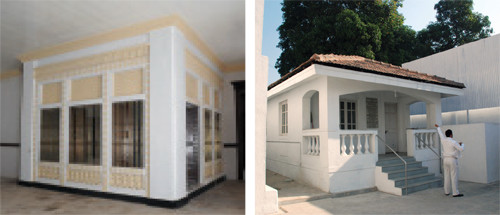
Left: The kebla during renovation Photo: Sarosh Daruwalla, Mazda Audio Video Lab Above: Newly constructed bathing rooms for worshippers
The fire origins
The date of the consecration of the Iranshah fire is unknown. Shapurji Kavasji Hodiwala’s History of the Holy Iranshah states, "There is not much doubt about the roj-mah of the consecration of Shri Iranshah. The crux of the problem is the year. There is no reference in either Kisseh-i-Sanjan or in any later writing as to when or after how many years, after they settled in Sanjan, our ancestors consecrated Shri Iranshah.”
But citing various sources including the Kisseh-i-Sanjan and Seth Rustomji Bambotwala’s manuscript, "The collection of Yashts and Nirangas” the "traditional year 721 AD cannot be disproved,” says Hodiwala.
The Foundation for the Development of Udvada (FDU) booklet published to commemorate the 265th year (October 2007) of the fire’s shift to Udvada says the fire was "consecrated on Indian soil soon after their arrival at Sanjan in the eighth century.” In the 13-14th century when Sultan Mahmad attacked Sanjan, the Parsis took the fire to the Bahrot Caves for 12 years (1393 to 1405 AC) and from there to Vansda, Navsari, Surat, Navsari, Valsad and finally Udvada (October 28, 1742).
An e-mail circulated by the Traditional Zarathushti Mailing List denounced the "so-called modernization which has taken place at our holiest Atash Behram, the Iranshah at Udvada. All these changes just decrease the pavitrata (holy atmosphere) of Iranshah.
"We must understand that Iranshah is not a museum that it need be glossed up to attract visitors and neither is Udvada a tourist center which needs to be ‘modernized’ so more tourists come there. If one needs to showcase a tourist spot, then Sanjan and Navsari are more appropriate places.
"Parsis go to Iranshah primarily for offering their sincere prayers to the most exalted of our holy fires, and as commensurate with a holy place, a bit of simplicity and spartan atmosphere is indeed necessary. The ‘holy bulls’ and the ‘angelic figures’ guarding the gates look gaudy and cheap.”
For those who criticize the ornamental artifacts, Dastoor says, "The good work should be appreciated,” not belittled. He bemoaned a tendency to indulge in "dirty politics… people reach Ahura Mazda through the Iranshah and the way to do so is to lead a life of good deeds.”
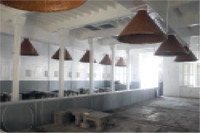
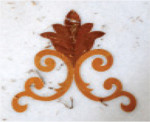
View of the paavi and below, detail of design on marble flooring
Photos: Sarosh Daruwalla
Udvada and the Iranshah
(Compiled from information sourced from the booklet by the Foundation for Development of Udvada commemorating 265 years of the Iranshah at Udvada on October 28, 2007)
In the last millennium Udvada was under the rule of Dharampur State. Around the16th century there was a treaty between the Portuguese and the Dharampur ruler whereby Udvada came under Portuguese control. An old well in Udvada, dating back to 1714, bears an inscription to prove that Udvada was governed by the Portuguese in the beginning of the 18 th century.
In the 18th century the Marathas defeated the King of Dharampur and Udvada came under the rule of the Peshwas. The Peshwas sent the defeated King of Dharampur, Maharana Durjansingh of Mandvi to fight the Portuguese. To reward the victorious Maharana, the Peshwas returned his kingdom along with Udvada.
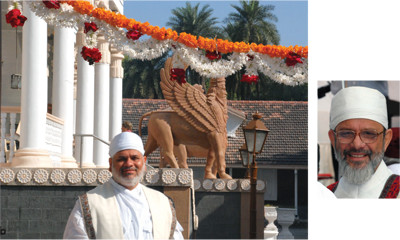
High Priests Khurshed Dastoor and Dr Peshotan K. Mirza (below)
Udvada housed the summer palace of the Mandvi King at Meriwadi. The grazing grounds for his camels, known as Untha Wad or Unt Vada, could have led to the place earning its name Udvada. The origin of the word Udvada could also have been a derivative of the Sanskrit word Ud- navaas meaning staying in sea water. Places like Valvada, Khervada may have derived their names because tidal waves accumulated around these areas.
Udvada had a Parsi population before 1697 most of whom were agriculturists, with surnames such as Kotkotias, Kadvas, Peshinas, Bachanas and Kumanas. In 1697 most of the families contributed towards the building of a dakhma, consecrated by Dastur Darab Hormuzdiyar. The government assisted by waiving the agricultural cess for two years. Previously the corpses were consigned to the dakhma at Valsad. In 1830, Seth Pestonji Khurshedji Mody of Khambat had a new dakhma consecrated at Udvada on the hilly land gifted by Hamir Singhji, the Maharana of Mandvi.
The Iranshah had remained in Navsari for about 320 years with the exception of three years when the fire was carried to Surat on account of infighting between the Sanjana priests and the Navsari priests arising over distribution of revenue generated from conducting services at the Iranshah. Due to the controversies and consequent complaints in the law courts, it was decided to move the holy fire to some place within the territorial jurisdiction of the Sanjana priests. In 1740, with the permission of the Government issued by Damaji Gaikwad, the holy fire was moved to Valsad and in 1742 to Udvada where it has continued to glow. In 1742 many Parsis too moved to Udvada.
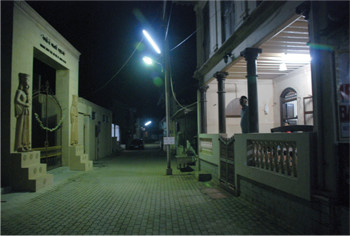
Early morning scene in lane outside the Iranshah
On Sunday October 28, 1742 the Sanjana Athornans came to Udvada with the holy Iranshah fire to the house of Mobed Mehernosh Hormuzd Bhathela who was the panthaky of the Udvada behdins. Thereafter the Iranshah was shifted into a small house at the northeastern corner of the settlement built by Minocher Bahman of Nargol. Around 1770 when this house was found to be small and inconvenient Seth Bhikaji Edulji of Surat started constructing a new building and in 1812 Jamshedji Nanabhai Guzder made several improvements and extensions to this building. In 1830, Dadabhai and Mancherji Pestonji Wadia had a new structure built as the earlier one had become very old. In 1894 Lady Motlibai Manockjee Wadia had the spacious building constructed wherein the Iranshah atash is presently glowing.
The nine families of the Sanjana Athornans — descendants of Dastur Nairyosang Dhaval — who accompanied the Iranshah took responsibility of performing ceremonies for the Iranshah by rotation every nine months. The families comprised of Andhyarujinas, Unwallas, Bhadhas, Katilas, Dasturs, Patels, Sidhwas, Mirzas and Bhaijinas. The community of these nine Athornan families is known as the Athornan Anjuman and the behdin residents of Udvada and Sodfalia are known as the Behdin Anjuman. Jointly they form the Samast Anjuman.
◆ ◆ ◆
From the archive