
Religion
Fighting the odds
Undeterred by WAPIZ jeers, the Foundation for the Development of Udvada and the Udvada Samast Anjuman celebrate Iranshah’s installation in the town 265 years ago
"By Zarathushtra’s farman, Iranshah’s blessings, we have overcome obstacles,” declared Udvada’s Vada Dastur Khurshed Dastoor Keikobad Dastoor. Alluding to obstructions created by an orthodox fringe group, Dastoor challenged, "Iranshah is ours. No priest, no Mistree can speak against us here. Ahura Mazda no hath chè (We have Ahura Mazda’s protection).”
Dastoor’s fighting words (in Gujarati, here in a free translation) from the dais at the function to celebrate the 265th anniversary according to the Gregorian calendar of Iranshah’s enthronement at Udvada on October 28, 1742 — a Sunday, like this one — were greeted by thunderous applause from the audience, reckoned by the organizers at nearly 3,500 Zoroastrians. They marked a strong public rebuttal of the insidious propaganda and mischievous disinformation carried out by the World Alliance of Parsi Irani Zarthoshtis (WAPIZ) to scuttle the event as part of its long drawn out battle against the Foundation for Development of Udvada (FDU).
Recalling the fabled trip through stormy waters that had led the Persian Zoroastrian forebears to Sanjan by "the grace of Ahura Mazda,” Dastoor maintained, "khara dil ni bundagi (heartfelt prayer) never goes unanswered.” Those migrants had made a promise to the divinity to build an atash behram if they found asylum and it was given to them by Jadav Rana. "We have kept our promises to Jadav Rana for 1,300 years and will continue to do so for another 1,300 years,” he vowed in Gujarati. He noted that the 16 fires from various sources which go into the making of an atash behram fire including one from lightning — said to be brought down by the special prayer of Dastur Neriosang Dhaval in the case of the Iranshah fire — signify the brotherhood of religions.
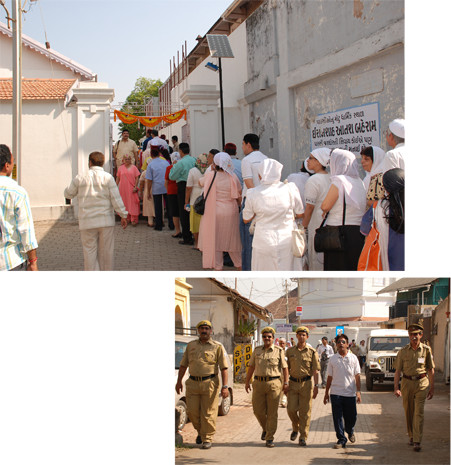
A meandering queue outside and inside the Atash Behram (above) and police patrol in the streets
"We wanted to inaugurate the Zoroastrian Information Centre (ZIC), distribute commemorative coins, but Parsis don’t break laws. We could not do so because of the electoral code of conduct and therefore we ask your forgiveness,” Dastoor told the gathered community, assuring the audience that "we’ll do both in time.”
Recalling the many benefactors who had built and rebuilt the edifices housing the Iranshah and Sir Dinshaw Petit who had donated the land on which the function was being held, Dastoor noted that the town’s population had once numbered in thousands. He attributed the decline to lack of educational and health facilities. Obliquely referring to the canard spread by WAPIZ that the place would be inundated with non-Parsis if the town is designated Pavitra Yatra Dhaam, he noted pointedly, "thousands of other community (members) live with us. There has been no conflict. Has the strength of the atash behrams in Bombay, Navsari or Surat declined because of non-Parsis in the neighborhood?
"They tried all sorts of things so that this function would not take place. They promised trouble...See if anyone has had the gumption to come here today. Why should we go to others when the community is with us? All the finance for today’s function has come from the community... Homai Engineer is an iron lady. We couldn’t have done this without her and three others,” Dastoor said, referring to support from some of the trustees of the Ahmedabad Parsi Punchayet. "We will not sell the community. We are not like others who keep a different faith for the rich and another for the poor…There are two types of people in the community: those who work and those who critic…We will not do anything to defy the code of conduct or shame Jadav Rana for giving us asylum…”
Switching between Gujarati and English, Bombay Parsi Punchayet (BPP) chairman and FDU managing committee member Minoo Shroff spoke about differences of opinion among Zoroastrian communities in various parts of the world. In Toronto, he said, some people tried to persuade him against meeting certain individuals. "It is an inevitable part of life. But you have demonstrated your indomitable Parsi spirit by gathering here today.” Noting that the Zoroastrian religion with its microscopic following is reckoned among the 11 important faiths of the world, he said that the president of the World Bank and the internationally respected magazine The Economist were perplexed that such a small community had thrown up so many individuals of such magnitude. He urged his listeners to restore their faith in the religion, especially among the young, and to desist from washing dirty community linen in the cosmopolitan press. "First there was the Afternoon (Despatch and Courier); now it is The Free Press Journal (FPJ); if the Free Press also closes down there’ll be others!” he alluded to WAPIZ’s antics, tongue in cheek.
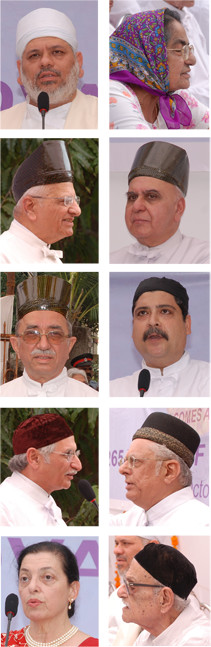
Clockwise from top left: Dastur Khurshed Dastoor, Mehroo Bengalee, Dinshaw Tamboly, Noshir Dadrawala, Rusi Bhesania, Noshirwan Daboo, Homai Modi, Jamshed Dotivala, Maneck Engineer, Minoo Shroff
Casting a communal eye over recent history, Shroff asked, "If JRD (Tata) had not supported Homi Bhabha would India have been a nuclear power today?... A TV anchor in Pakistan asked me regarding Zoroastrianism. I asked her, ‘Who were Jinnah’s wife, daughter, son-in-law?’ …Parsis are the focus of attention in small towns in India. Other communities come with offerings on their special occasions.” Referring to an earlier meeting with Queen Elizabeth II of UK, Shroff noted that she had mentioned her belief that "Parsis had done so remarkably well ‘because you are so confident, you never asked for reservation.’ The Jews can shake the US government because they are thriving with bankers, litterateurs and various professionals among them. They take pride in pushing the community forward, not in pulling it back,” said Shroff before concluding, in the words of former President of India Dr Abdul Kalam, "Our past has been great. It is up to us to make our future greater.”
Surveying the densely packed audience, Surat Parsi Punchayet trustee Jamshed Dotivala noted, "The numbers show that people still have faith in the religion and in Iranshah. There would have been more people if the function had been held as planned. But there are so many on this small ground. It shows warmth of heart!” He referred to their efforts in Surat to induce the young to marry and procreate. "We keep housing blocks for them in reserve. We want to ensure that the community lives in peace, in keeping with the tenets of manashni, gavashni, kunashni (good thoughts, good words, good deeds).”
Recalling the greats of Parsi history — both mythological and modern — author Rusi Bhesania, past president of Surat’s Pragati Mandal, referred to a community trait: "We will eat simple bread but we won’t bend our head.” His Gujarati speech also included testimony from Mahatma Gandhi who has extolled Rustomji Ghorkhodu of South Africa who had given him aid and asylum at the inception of the satyagrah movement there, Dadabhai Naoroji to whom he turned for advice and Pherozeshah Mehta who inducted him into the Indian National Congress. "Why are we denigrating our great history by fighting each other?” he asked.
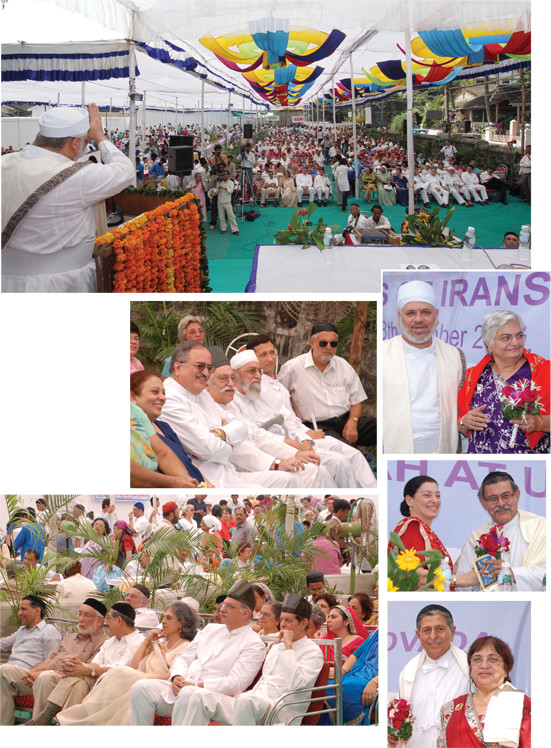
Clockwise from top: Tough talk under the shamiana; Dastoor and Homai Engineer; Homai Modi and Navroze Kanga; Mithoo and Jimi Jesia; (R to L) Homi Dhalla, Rustom and Delara Jejeebhoy; (L to R) Jasmin and Zarir Bhathena, Dadi Mistry, Ervad Eruchsha Dastur, Jimmy Mistry and Rustom Tirandaz
"Before me is Iranshah’s durbar — evidence that his power is undimmed,” began guest speaker Noshirwan Daboo of Ahmedabad, son of the late well beloved High Priest, Dastur Khurshed Daboo of the H. B. Wadia Atas Bahram of Bombay whom the function’s master of ceremonies Noshir Dadrawala described as "the high priest of the people.” "In Kem na Mazda Zarathushtra asks, ‘When things go wrong, who will save us? Faith, manashni, vohuman (good thoughts, good mind) — these Zara-thushti tenets will save us, together with the rays of the holy fire,’” continued the frail, ailing Daboo. "If we do not break promises or tell untruths, we maintain an important tenet of the faith…Our community is small, like a cardamom, and like it, will maintain its flavor.”
The day’s guest of honor was Dr Mehroo Bengalee, a former trustee of the BPP and former vice chancellor of Bombay University who is currently the Zoroastrian member of the National Commission for Minorities (NCM). Since she is also a founder member and trustee of WAPIZ, her support of the FDU and her presence at the function were particularly gratifying to the organizers. Noting that she had been assigned the states of Maharashtra, Gujarat and Goa and the union territories of Diu, Daman and Nagar Haveli as member of the NCM, she stated that she had noticed that Parsis have not been seizing the opportunities ushered in for the minority groups. She was particularly appalled at the number of Parsi births in Bombay being in the region of 180 a year and the lethargy of the community in not providing the data that she has been trying to collect. "Parsis need to be stirred. It is the responsibility of parents to see that children are well settled early in life and have issue.”
She touched on infrastructure facilities for Udvada like the purifying of saline wells and the construction of a sea wall to prevent further ingress of the waves. According to her NCM would pay for the reform and establishment of madressas where Avesta-Pahlavi and Persian need to be studied. She referred to a recent event hosted by the NCM where Shroff had spoken about the problem of admission to professional colleges, Dinshaw Tamboly on the problems faced in Udvada and Burjor Antia on defunct anjuman properties. Both Tamboly and Antia, trustees of the BPP, are also managing trustee and committee member of the FDU, respectively. Bengalee stated that 18 of the 72 defunct anjumans may be able to get compensation if not the return of their encroached properties at the market rate with the help of the NCM. Thanks to a special priority sector lending schedule at the Zoroastrian Co-operative Bank, Bengalee said she was hoping to float two or three enterprises in rural areas with the help of Tamboly and others.
Unhappy at the way community flats were distributed with hardly any supervision, Bengalee noted, "People then spend crores of rupees on renovation… We have all the resources, abilities, genes — make sure we do not mix (them). Make sure the community prospers and let there be peace within the community… December 18, 2007 has been designated Minorities Day in Delhi. We have been asked to give the nomination of anyone who has done special work in the community, something to be proud of. I want those nominations from you.”
Responding to Bengalee’s many statements, Dadrawala noted, "I am very happy that the NCM is taking interest in Udvada. Also, as you said, peace should prevail. May I suggest that you use your position as founder of a particular organization to get them to sit down and talk things over? Please bring that about.”
The event
The festivities had commenced with a thanksgiving jashan at 9.45 a.m. on October 28, 2007 at the Iranshah led by Dastoor. While the few who could be seated in the Motlibai Wadia Dare Mehr (the main atash behram building being closed for renovation) enjoyed the jashan ceremony, the congregation filed past in a serpentine but orderly queue, after divesting their shoes and cell phones at the entrance. Once the jashan was over, the venue changed to the Petit grounds. A humbandagi in which the gathering participated and several monajats, rendered delightfully by 16 girls of the Bai A. F. Petit Girls’ School led by their matron Yasmin Charna under the baton of Murzban Mehta, ensured a serene atmosphere.
"Usually older people pass on the legacy to young children. Today young children have shown us what the Zarathushti legacy is,” commented Dadra-wala. After retracing the long journey of the holy fire due to political upheavals after its initial 669 years in Sanjan — through a 12-year sojourn in the Bahrot Caves, 14 years in the Vansda forest, 313 years in Navsari, three years in Surat, five years again in Navsari, one year in Valsad and the remaining 265 in Udvada — Dadrawala quoted the five virtues that every Zoroastrian is required to cultivate according to the Pahlavi Dinkard, providing bilingual (English-Gujarati) analogies as he went along: "Truth as opposed to falsehood and the intellectual dishonesty displayed by the detractors of this event; charity as demonstrated by scores of generous Parsis who exclusively funded and supported the event; skill as evinced by the girls of the Bai Avabai Petit School; endeavor as shown by the organizers of the event despite all efforts to block it; and finally, giving encouragement to others in performing good deeds and not exhibit the crab mentality as observed in recent times. The Zarathushti religion is one of peace and brotherhood. It is unacceptable to fight even with Iranshah! Tell me, is it ‘good news’ to say the function to honor Iranshah is cancelled?...Our religion does not enforce a single day of fast. Our fast is only against paap, sin.” Dissociating himself from the "Taliban of Zoroastrianism,” Dadrawala asked, "What is irreligious about this function? Yet every attempt was made to thwart it. It is not important if you are orthodox or liberal but if you have stood for the right thing. I salute all of you who are here in support.”
After a formal vote of thanks by FDU committee member Homai Modi, the formal part of the event was over. The community had already had several sittings of lunch, amazingly catered by Maneck Todiwalla of Hotel Mek, by then, but there was no place at the table for the VIPs who were in a hurry to leave. Thinking fast on their feet, the organizers whisked them off to the dining hall of Globe Hotel followed by the lunch!
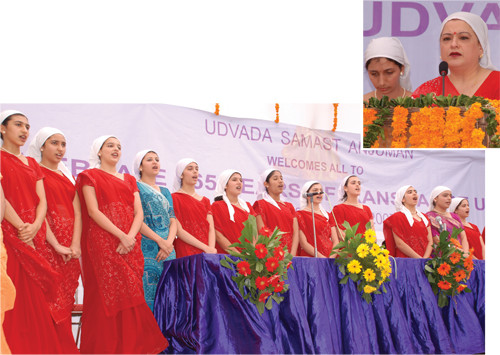
Monajats by the girls of the A. F. Petit School (above). With matron Yasmin Charna (right) and conductor Murzban Mehta (top)
The prelude
According to a press release dated October 2, ZIC, the brainchild of the FDU, an organization set up in collaboration with the Government of Gujarat (GOG), was to be inaugurated and the Iranshah anniversary celebrated on October 28, 2007. The function was to be hosted jointly by the Udvada Samast Anjuman and the FDU. However the proclamation on October 10 of general elections in the state of Gujarat on December 11, 2007 meant that the state was confined by the election code of conduct for two months starting from that day. That further translated into an embargo on any public celebration — or inauguration of a project — in which the government was involved.
Since the ZIC had been funded by the GOG as well as the Government of India, this translated into a prohibition of the use of government land or participation by any member of the government or administration in the function. In response to invitations sent out by the FDU earlier, a letter dated October 16 from the zilla (district) electoral officer had notified the FDU that it would not be allowed to make any formal speeches or throw the ZIC open to the community at large. It was suggested however that it may make a soft opening with the lighting of a lamp. And on that basis the FDU proceeded.
On October 26 a full page WAPIZ advertisement in the FPJ crowed, "Holy Iranshah’s chamatkar — Divine intervention in Udvada 2nd time around! Inauguration of FDU’s ‘Zoroastrian Information Centre’ at Udvada cancelled for the 2nd time in one year.” The second part of the WAPIZ advertisement referred to a similar mishap when the opening of the ZIC by the chief minister of Gujarat had to be abandoned earlier due to local elections in the district. The WAPIZ advertisement produced a lot of confusion among community members who planned to join the festivities.
But WAPIZ’s mischief did not end with the FPJ advertisement. Barely three days in the chair and unversed in Parsi community affairs, the FDU failed to muster significant support from the new incumbent of the collector’s chair in Valsad. When Homai Modi arrived in Udvada on October 26 to start setting up the ZIC for the opening, she was prevented from doing so. The following morning, Dastoor was summoned to Valsad, ostensibly by the collector but in reality by an underling, who disputed the right to hold any function and asked him to provide a long winded undertaking not to pursue many of the FDU commitments. Indeed, this junior official insisted that the FDU dissociate totally even from the celebration of the Iranshah anniversary, even though the permission to hold the function from the chief election officer in Ahmedabad (stating in Gujarati that there was no objection to the Iranshah’s anniversary celebrations as it was a religious function that did not impinge on the elections) had been addressed to the FDU managing trustee.
Sensing trouble, community volunteers from a number of organizations including the Parsi Ambulance Division in Bombay arrived in Udvada by nightfall while builder Jimmy Mistry brought reinforcements from his Parsi Resource Group. Promising all support, the police turned out in strength to ensure a peaceful event.
Worried about the wellbeing of the Centre and its lovingly created exhibits and artifacts should there be any violence, Modi and architect Jamshid Bhiwandiwala had them all packed away in a hopefully safer upper storey.
Though the general opinion among FDU stalwarts, some BPP trustees, social workers and activisits converged on WAPIZ as responsible for all the mischief, the early trend was to play it with an abundance of caution so as not to embarrass the GOG which has already done much for Udvada. Hence the FDU name was deleted from the banners and cut away from the badges the volunteers were to wear at the event even though the function had been jointly sponsored by the Foundation and the Udvada Samast Anjuman. Souvenirs for distribution were held back as they included information on the ZIC and the FDU and the sale of silver medallions, which commemorated the event, was postponed. Even the congratulatory messages from government and community dignitaries, to be read from the podium, were edited to delete all reference to the FDU and the Centre. In fact High Priest of Udvada (Dr) Peshotan Mirza who was abroad at the time of the celebration, had stated in his message, "It is a matter of concern that some of the present day Parsis are undermining their religious teachings, customs and traditions, so zealously guarded by our forefathers. We sincerely hope and pray that the Zorastrian Information Centre will help Parsis to restore their Zarathosti faith and fervor.” Dadrawala was requested similarly to rein in all such references and Dastoor cautioned not to fall victim to heckling from the audience!
(WAPIZ founder trustee Khojeste Mistree shrugged off these allegations about WAPIZ trying to scuttle the function. Asked for his comments on the phone, he noted, "It’s a false allegation. All sorts of unfounded rumors were made against us including that WAPIZ wanted to send goondas to stop the function. We don’t stoop to that level of activity. Our position is very clear. We said what we wanted in the WAPIZ Page and that’s what we stick by. Many questions remain unanswered.”)
With the arrival of Homai Engineer of Industrial Boilers and her son Rohinton in the late evening, the mood began to change. Radiating positive energy the "iron lady,” as Dastoor described her to the congregation the following morning, a copy of the chief election officer’s permission in hand, smilingly encouraged the gathering to show a bold front. Her words were backed with substantial clout in the Gujarat government and administration.
Simultaneously with the above, local workers struggled to trim the undergrowth on the land (opposite Hotel Mek) donated by Sir Dinshaw Petit to the Udvada Anjuman and to cover it with makeshift carpets to make it walkable. Even so, volunteers the next day physically aided the elderly to ensure safety. The feverish activity at the new venue of the function became necessary as the original arrangements had all been on the government land beyond the ZIC. The beautiful shamiana, ablaze with color, was ready for the arrival of votaries in 33 buses from Bombay, seven from Navsari, three from Surat, two from Poona and one from Ahmedabad which converged on the little town the following morning.
A worrisome and tense situation had been successfully countered and laid to rest.
◆ ◆ ◆
From the archive