
Professions
“The warrior is a child”
A three week stint with a non-government organization in Afghanistan depicts the uncertainty of life in the strife torn nation
"You take that to Kabul?” asked the passport control officer at the Delhi International Airport looking at my camera bag. I nodded. "You should take gun,” he said, and smiled winningly.
The flight was packed with proud, beefy, true blooded Pashtuns, and a handful of foreigners. It was a rickety old aircraft that carried us up and over Pakistan and into Afghanistan. An hour and a half later we descended on the rugged, windswept mountains of Afghanistan which folded dramatically into rocky valleys and craggy passes. I saw thick black smoke rising from an unidentifiable object in the distance.
Kabul International Airport was much tidier than I expected. A dozen or more American helicopters stood in their place, poised for flight like perched insects. The walls bore large posters of Hamid Karzai and Ahmed Shah Masood, the charismatic Tajik military genius, who was killed by suicide bombers posing as cameramen two days before the 9/11 attacks. Karzai’s poster welcomed us to Afghanistan. Beside him, Masood was pictured with crossed arms and a furrowed brow. His inscription called for national unity.
Seven years now after the fall of the Taliban, at a time when the country is more prosperous, open and secure than it has ever been in the lives of most young Afghans, it’s still a stunningly backward, difficult and dangerous place. I say this even though, in over a month there, I scarcely heard a shot fired in anger. Good luck almost seemed to follow me in Afghanistan.
The terminal was bustling with security men, both Afghan and foreign. The scene outside the airport was intriguing. Teams of muscular Land Cruisers with tinted windows and no plates, rolled by, alongside UN Land Rovers and Red Cross vans. There were plenty of guns around, and I was quickly ushered away from the doors of the airport to behind a barbed wire barricade. A car came, and ferried me through the busy streets to the fortified compound of my NGO (non-governmental organization) headquarters. I had green tea with the Hazara cook and met my colleagues, a friendly group who banter together in Dari and broken English and then shake uncontrollably with laughter. We dined on Kabuli pulao and mutton curry for dinner, before reclining on cushions on the floor to watch the latest installment of an Indian soap opera.
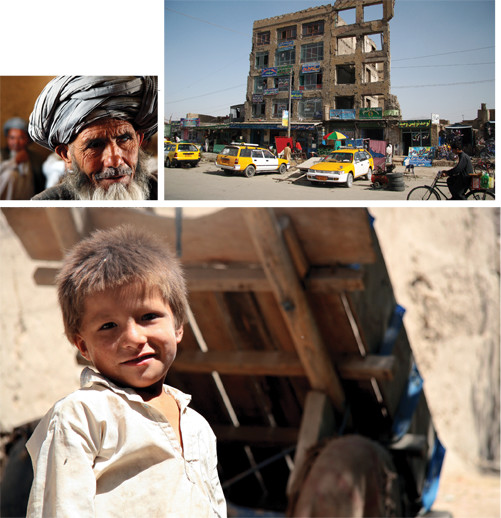
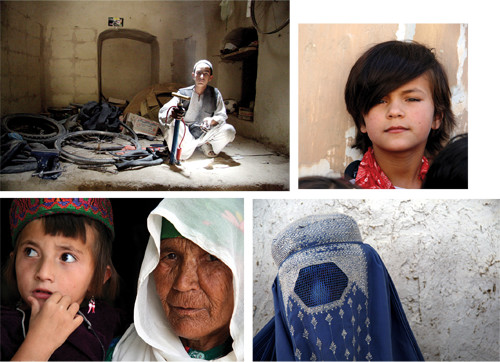
The faces and facets of Afghanistan
Next morning we woke up to the news of a jail break down south in Kandahar where over 1,000 Taliban prisoners flew the coop. At our headquarters in Kabul, my colleagues were busy scheduling my itinerary. It was decided I would travel eight hours north by road convoy to Mazar-e-Sharif where I would be based for the next three weeks of my stay. From Mazar, I’d leave and visit various isolated villages spread all over the landscape. Spending nights at certain border villages where Uzbekistan seemed much closer than the drive back to Mazar was an unwelcome proposition.
Convoys on the road to Mazar-e-Sharif were ambushed the day before and the day after mine, but my eight-hour ride was uneventful. After navigating through the Hindu Kush mountain range, the very route the Russians took on their way to Kabul, I found myself in dangerous territory. My security guards reminded me to stay alert for an ambush as it was on this stretch of road where a convoy had fallen prey to insurgents just 24 hours ago. They pointed to high mountain tops and showed me old Taliban strongholds from where rockets and grenades were launched at passing convoys.
It took us an hour to clear that stretch of the road and then I found myself staring at blown up villages on either side. These were all reportedly bombed during the Taliban regime and a few even after American occupation. To teach those villagers who’d side with the Americans, the Taliban would attack their dwellings at night and raze them to the ground. Once all the villagers had fled, the Taliban would strategically place land mines around that area. The unsuspecting villagers would come back to start a new life in their territory, completely unaware of the danger lurking beneath their very feet! Following a couple of explosions killing friends and family, they never returned.
Mazar-e-Sharif finally welcomed me with 450+ temperatures. There were frequent power cuts and I was trapped in my little room not being able to venture anywhere on my own.
My accommodation in the villages was usually four mud walls, a bamboo and mud roof with one blue window. A very thin mattress accompanied by a very thick and lumpy pillow. Ablutions usually took place in a small mud-brick toilet in a shameful corner of the compound, a hole in the ground which wasn’t nearly deep enough, a scrap of cloth for a door and the wind whistling through. No running water, needless to add.
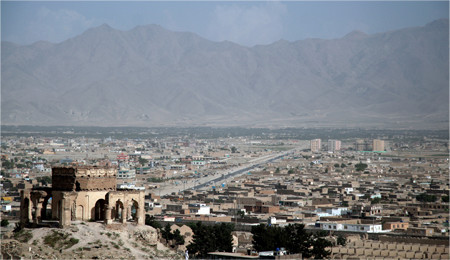
Despite the insurgency, life continues in the cities
Pitching up at some distant village in a cloud of dust we would wait for a crowd to gather around or send some young boy scampering off in search of the person we needed to meet first. Usually it was a village elder. After a lengthy greeting, we would walk off to the project site or settle down under the shade of a tree, in someone’s house or in the village mosque.
If at all humanly possible, tea was brought in and we would slowly get round to discussing what it was we had come there about. While that conversation rapidly built up speed, I would quickly get a few shots in.
Sometimes we would spend the best part of the day in one place, slowly resolving various issues and being treated to immense hospitality that I feared would leave a family without anything to eat for themselves for the next few days.
Other days were spent mostly on the road, furiously pounding along dusty tracks and stopping off at a number of different places to briefly curse the weather and the harvest. By the day’s end I feared that my insides were covered with sand and my spinal cord reduced to dust.
Dawlatabad was an all-consuming experience for me. My NGO being involved in the Child Sponsorship Programme, we distributed reading and writing material along with food packets to the 200 odd village kids who had nothing! All it took was a simple notebook and a few crayons to add color to their mundane lives and put a smile back on their faces. Suddenly I felt the materialistic aspect of this project evaporate in the hot sun and all that mattered was seeing the joy and immense sense of satisfaction on their scruffy little faces.
Children as young as 12 were forced to fight in the war and had been badly affected; not being able to attend school, experiencing post-war trauma, without skills to earn an income, lacking in self confidence and, more importantly, missing out on being children. Concerned that these young men would turn to a life of crime and engage in antisocial behavior if they were not reintegrated into society, the NGO had been working with over 500 such children, providing them with the opportunity to attend literacy classes and vocational training like tailoring, mechanics, carpentry and livestock training. This would aid rebuild peace in Afghanistan.
A campaign, "The Warrior is a Child” dealt with the child soldiers of Afghanistan. At the tender age of 16, Ghousuddin’s own parents encouraged him to serve the fighters. He was given a Kalashnikov gun allegedly "to protect his village from enemies whom he could not identify himself.” He was found and taken under the wings of our NGO and is now trying to live a normal, civilian life, because despite the armor of hostility and death, the warrior inside is just a loving, hoping and caring child. Many children in the Balkh and Jawazjan Province were child soldiers.
Those three weeks up north had been the most humbling experience of my life. From the people I’ve met to the things I had seen. From their resilience to their brittleness. I had been touched in many ways and was pretty sad to be leaving so soon back for Kabul.
I was touched by every village I had visited. I had shared their pain and laughter, shared food from the same plates and spent nights sheltered by their hospitality. Not as easy as I had imagined — moving from one village to another — trying to be as professional as I could. Though you feel their pain while interacting with them, that feeling multiplies massively once you leave. Especially sitting at home nonchalantly; your mind can’t help travel back to a particular village or person and play back in real time what he’d be doing that moment while I was unwinding in front of a television with a coke.
On my return to Kabul I sent one of my guards to the nearest supermarket to get loads of chocolates and aerated beverages I had been denied up north.
While brushing my teeth the next morning, I almost bit my tongue off after I heard a massive explosion. I’m a virgin when it comes to the sound of bombs. But then calls started coming in. Networks were getting jammed. So, topless, with a towel around my waist and a toothbrush in my mouth, I found out that a suicide bomber had started his day with a bang!
The streets were quieter than usual in the Afghan capital of Kabul after it was rocked by the suicide bombing on the Indian Embassy. At the scene of the explosion a vegetable cart lay in cinders. The wall of the building behind it was pockmarked with shrapnel. Kids had gathered to stare at the damage. However, to most residents of this city desensitized by 25 years of continuous war, life went on as normal. A mere 100 meters from the Indian Embassy, people could be found haggling for spices and selling watermelons.
At the scene, the cleanup was fast and thorough. Yet, the attack had broken the relative calm that Kabul had enjoyed as the Taliban’s insurgency gained momentum in the south of the country.
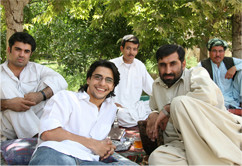
Dastur (center) with friends
Dare not walk
It is not widely encouraged for a foreigner to walk through Kabul alone. Make it a daytime habit and you risk becoming a target of the insurgency. Go at night, and you take your life in your hands.
As a result, most foreigners zip through the capital in company cars, with Afghan drivers. Some even consider the local taxis suspect. At night, a car speeding through the city with foreigners in it need only stop for a second at the roundabout checkpoints, where armed policemen nervously keep guard. The driver rolls down his window long enough to say khareji, the Dari word for "foreigner,” and then speeds off again. The image of the policemen gripping their guns in the deserted dark streets is, strangely, one of acute loneliness.
But come sunrise, the roads of Kabul are alive and well, bursting with mango and watermelon carts, gear-grinding buses, UN Land Rovers, and tan, tinted-window Afghan National Army pickups. The air is thick with the smell of diesel, grilling kebabs and raw sewage. Skinny cats scamper through the alleyways. Hole-in-the-wall bakeries churn out hot, meter-long naans that are carried away by the dozen. Girls as well as boys march to school in smart uniforms in the mornings. Metal shops bang away, turning scrap metal into wheelbarrows and chairs.
Tucked away in a little corner of the Shahr e Nau district of the capital is a thriving gathering place for expats. The French-owned L’Atmosphere has no sign announcing its existence, only a dozen odd SUVs (sport utility vehicle) parked out front, and two Kalashnikov-wielding guards at the gate. On a Thursday night, the start of the Islamic weekend, a couple hundred foreigners gather here amongst the candle-lit garden tables to swim in the pool, smoke, and knock back imported booze. Meals go for around US $ 10 a plate — roughly half a month’s earnings for the average Afghan, according to International Monetary Fund statistics.
It is an unlikely mix of people. Aid workers, businessmen, soldiers and journalists mingle and drink to unwind from the stress of living in a war zone. Each one has a story of why he/she is here. For some it is simply the money. Private sector consultation is a huge industry in Afghanistan at the moment, and there seems to be no shortage of salary benefits. For others, it is a love affair with the country that they find difficult to describe, an urge to see it emerge into a successful, safe nation. There is the expected mix of cynicism and idealism, often sadly proportional to the time spent here.
Everyday was a learning experience. I still find myself compelled to act quickly, to somehow enable social change and the building of peace. Yet I understand so very little. My sheltered and privileged childhood in India continues to structure my understandings of time, progress and the formulas for creating a strong and vibrant community. In the month of my experience here, I was so consumed by my desire to build possibilities for change that I found myself constantly stumbling. I concentrated so intently on the road far ahead, on that desired destination of peace, that I wasn’t paying enough attention to the insights and relationships right next to me, to the obstacles that existed before me.
I had not internalized that I was leaving Afghanistan and that I didn’t know when I would be back. My flight whisked me from Kabul International, climbing steeply as a precaution against the many CIA (Central Intelligence Agency)-supplied Stinger missiles that remain unaccounted for in the country, and took me not so far away to India. For some odd reason, it feels like I’ll be back soon. My plans for the future are all up in the air at the moment, but I believe this will be an intermission rather than an end.
With the future status of this country on the brink, this is a time when change is tangible, when past histories and future uncertainties weigh so heavily on the day-to-day realities of the present.
Change can be hard. The harder you hold on, the more you want to let go. I can’t say that I’ve changed things out here. But what I can say is that I was part of the change which some people have been committed to years before I got there and will continue years after I’ve left.
Cyrus Dastoor believes travel broadens one’s view of the world, helping us understand that all lives are interconnected yet individual. Through photography he seeks to share with others the beauty and diversity of the world.
◆ ◆ ◆
From the archive