
Cover Story
The photographer priest
Delhi head priest Ervad Cawas Bagli’s passion is wildlife photography
In wildlife photography your luck and your patience” determine how successful you are, says Ervad Cawas Bagli, the head priest of Delhi’s Kaikhushru Pallonji Katrak Dar-E-Meher and an avid wildlife photographer. "I learned with experience. No one taught me,” says the 45-year-old clergyman from the Navsari Bhagalia clan.
A film camera enthusiast, Bagli switched to digital cameras a year back when for completing 25 years with the Delhi Parsi Anjuman, the trustees presented him with a Canon 550D camera. "Digital cameras are easy to use,” he explains, "but film cameras still have warmth in them.” In addition to his camera, Bagli has three main zoom lenses, an 18-200 mm, a 70-300 mm and a 170-500 mm which enable him to get close-up shots from a distance. He has his own website www.forttiger.com. The website has still to create a market for his photographs but inquiries have been made whether the amateur teaches photography. Bagli replies in the negative. "I’m not a good orator,” he says, an indirect reference to his slight stutter.
Bagli’s photographs of animals adorn the dining room and the 40 residential rooms of the Delhi Parsi Rest House formerly known as the Mengusi Dharamshala. "This is the first time I have put them up,” he states modestly.
"I started wildlife photography at the Bandhavgarh National Park known for its fort and tigers,” he explains when asked how he chose the name for his website. Bagli has photographed in 12 game reserves since he started wildlife photography in earnest in 2004. To photograph tigers Bandhavgarh is the best, he opines. "I mostly shoot the big cats. But I can’t be a choosy guy, I shoot whatever I can.”
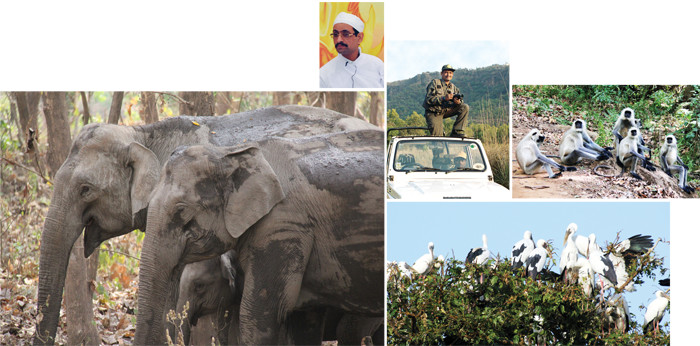
Ervad Cawas Bagli in priestly garb and on safari; elephants at Rajaji National Park, Hanuman Langurs at Bandhavgarh National Park and white neck stocks at Kanha National Park
He has been "charged by a large rhino and elephants.” He was in a jeep at both times with a guide and managed to escape. Sometimes he is able to get as near as 10 feet to his subject. "How close I can go depends on the mood of the animal. Certain shots are taken of wildlife right next to my jeep… In every game reserve I have a team comprising a jeep driver, a guide and a spotter. The finances are my own. If at the end of the day I get two good shots, my day is made.” He recalls sitting in a machan, a tent like makeshift structure that blends in with the surroundings, for a whole day without "shooting a frame.”
When selecting a place to set up a machan he recommends a spot near a water hole where one gets "a wide angle view… We leave the room by 5 or 5.15 in the morning. By 5.45 or so we are in the jungle. The movement of the large four (which he names as lion, tiger, leopard and snow leopard) is till 7 a.m. Once the sun is up” it is difficult to spot them. In the evening from 4.45 to sunset one can photograph. "Summer days are longer” so there is more opportunity to photograph, he observes. Bagli uses a tripod, a bean bag or his hands to hold the camera and utilizes both the auto and manual options. He also has a light meter to help determine the correct shutter speed and exposure.
He plans to visit the Gir Forest in Gujarat this April. "February to June is the season for wildlife photography.” But his ability to make trips "completely depends on if I have a (substitute priest). This is a 24-hour job. Not having another priest I have to perform all the five gahs myself.” Advertisements for a full-time mobed to assist him have elicited "no response.” The priesthood, he says ruefully, is not an attractive profession. "All that glitters is not gold… if my father were alive he would not have made me a priest.” His father Darayus, who along with Dastur (Dr) Firoze Kotwal and others consecrated the dadgah in 1961, was the head priest at Delhi for 18 years. He died in 1979 and on his first death anniversary Cawas became a navar. He joined as head priest in 1984. "I wanted to become a priest,” says the mobed.
To attract new entrants to the priesthood they must be paid a monthly salary of "nothing less than Rs 30,000 a month — the basic pay,” he claims. The perquisites would have to be extra. In 2007 Cawas was diagnosed with Hodgkin’s disease, a cancer of the lymph nodes. His oncologist advised him against praying before the atash as "working with fire makes it worst.” But Bagli says he considers the ailment akin to a "cough and cold” and soldiers on.
While studying at the Dadar Athornan Institute (formerly known as the Dadar Madressa) for a year in 1983, Cawas befriended freelance photographer Noshir Desai "who used to come regularly” to the Madressa. "I developed a liking for photography from him.” Rakesh and Naresh Bedi of Delhi, photographers who now make documentary films, also encouraged Bagli’s passion. Cawas’ mother, Dhun, who manages the dharamshala assisted by his wife, Benaifer, who hails from Ratlam, "both encourage me” in my hobby, he says. "Benaifer also comes with me sometimes, otherwise I travel alone… I wanted to do something with wildlife (since childhood). No one told me to do it. It was in me.”
His limited resources and equipment do not deter Bagli from thinking big. Having taken a course in fashion photography in Poona, he plans to some day set up his own studio "and do portfolios.” Also on the anvil is a trip to Tanzania and Kenya to shoot wildlife. "My ultimate aim,” he says with a smile, "is to photograph a snow leopard in its natural habitat.”
◆ ◆ ◆
From the archive