
In Memoriam
Nobility in the Nilgiris
Died: Dr Homi Edulji Eduljee, 93, president of the Parsi Irani Zoroastrian Anjuman of the Nilgiris and an outstanding chemical engineer, in Ooty on October 12, 2008.
"A man of great strength of character and discipline,” Eduljee was commended for being "extraordinarily modest with an uncritical and non-judgmental attitude… a basically reserved, quiet person imparting from his fund of knowledge only when specifically asked,” as noted a family friend Sheeroy Sunawala. "He had much to be proud of his stature and his achievements.”
Instrumental in starting the first penicillin factory in India at Pimpri in the early 1950s, Eduljee’s knowhow was subsequently harnessed in the setting up of the National Peroxide factory in Bombay. During his years of association with the Wadia Group he was involved with two other chemical factories, Sturdia and Citurgia. After he retired from Neville House in 1970 he was absorbed by Dai-Ichi Karkaria Limited, part of the Neter-wala Group. His association with this firm continued for 16 years.
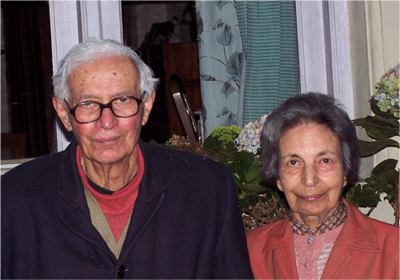
Dr Homi and Minnie Eduljee: nearly six decades of togetherness
While in Bombay he spent many fruitful hours at the K. R. Cama Oriental Institute (KRCOI), serving as its joint honorary secretary from 1975-81 and subsequently as its trustee for the next six years. Homai Modi who succeeded him as joint honorary secretary gratefully acknowledged the "help and guidance I got from Homi and Dasturji (Dr) Kaikhusroo JamaspAsa, both of whom were very regular at the Institute. When I joined the Cama Institute I was a total novice…” Since the joint honorary secretary is also required to edit the Cama Journal, Modi recalled how she had to fall back on Eduljee for his expertise. "Very soft-spoken, very easy to get on with, he was an exceptionally beautiful person to work with,” summed up Modi. Committed to his research work, he contributed many papers to the Cama Journal on topics like the date of Zoroaster, the legend of Kersasp, the legend of Faridun, Parsis and Portuguese in the 17th century, Rustom Maneck… One of his books in particular, Kisseh-i Sanjan generated a lot of public interest when it was first published in 1991 and was subsequently reprinted in 1996.
Even after he settled down in Ooty, whenever work brought him to Bombay, "one stop he had to make was at the Cama,” looking up the library, reminiscing of years spent there. Describing him as a "total lover of books,” Modi referred to the largesse of his wife Minnie who offered the KRCOI some of the tomes from his collection.
Whilst in Ooty he served as president of the Nilgiri Library for three years and also as president of the Parsi Irani Zoroastrian Anjuman of the Nilgiris. When steering the affairs of this liberal Anjuman he had declined to support the World Alliance of Parsi Irani Zarthoshtis (WAPIZ) in its efforts to alienate the Federation of Parsi Zoroastrian Anjumans of India. He had been at the helm of the Nilgiris Anjuman which is one of the few to permit non-Parsis to sit in the bungli/sagdi when the family prayers are recited and to pay their last respects to the deceased. At religious ceremonies, lay individuals recite the prayers in the absence of a qualified mobed. Despite the dwindling numbers, the nonagenarian felt the community would continue its existence in the mountains as people return to their ancestral homes after retirement as the Eduljees had chosen to do.
Born in Rangoon to Edulji and Meherbai (née Colombowalla) he excelled in school and college winning a gold medal in his BSc (Hons). Thereafter he proceeded to the Imperial College London for his PhD in chemical engineering. During World War II he remained in Britain, working for ICI Company. At the end of the War he returned to India and joined A. P. V. Comp Heaol office in Calcutta. In 1949 he married Minnie in Ooty, his father-in-law Dinshaw Hazary being the managing trustee of the Parsee Anjuman of the Nilgiris, as the Anjuman was then known. The next year saw the birth of their twin children Jer and Gev. Referring to their 59 years of togetherness, Minnie acknowledged, "Homi’s absence has left a deep void. But we are comforted by the thought that he was blessed with a long, fulfilled life, suffered no major illness and slipped away very peacefully, mentally alert to the end…”
Besides his own field of science his range of interests encompassed disciplines as diverse as archeology, ancient mythology and western classical music, as commented Sunawala. Even at the age of 93 years he would always be impeccably dressed at all times, reading widely and alert to world affairs and developments.
The modest role model is survived by his wife Minnie and son Gev.
◆ ◆ ◆
From the archive