
Cover Story
To the land of high passes
A 21-day road trip to Ladakh helped a team of environmental scientists study the region and become acquainted with its problems
"Driving one’s own vehicle enables access to remote areas that may not have proper road or rail links,” maintains Bombay based ecologist Dr Rashneh Noshir Pardiwala who has covered large tracts of the country on her many field trips. So, when she was invited to attend the 14th International Association of Ladakh Studies (IALS) colloquium in Leh from July 16-19, she naturally opted to do the trip by road. During the past four years the petite ecologist has driven across 21 states of India covering over 75,000 kms, though she says she has yet to visit the far eastern states of Assam, Meghalaya, Mizoram, Nagaland, Sikkim, Manipur and the island states of Lakshadweep and Andaman-Nicobar.
Accompanied by her team comprising environmentalist Janjri Jasani, environmental anthropologist Sunetro Ghosal and wildlife enthusiast Rajesh Bhat, the party headed for Leh was joined by two professional wildlife photographers, Kedar Bhide and Meethil Momaya, in their own vehicle on certain sections, Pardiwala informed Parsiana in an e-mail. She drove her Tata Safari SUV (sports utility vehicle) 6,714 km over a period of 21 days, without a backup driver, to Leh-Ladakh in the beautiful state of Jammu and Kashmir leaving on July 5 and returning on July 26, 2009.
The trip, she admits, was "both physically and mentally demanding because of the harsh terrain and limited resources such as food, water and shelter.” The journey from Bombay to Leh was via Manali (Bombay-Udaipur-Delhi-Manali-Pang-Leh) and the return trip was via Srinagar (Leh-Kargil-Srinagar-Jammu-Ludhiana-Delhi-Udaipur-Bombay), which is the longest Pardiwala says she has ever driven single-handedly. There were days when she was at the wheel 18 hours at a stretch to reach their destination, "but I’m not complaining, as driving is my passion!”
The environmental scientists had gone to the Himalayan state for a convention covering a wide range of topics, from ecology and wildlife to culture and traditional practices. Though networking at the conference was invaluable, Pardiwala acknowledges that she gained "maximum knowledge” not in an air-conditioned five star hotel conference room but out in the wilderness of Ladakh and amongst locals.
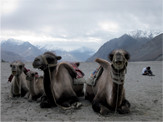
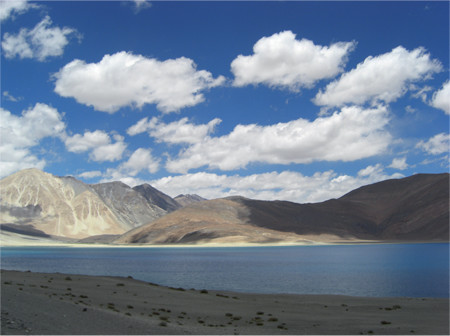
Serene Himalayan landscape (top); Bactrian camels (above)
Elaborating on her experiences on a subsequent visit to Parsiana, the soft spoken scientist admitted this extensive tour of Ladakh had many positive outcomes. She and her team used the opportunity to study existing rural environmental models such as "solar architecture” which is making a comeback to the region. After following the universal trend of reinforced concrete structures, which proved unsuitable for the climate, more and more people are reverting to the traditional form of local architecture using indigenous materials which keep the dwellings warm when the weather is cold and cool when it is warm outside. No concrete is used in these constructions, with the exception of one central beam.
Liaising with the NGO (nongovernmental organization) SECMOL (Students Educational and Cultural Movement of Ladakh), the Bombay team was able to acquaint itself with particular problems plaguing the area. Why is school attendance so poor in Ladakh? There are problems with language. Ladakhis speak the language of the region, but the medium of instruction in schools is English or Hindi, as per the national curriculum. Such a unified system of education has led to loss of local culture and SECMOL is striving to develop its own curriculum, for what do students in the Himalayan region gain from studying about coconut trees when they are unlikely to ever encounter one? Pardi-wala queried.
The roads in Ladakh were treacherously narrow, winding and extremely steep, especially near the passes. On one occasion the team got stuck in a turbulent waterfall due to falling boulders and it took every ounce of power in their four-wheel drive vehicle to extricate themselves.
Ladakh, the land of high passes, also referred to as Little Tibet, lies at altitudes ranging from 9,000 feet to 25,000 feet. The ecologist drove across 11 of the high passes in Ladakh, including Khardung La which is the highest motorable road in the world to traverse the great Himalayan, Zangzkar and Karakoram ranges. The rugged mountain peaks are dotted with monasteries or gompas. The team visited all the major gompas including Hemis Gompa, Shanti Stupa, Shey Monastery, Alchi Gompa, Thiksey Monastery and the palaces of Leh and Stok.
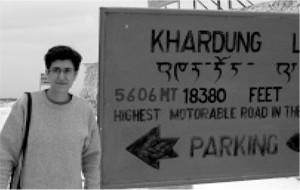
Dr Rashneh Pardiwala at Khardung La
Camping out in tents or managing home stays wherever possible, at close to 16,000 feet the thin, rarefied air resulted in all her team members suffering from AMS (Acute Mountain Sickness) due to the lack of oxygen for the first couple of days. Thankfully, Pardiwala just felt heavy-headed the first night and was slightly breathless while trekking long distances. However, everyone soon became acclimatized and enthusiastically covered the length and breadth of Ladakh including the major areas of Changthang, home to the three main glacial lakes of Tso Kar, Tso Moriri (a high altitude wetland) and Pangong Tso.
Another breathtakingly beautiful region of Ladakh is the Nubra Valley, a high altitude desert with rolling sand dunes that is home to amazing wildlife including the Bactrian (double-humped) camel. Pardiwala says they were lucky to spot black-necked cranes, hoopoes (a common bird in Ladakh), marmots, Kyang (Tibetan wild ass) besides herds of yaks and pashmina sheep.
Having studied at the University of Edinburgh, specializing in climate change, Pardiwala is founder and director of the Centre for Environmental Research and Education (CERE), a non-profit organization that works to promote environmental sustainability through formal education, corporate partnerships, public awareness campaigns and legal advocacy. CERE has undertaken many rural and urban national level research and development projects, and has been consultant to different government departments, helped integrate environmental education into the mainstream curriculum, published over 25 titles and produced short films on global warming, the e-mail notes. In 2005 Pardiwala was awarded the Ashoka Fellowship and recognized as a "Social Entrepreneur for Change.” In 2009 she was selected as one of Asia’s 21 young leaders in Tokyo, Japan, and conferred the Asia Society Fellowship. CERE’s website is www.cere-india.org
When Parsiana asked how CERE managed to secure funding, Pardiwala explained that initially they were dependent on grants from trusts and foundations, but the process was time consuming. Also, though individual projects received generous grants, "how were the researchers to survive between projects?” This led to the evolution of an ingenious system of self-sufficiency. CERE sustains itself through the sales of in-house educational publications which are in great demand with a number of schools throughout the country. An 18-book English reader series titled A Wisdom of Words, a handbook on Art-n-Craft From Waste materials and a series of six pocket-size information booklets on environmental sus-tainability with special focus on climate change have recorded sales of over 2,00,000 copies. The income generated from the sales is used to fund projects and to cross-subsidize the gifting of educational books to schools in less affluent areas that are unable to afford them.
◆ ◆ ◆
From the archive