
Seminar
Mainstreaming minorities
The Minorities Development Department of the Government of Maharashtra hosts a special workshop
"A minority member should not be treated as a trespasser or migrant. Minority property, land and religious institutions need protection. There are hurdles faced by minority educational institutions. Nor are the minorities represented in bodies at various levels. There are only two members on the Maharashtra State Minorities Commission when there should be nine as per its constitution. The same is the case in states all over India. There is not a single Parsi on any of the state commissions.”
Zoroastrian member of the National Commission for Minorities (NCM) Dr Mehroo Bengalee made these remarks in the course of her summation as chair of the first session at the Workshop on "Mainstreaming Minorities — Towards an Inclusive Development Agenda” held under the aegis of the Government of Maharashtra at its official guesthouse Sahayadri on Bombay’s balmy Malabar Hill. The full-day workshop on July 2, 2008 comprised two panel discussions, a presentation of schemes for the welfare of minorities formulated by the central government, group discussions, etc.
The inauguration of the meet by Maharashtra chief minister Vilasrao Deshmukh marked high level attendance including that of deputy chief minister R. R. Patil, chief secretary Johny Joseph, other ministers and officials. According to Thanksy Thekkekara, principal secretary of the Minorities Development Department, who welcomed the dignitaries in Hindi, the Maharashtra government is the first to enforce the recommendations of the Sachar Committee Report. The Committee had dealt with the status of the Muslim community in India, assessing its presence and impact according to various governmental/official parameters.
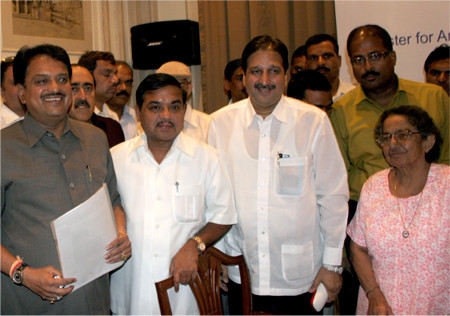
(From left) Vilasrao Deshmukh launching book on minority welfare with R. R. Patil, Naseem Siddiqui and Dr Mehroo Bengalee
Though the workshop was meant to create a climate "towards an inclusive development agenda,” the Sahayadri meet was largely aimed at Muslim amelioration. The concerns of the other minority representatives seemed to get a token hearing.
The occasion marked the ceremonial launch by Deshmukh of a booklet (in English) detailing the Prime Minister’s "new 15-point program for the welfare of minorities.” Issued by the Minorities Development Department of the Government of Maharashtra, the publication lists the special opportunities for education, employment and income generation schemes, improved living conditions, riot prevention and control mechanisms. Interestingly, the publication lists scholarships for meritorious students from minority communities where the post matric scholarship scheme provides for 15 scholarships for Parsis (as against 4,065 and 2,314 for Muslims and Buddhists respectively) and four more under the merit cum means based scheme. Parsis are the only ones who have not availed of any to date.
Patil, speaking in Marathi in his capacity as chief guest, commented on the large number of dropouts among minority — mainly referring to Muslim — children. Deshmukh addressed the audience in Hindi and noted that people were often unaware of the facilities available to them. While he had no reservation about children being educated in Urdu in the madressas, he noted that without a good knowledge of Marathi they are unable to join the mainstream. He acknowledged that they did learn the language as also English from the third standard, but that was too late to benefit from the child’s nascent ability to assimilate languages quickly. It is not a matter of state enforcement but of improving the future of the Muslim minority, he added. He had many more suggestions for the Muslims including a comment that unless there were students capable of taking advantage of reserved seats in the IITs, those seats would not be utilized for their benefit.
After the inaugural session when the chief minister and his retinue had departed, Bengalee chaired the first panel discussion titled "An inclusive agenda for a pluralistic society.” Many of the speakers who included former police commissioner for Bombay Satish Sahney, Teesta Setalvad, editor of Communalism Combat, Swadheen Kshtriya, principal secretary to the CM and Father (Dr) Frazer Mascarenhas, principal of St Xavier’s College made a number of points starting with the fact that an inclusive agenda for a pluralistic society had been set at the very start of the nation’s life, in its Constitution. The problems lay in the implementation, in the complete lack of security so that the minorities often felt that they were targeted rather than protected by the state and its police force. "There has been increasing intolerance since the end of the Nehru era,” stated Sahney. "Tolerance of dissent is the sine qua non of a democratic society,” he added, stressing that the educational system, the Press, the intellectuals and the state were equally responsible for creating and maintaining such a society.
Setalvad said that a seminar/workshop such as this needs to be held at the district level where the under 30 age group at the grassroots level can be involved. While India is relatively free from prejudice in cinema and sports, the implementation of many a scheme is in the hands of bureaucrats with their institutionalized prejudice preventing them from being fair to minorities. She lambasted the government for unimplemented schemes and budget allocations unused and demanded a public audit conducted by people working on the ground, not governmental ‘yesmen.’ "The culture of tolerance can only come through the rule of law. There is complete breakdown in the rule of law in Maharashtra,” she alleged.
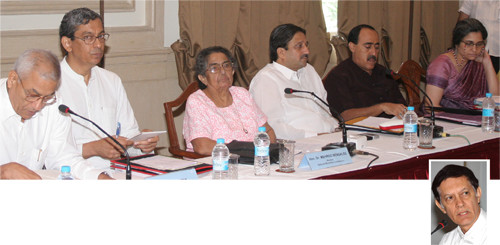
L to R: Satish Sahney, Fr (Dr) Frazer Mascarenhas , Bengalee, Siddiqui, Swadheen Kshatriya and Teesta Setalvad. Inset: Dr Homi Dhalla
Endorsing much of what the others had said, Mascarenhas emphasized the Christians’ contribution in the field of education, "much more than our share of the population. All educational polls have given Christian institutions an excellence rating. If we are not protected, how can we make this contribution?” He was referring to the negative endorsement his community was getting on the alleged conversions. He defined a legitimate government as one that has come to power by appealing to people’s intellect, not their emotions.
Contributing from the audience Dr Homi Dhalla spoke of the importance of the media in the smooth working of a pluralistic society and offered the example of the Philippines where the Muslim and Christian communities used to be constantly embroiled, with the media whipping up the hysteria. When leaders of the two communities sought a dialog with the media, pointing out to the latter how it was creating negative images, the problem dissipated. Dhalla advocated a similar approach closer to home.
Akbarally’s chairman Fakhruddin, Khorakiwala entered the discussion to point out that all the major holidays in India had religious connotations except for the two national holidays — Independence and Republic Day. But the celebration of these two days had left the common man entirely out of the festivities, concentrating instead on governmental functions, he noted. Advocating the advantages of people celebrating together, he also homed in on Holi, a spring festival, and Raksha Bandhan where Hindus and Muslims can be encouraged to tie the rakhi (band pledging protection) on each other.
Responding to Mascarenhas’ comment on Christian educational institutions Bengalee noted, "Parsis pioneered education in India, especially the education of girls. Most (vocational) colleges were put up by Parsis, yet there was never a question of ‘only Parsis.’ We integrated into the system, did not maintain separate representation at the Parliament, state or municipal level…But now we have genuine grievances: our Parsi children are finding it difficult to enter the institutions we helped to establish…”
During the second panel discussion on "What minorities need for their development,” Dhalla brought up the case of the Bahrot Caves where the Iranshah was accommodated for 12 years and is hence an important place of pilgrimage for Parsis. The monsoons have pounded the rock into rubble in large measure, so that only a few of the Caves are still salvageable and access to them was very difficult, he noted. He told the gathering that he had taken up the matter with the Archeological Survey of India (ASI) since 2000 but it was only in 2007 that the ASI wrote officially to the Department of Tourism and Culture to make a road to the Caves. (After the meeting Dhalla says he has given a copy of the ASI letter to Thekkekara.)
Dhalla also noted that he had been asked to coordinate a project on the socio-economic and educational status of the Parsi community in India by the NCM which was to be undertaken by the Tata Institute of Social Sciences and sought governmental funds for this and other research projects pertaining to the Parsi community. He also reiterated the plea for a certain provision for admission of Parsi students to institutions founded by Parsis.
◆ ◆ ◆
From the archive