
Cover Story
Perspective on Parsis
With Zoroastrians Through the Ages Frohar Foundation has helped spread awareness of history, religion and culture with the help of photographs, texts and models
"There are quite a few misconceptions about Parsi religious rituals — especially dakhmenashini and agiaries” and the main aim of the exhibition Zoroastrians Through the Ages is "to spread awareness about our religion and dispel all misconceptions in the minds of members of the public — Zoroastrians and non-Zoroastrians,” Ervad (Dr) Cyrus Dastoor, Frohar Foundation’s managing trustee informed the Press at its inauguration. The four-day exhibition was mounted at Allbless Baug in Bombay from April 13-16, 2008. Dastoor is also the driving force behind the tele-serial Humata, Hukhta, Hvarshta with the same aims and objectives, produced by the Foundation under the banner of Frohar Films and aired on Zee Gujarati, Zee Network on Sundays. The serial, which has taken a two-month sabbatical, will soon be back on the small screen.
Featuring Iranian history covering the five main dynasties of the Zoroastrian kings in Iran, the exhibition went on to trace the history of the Parsis from the earliest times to their landing in India at Sanjan in Gujarat as well as their considerable contribution to independent India. An important segment was devoted to rites and rituals and there were special screenings of significant episodes of the tele-serial, as per a write-up received by Parsiana from the Foundation.
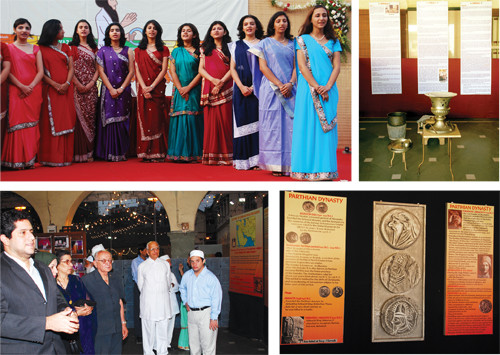
First row: Avabai Petit School choir; (right and below) displays at exhibition; (below from left) assistant Iran consul Mohammed Khirkhan, Havovi and Godrej Dotivala, Minoo Shroff and Darayus Mirza
Photos: Cyrus Shroff
Inaugurating the exhibition on April 13 chief guest Dastur (Dr) Kaikhusroo M. JamaspAsa said he was "highly impressed by the efforts made to put together a clear perspective of Zoroastrian history” with the help of photographs, texts and models. He appealed to Parsis to remain "united and not fall into useless controversies” so that we can progress like our forefathers. Dr Homi Dhalla, founder president of the World Zarathushti Cultural Foundation was the guest of honor. Master of ceremonies Mithoo Jesia introduced the dignitaries and welcomed visitors. JamaspAsa was presented a shawl. He and his wife Bakhtavar also received floral tributes. Silloo P. Mahava, trustee of the Foundation, similarly honored Dhalla.
A special brochure on the exhibition was released by JamaspAsa. When Dhalla released another brochure in memory of the late Kersi Mistry, the talented music director who composed all the music for Humata, Hukhta Hvarshta and presented the first copy to Mistry’s wife and son, it was an emotional moment for all. Marzban Mehta then regaled the audience with Parsi songs.
Large two-dimensional creations accompanied by text panels depicted the history of the Zoroastrian religion from Peshdadian times through all the dynasties up to the advent of the Parsis in India. Another section featured Parsis after their arrival in this country with pictures of Sanjan, the coastal settlement where they first landed. Photographs of achievers from our small but vibrant community graced this space. Basic Zoroastrian rituals comprised the final section. Marble muktad tables and vases with flowers in them recreated the annual memorial ceremonies for souls of the deceased. There was a model of a dakhma complete with a small vulture perched on the wall as well as one of a solar concentrator to make it look authentic. Inner liturgical ceremonies such as the yasna were symbolized by stone hindoras on which all the items required for these holy rituals were placed. An afarganiu, khumchas with fruits, flowers and malido depicted the jashan ceremony. This section also showed items used in the navjote and lagan ceremonies. The artistically rendered model of the kebla (sanctum sanctorum) of an agiary drew universal praise, while the boi ceremony performed five times a day in a fire temple was demonstrated by a bell hung from a stand, an afarganiu, chipia, chamach and gurz. The exhibits were accompanied by explanatory texts and some had large photographs as well to make it easy for the viewers to appreciate the rituals.
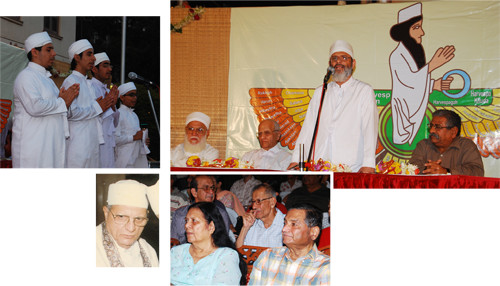
(Above left) Praying for the gathering; Ervad Asphandiar Dadachanji, Minoo Shroff, Dastur (Dr) Peshotan Mirza and Dinshaw Mehta; alongside Dastur (Dr) Kaikhusroo M. Jamasp-Asa; Roshan and Burjor Antia;
Photos: Cyrus Shroff
Ervad Burjor Antia, chief guest on the second day, felt that the exhibition should be shown in other cities in India and even abroad. Chief guests on the following day, Ervads (Dr) Ramiyar Karanjia and Parvez Bajan, spoke on the religion, while on the fourth and final day the closing ceremony fell to the lot of chief guest Dastur (Dr) Peshotan Mirza of Udvada who appreciated the efforts of the Foundation and its trustees, committee members and volunteers. He enlightened those present about the various types of fires with reference to agiaries and atash behrams. Bombay Parsi Punchayet (BPP) chairman Minoo Shroff and BPP trustee Dinshaw Mehta, both guests of honor, suggested that the exhibition be recorded in the form of a booklet to reach a wider audience. Master of ceremonies Ervad Sherzaad Pavri welcomed those present while Dastoor expressed a vote of thanks.
The beautiful artwork for the section on Iranian dynasties was the handiwork of Jennifer Dinshaw, while Karanjia provided much of the text. Material for the section on the Parsis at Sanjan was supplied courtesy Dhalla. Implements and materials used in the displays on rituals were loaned by Ervads Asphandiar Dadachanji, Pallonji Dastoor and Karanjia. The Frohar Foundation was extremely thankful to sponsor Shahrukh Kathawalla, co-sponsors Godrej Industries, Jeena and Company, BPP chairman emeritus Jamshed Guzder as well as numerous others for helping to make the exhibition a reality.
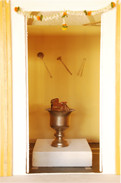
Exhibit at function
The panel of trustees which includes, in addition to Dastoor, Mahava and Dadachanji, Bachi Tamboly and Zarir Bhathena, along with the executive committee comprising Mahava, Yasmin Charna, Dr Arnavaz Havewala, Aban Baria, Parvez Irani and Ervad Marzban Bhesania, have a number of ambitious future projects on the anvil. They hope to purchase and furnish an ambulance with ICU and critical care facilities for all communities; establish a medical diagnostic center charging charitable rates; conduct free medical camps for the weaker sections of society; set up a library of all audiovisual material available on ancient civilizations and cultures and create an archive of CDs and video cassettes of Humata, Hukhta, Hvarshta; institute a regular lecture series on ancient cultures, customs and rituals in the world; and set up a talent bank for youngsters of the community who would be offered training, counseling and help in placement, as per the brochure of the exhibition.
◆ ◆ ◆
From the archive