
Drama
Staging new skills
Meher Pestonji’s plays explore contentious themes and contemporary concerns
Most people are aware of Meher Pestonji as a successful novelist; what most people are not aware of is that she is an equally skilful and vibrant playwright whose plays, like her fiction, center round themes which are close to her heart. Parvez traces the growth of political activism in a young Parsi woman whose marriage has fallen apart. Sadaak Chhaap is a hard hitting novel about the lives of slum children. She has written two plays: Piano for Sale, staged in 2006, was directed by Avaan Patel who also played one of the lead roles along with Dipalle Parmar and Feeding Crows, a dramatized reading of which was directed by Dolly Thakore during the Kala Ghoda Arts Festival as well as the Kitab Festival early this year.
Pestonji’s first play Piano for Sale is very unlike her novels because there is absolutely no evidence of political or social activism. Sheila has lost her mother, a music teacher seven months ago. She is now being harassed by property sharks for her prize piece of real estate — an entire ground floor of a bungalow on Club Back Road in Byculla. She is compelled to shift into a smaller flat where she has no room for a baby grand piano. The play begins with a call from a potential buyer in response to an advertisement Sheila has placed in a newspaper for the sale of her piano. The conversation is amicable and friendly till she realizes that the lady who wants to buy the piano turns out to be Anita Banerjee and suddenly all hell breaks loose and the scene ends on a note of discord and tension. We later learn that the cause of this animosity is the link during their youth, a young man called Amit who is loved by both the women and who is now Anita’s husband.
The piano acts as the catalyst in the plot as it brings these two extremely dissimilar women together, women who are as similar as chalk and cheese, and forces them to introspect. Anita is rich — a beautiful woman impeccably dressed in designer clothes and jewelry. She goes skiing at the Matterhorn, organizes kitty parties on Wednesday afternoons and has now come to buy a piano for her daughter. Sheila is single, still probably suffering the pangs of unrequited love, and has devoted her entire life to teaching dance and drama to deaf students. She has high ideals and at one point in the play we tend to associate her with Danteshwari, whose statue adorns her living room. Danteshwari was a tribal goddess born with all her teeth. At eight months she killed a snake by biting off its head. At the age of four she saved her father from a tiger. She never settled into domestic life and after her death she was elevated to the status of a Goddess and depicted as riding a tiger.
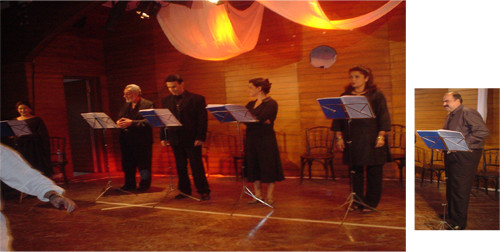
Dramatized reading of Feeding Crows (from left): Vandana Gupte, Firdausi Jussawalla, Arif Zakaria, Meher Acharya Dhar, Meenakshi Advani and Riyaaz Makaney
However, Sheila is no Danteshwari. In the second act we see a total transformation in her character. She has given up her job with the school for deaf children and now works in a call center. She has abandoned her sheltered abode in Club Back Road for a dingy flat in a building called Paradise Apartments. She now lives vicariously and spends her time going to parties and travelling around the world in packaged tours for singles.
Though the play explores contemporary concerns and deals with the dynamic, edgy and changing relationships between these two women, interaction between parents and children, the mobile revolution and, of course, the eternal human triangle, the main character in the play is music: "innocuously a note, a chord touches something and before you know it, forgotten feelings erupt like a volcano and you collapse like a house of cards.” The motif of Für Elise which is played at significant moments of the play has a haunting, refrain-life effect.
Meher Pestonjee’s play Feeding Crows reminds us of her novels. It is a play with a message and hence she wastes no time plunging us into the action immediately. The first scene of the play is concise, dramatic and introduces us to the themes of the play. We learn that Farhad, an upwardly mobile executive in his mid-thirties and his wife Zenobia have shifted from a spacious 3,000 sq ft flat in the unfashionable and middle class area of Grant Road to a relatively small apartment in smart, elite and well-heeled Walkeshwar. We also witness Zenobia’s obsession with her small Pomeranian, Flossie, who is presently at the hairdresser before taking part in a dog show later in the day. Pestonji skillfully reveals the petty concerns of the couple in the first lines of the play when Zenobia reminds Farhad to pick up smoked ham, mushrooms and broccoli from the club. We are also told that Dhunmai-mamma, Farhad’s aunt, is sick and is dying at the Parsee General Hospital, where she has been on life support for the last two years. And, finally, there is the old retainer, Savitri, who has served Farhad’s family for more than three decades and who is constantly feeding crows, much to the annoyance of their neighbor Malti Bhatia, who makes no bones about hiding her annoyance and slams a window shut to avoid the menace and the din caused by the raucous birds.
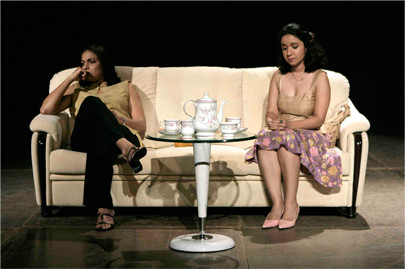
Dipalle Parmar (left) and Avaan Patel in Piano for Sale
Photo: Ranjana Gaur
Pestonji skillfully brings all these strands together and draws convincing parallels between the plight of Savitri and the orthodox Parsis both of whom seem to be caught in a time warp. Parvati was widowed in her youth and while performing the funeral rights of her husband a crow perched on her head causing her grieving mother-in-law to exclaim that her son had come back to say goodbye to his wife. Savitri firmly believes that her husband’s spirit has entered a crow and as she cannot identify which particular crow, she has no other alternative than to feed all the crows.
On the other hand we have the dying Dhunmai-mamma and the argument between her son, Rustam, who wants to cremate her and Farhad, who represents the conventional view that we should support dakhmenashini. Rustam, a resident of Chicago, is horrified by reports and photographs of piles of rotting bodies lying in the Towers of Silence. He has now come to Bombay to make sure that his mother has a dignified exit and is not compelled to join the slowly decomposing corpses.
This Shavian argument is possibly the weakest and the most disappointing in the play when the two opposing factions are pitted one against the other. It is possible to guess where Pestonji’s sympathies lie as Farhad’s arguments in favor of dakhmenashini are vague, emotional and lack logical reasoning. He speaks fervently and eloquently about custom and ritual and the atmosphere on Farvardin roz and Farvardin mah when the Parsis troop to the Towers of Silence to pay their respects to the dead. His arguments are weak and lack conviction.
Rustam on the other hand is cogent and logical. He patiently explains how irrelevant the concept of dakhmenashini has become over a period of time. He accepts that the concept of donating one’s body to the animal kingdom as an ultimate act of charity and to remain in harmony with nature is praiseworthy but sees that like most customs it has outlived its usefulness and is "incompatible with a modern technological age.” This idea is enforced by the outsider point of view as well, represented by the Bhatias, when Malti’s husband exclaims that the Bombay Parsis tended to live in a world of their own.
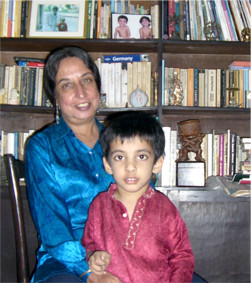
Meher Pestonjee with grandson Farhan Photo: Thomas Gugler
Through Savitri and the controversy of the dakhmas, Pestonji seems to imply that change is inevitable; the only way forward is in a spirit of acceptance, understanding and an open mind. Farhad rightly mentions: "When you understand why someone does what they are doing, it’s difficult to stop them.”
As a sub theme, which is often more humorous and dramatic than the main argument against dakhmenashini, Pestonji presents the callous and thoughtless mindset of the upwardly mobile middle classes. Zenobia and Farhad are ruthless in their drive to consolidate their position and to move up the ladder of society. Farhad has no compunctions about sending Savitri to a home after she has devoted her entire life to taking care of him and his family in order to ingratiate himself with Bhatia who is a chairman of a bank and who will hopefully underwrite his public issue and accept a seat on the board of directors of his company.
The cast for the dramatized play reading directed by Dolly Thakore included film and TV actors Arif Zakaria, Meher Acharya Dhar, stage actor Firdausi Jussawalla, among others. All the actors read their parts perfectly and the entire production was very effectively managed. Bharati Achrekar was very effective in her rendering of Savitri and read her part with a great deal of emotion. She spoke in Marathi, which would be rather unusual for a servant who has spent more than 35 years in a Parsi household. Surely the Parsis would have compelled her to learn Gujarati or English!
◆ ◆ ◆
From the archive