
Books
Power packed plays
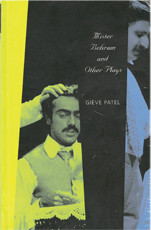
Mister Behram and Other Plays by Gieve Patel. Published in 2007 by Seagull Books Private Limited, 26 Circus Avenue, Calcutta 700017. Pp:290. Price: Rs 350.
If you approach the plays of Dr Gieve Patel with the expectation of being entertained by the eccentric and whimsical characters one encounters in the work of several Parsi novelists or if you expect the farce which is generally associated with Parsi drama, then you are in for a disappointment. Patel mentions in an interview with Karen Smith which is reproduced in the book, that he wanted to show that "Parsi life is as full of violence, brutality and warm, human charm as any other.” In fact, it is in this way that Patel moves his subject matter as well as the themes of his plays out of the narrow confines of a single minuscule community and projects them onto the broader canvas encompassing human nature.
All his plays are peopled with Parsi families from the west coast of Gujarat. Patel wrestled long with the problem of the language he should make his characters speak. Parsi villagers would speak Gujarati amongst themselves and with their servants and the visitors from Bombay would generally speak in Gujarati and occasionally lapse into English. But Patel decided to make all his characters speak English. He believes that though the language of the theater is finely crafted and formal, it is finally the actors who will convince the audience that they are listening to normal human speech. The formal speech of the poet, on the one hand, is counter-balanced by an underlying current of raw and vibrant emotion on the other.
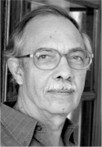
Dr Gieve Patel (Photo: Cyrus Dastur)
The English in his plays is not the current everyday English spoken by the Parsis of Bombay and is peppered with strange expressions which Patel must have translated from Gujarati. Some of these are quaint: "I am waste” or "He is dung;” and some expressions gather meaning through their context in which they are used. In Princes, Nergish refers to Navzar, Noshir’s father, as "chattel dung” because he was consorting with prostitutes instead of taking care of his wife who died in childbirth. The verb "to sit” is used in a fascinating manner and often the meaning changes with the context in which it is used. In the same play, Sorabji tells his unmarried daughter Nergish "You don’t sit on our hands” implying that by remaining single she is not a burden to the family. His son Khushrow tells his father Sorabji, "You give the estate, then sit on my neck” suggesting that he does not allow him to function independently and constantly subjects him to close scrutiny. Khorshedmai tells Nergish, "Get married girl. You want a man to sit on your mouth” signifying that once Nergish is married she would not be able to brandish her tongue so freely.
A constant theme which runs through all the plays is the theme of power and its ramifications in our day-to-day lives. In Princes, the power struggle is between two families for Noshir, a young male child, whose mother has died in childbirth while his father is ‘whoring away.’ Noshir is raised by the mother’s family. The father has not seen his son for the past two years. He suddenly comes to claim his son along with his wife and his mother Khorshedmai and the young, sickly child becomes a pawn in their struggle to gain power and control. For Homamai and Sorabji, the parents of Noshir’s mother, the boy is extremely important as there is no male grandchild in the family: their son, Khushrow, has three daughters, their two daughters, Ratan and Tehmi, are childless and Nergish is unmarried. The struggle between the two families becomes intense, passionate, cruel, nasty and vicious for the possession of the boy and very little concern is shown for either his welfare or his tender physical health.
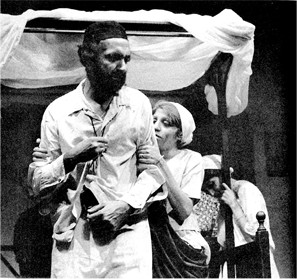
A scene from Princes where Alyque Padamsee plays the role of Pappa, Yasmin Richmond of Mamma and Kamal Lavangia of Nergish
The theme of power and ownership also spreads its tentacles to land. It must be remembered that these plays encompass a period when rich Parsi landlords who owned extremely large properties were on the verge of losing their lands on account of the newly introduced Land Ceiling Act under which land was destined to go to the tiller of the land, which, in western Gujarat, is a tribe of people known as the Warlis. At one point of time the relationship between the land-owning Parsis and the Warlis was not one of master and servant but they were treated as family members and the landlord would feed them in the lean season when there was no work and take care of all their needs including the marriage of their daughters. But with the change in times, the relationship underwent a subtle transformation.
The second generation of landowners were certainly not as benevolent and this can be seen in a very effective but short scene in Princes where Khushrow berates the foreman, Lahnu, for the relationship of the Warli laborers with the Congress leaders and the Communists who were using them for their own purposes. Once again it is a scene in which one sees the use of power between Khushrow, who has the ability to release one of the imprisoned workers, and Lahnu who in spite of remaining silent throughout the scene comes out the winner with his quiet demeanor and dignity.
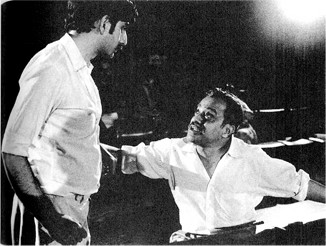
A scene from Savaksa where Nosherwan Jehangir (left) plays the role of Dorab and Roger C. B. Pereira of Savaksa
Signs of uprising and tension between landlords and Warlis are also hinted at in Savaksa where the laborers are under the influence of a tailor and are not reporting for work. However, it is in Mister Behram that Patel gives the Warli a voice. It is here that we encounter Naval, a Warli, who is adopted by a Parsi family and given an education in India and abroad. He becomes a successful lawyer like Mr Behram and even marries the latter’s daughter. However, jealousy springs in the heart of Mr Behram when he discovers that his protégé has now surpassed his own legal skills. There are scenes in Mister Behram when each, Naval as well as Behram, is aware of the power he exerts on the other and the fact that neither can exist without recognition and respect and a return of affection from the other. This struggle of power and domination swings back and forth and comes to a peak in the scene where Behram forces Naval to undress and wear his traditional Warli costume of a vest and a G-string which he had not worn since he was seven.
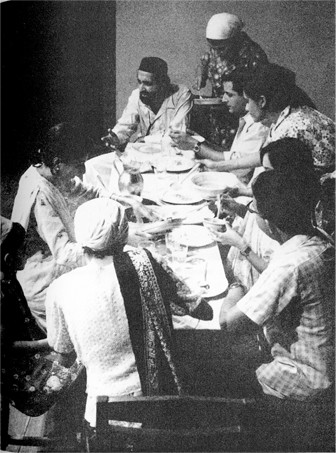
The family at lunch in Princes
The theme of power is once again seen in Savaksa’s position in society and constant references to the power he wields by his place in the District Panchayat. His son, Dorab, dislikes his onerous duties on the farm and aspires desperately for this position. As a parallel to the political power Savaksa wields, he also exerts a similar power over his son and keeps him guessing whether he will offer the seat in the Panchayat to Dorab or to his own intended wife, Perin.
Power is also exerted within members of the family between rich relatives and poor relatives as one sees in the dramatic scene when Perin confides to Savaksa about the game she would play with her Mehru aunty over her studies which always resulted in a "nice wrapped-up dinner” for her and her mother. The power struggle between the sisters, Hutoxi and Perin, is also very dramatically delineated. Hutoxi is obviously the stronger and takes care of her mother and her sister but also dominates their lives by virtue of being the breadwinner. She goes to the extent of visiting Perin at her place of work and berating her bosses for the paltry sums they pay her and spies on how regular she has been in the performance of her duties.
The plays are dramatic and vibrant with emotion and highly charged language and contain all the elements of great theater. There is just one misprint on page 287 where a speech has been erroneously attributed to Naval instead of Behram. If merely reading these plays offers the reader such a magnificent theatrical experience, the reader can’t help but wonder how marvelous it would be if we could see these plays performed.
◆ ◆ ◆
From the archive