
Observation
Matrons of medicine
The first three Parsi lady doctors of Ahmedabad provided honorary services to the poor and deserving
"Presented to the Hospital by public subscription in recognition of 40 years of meritorious medical and social services,” reads the inscription beneath the marble bust of Dr Motibai Rustomji Kapadia, installed at the Victoria Jubilee Hospital (VJH) for women and children in Ahmedabad. In fact, so popular was this medical officer that the Hospital was more frequently known as Dr Motibai’s Hospital and the road next to the Hospital was named after her as well.
Although she was originally from Bombay, she made Ahmedabad her home and earned the distinction of being Ahmedabad’s first Parsi lady doctor. Born on July 18, 1867, she earned her medical qualifications (Licentiate of the Royal College of Physicians and Licentiate of the Royal College of Surgeons) from the Bombay University. Kapadia was appointed medical officer in 1889 of the VJH established near the railway station in Ahmedabad by Rao Bahadur Ranchhodlal Chhotalal, the father of the cotton textile industry in Ahmedabad.
In the beginning she had to manage with only one nurse as nurses were not available in Ahmedabad. To overcome this handicap she requested the management to allow her to establish a school of nursing in the hospital. Sir Chinubhai, grandson of Ranchhodlal, had a separate building constructed at a cost of Rs 60,000 for a nursing school and gave an endowment of Rs 1,00,000 towards its running.
To supplement her medical qualifications from Bombay, Kapadia took leave to go abroad and returned with a FRCS degree (Fellow of the Royal College of Surgeons) from the Edinburgh University. The committed lady doctor had been conferred the Kaiser-e-Hind medal.
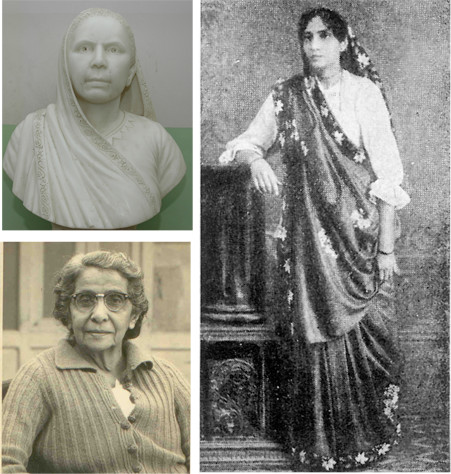
Clockwise from top left: marble bust of Dr Motibai Kapadia; Dr Dhunbai Wadia; Dr Goolbanu Medora
Blessed with a pleasant and jovial temperament, she played a keen role in different activities in Ahmedabad. As member and subsequently honorary secretary of the Gujarat Ladies Club she organized dramatic and cultural events and encouraged members of all castes and communities to take part in them. During World War I and the famine, funds generated from these events were used to aid the distressed. A public hall for women in Madhav Baug, next to the Hospital, was also built by her and donated to the Mahila Mandal of Ahmedabad.
After her death in 1930 the Dr Motibai Rustomji Kapadia Parsi Charity Blocks were constructed, for, in her will, she had bequeathed a handsome amount for a plot of land with building thereon next to the Zoroastrian Hall behind the Parsi Agiary at Kankaria to house two deserving Parsi families.
Yet another medical student from Bombay, Dhunbai Hormusjee Wadia, had earned the distinction of being Ahmedabad’s second Parsi lady doctor. A scion of the Lowjee Wadia family, the master shipbuilders who built numerous battle ships and frigates, Wadia was also related to Maharashtra’s outstanding advocate general, the late Homi Seervai. Born on August 12, 1879, she completed her matriculation at the age of 18, standing first in French and receiving a prize from Circle Literaire. After passing her final examination from the Grant Medical College in 1902 she worked with Kapadia in Ahmedabad for some time before she started her own dispensary. She had compiled and published for private circulation a short sketch on her mentor Motibai Kapadia.
Wadia was also in charge of a charitable dispensary run by the well known mill owner, Sheth Mangaldas Girdhardas Parekh. Due to her charitable disposition and obliging nature she became popular as a gynecologist in the city and also in neighboring villages. Though she had a large practice, she willingly visited patients in villages, sacrificing her time and money to attend to the needy.
In 1912 during the famine in Gujarat a fund was started to supply fodder to peasants who needed it. She devoted her time and energy to augment the fund and succeeded in collecting a good amount which was handed over to the Relief Committee. After retiring from practice in Ahmedabad in 1917 she settled in Bombay where she gave her honorary services to Masina Hospital. On a visit to Europe in 1922 she familiarized herself with the working of hospitals there. Touched by the poverty of Zoroastrians in Yazd when she visited Iran in 1926, Wadia decided to return to that country in 1938 and spent over a year there providing honorary services to the poor patients at Behman Zayashgah, a maternity hospital in Yazd. Before she died at the age of 65 she also toured USA and Japan. Her accomplishments find a mention in H. D. Darukhanawala’s Parsi Lustre on Indian Soil, Volume II.
The third Parsi lady doctor of Ahmedabad was Dr Goolbanu Dhanjibhai Medora who was a leading and popular gynecologist of the city with a large practice spanning almost 50 years. Daughter of Dhanjibhai, the first Parsi to establish a cotton textile mill in Ahmedabad and pioneer of Life and General Insurance in Gujarat, Medora obtained her Bachelor of Medicine, Bachelor of Surgery (MBBS) degree from Bombay University. She had proceeded to Edinburgh to acquire higher qualifications but met with a severe motor accident and had to be hospitalized after which she cut short her studies and returned to Ahmedabad where she started medical practice in the first quarter of the last century. Her consulting rooms and maternity home were located in a prominent ancestral building known as Dhun House in Bhadra, Ahmedabad which was a landmark in those days and was listed by the Bombay Environmental Action Group among the "jewels that need to be preserved.”
Mahatma Gandhi would regularly send poor and deserving patients to her with notes written in his own hand. She had also rendered honorary services to the VJH for many years. A nominated municipal councilor, she was one of the first two lady members on the managing committee of the Ahmedabad Parsi Panchayat.
◆ ◆ ◆
From the archive