
The forgotten liberal - I
A doyen of the law and a Gandhian, the community turned its back on Dorabji Bahadurji
A worthy sibling of the ‘lustrous’ physician-patriot Dr Kaikhusrao, MD (1860-1898) (Parsi Lustre on Indian Soil by H. D. Darukhanawala), Dorabji too, displayed unwavering nationalism. For example, as a member of the Indian National Congress he made his time and legal expertise available to the party — on Gandhi’s recommendation and request — on at least five occasions.

Dorabji Bahadurji: no photo is traceable
Dorabji held liberal political views and was decidedly reformist in matters affecting his community. Despite obloquy he stubbornly promoted an unpopular cause by personal example.
In Bombay, two valuable medical institutions with which Dorabji was associated stand testimony to his fraternal and filial loyalty and civic-mindedness.
Strangely, Dorabji does not find a place in the collective memory of his community today. Additionally, despite diligent search, it has proved impossible to locate a photograph of this unusual man, who perforce remains faceless (see "Dorabji Bahadurji,” Readers’ Forum, Parsiana, December 7, 2013).
Dorabji was the youngest of three brothers (there was also a sister about whom little is known). Their father was a dedicated member of the Theosophical Society (Fifty Years of Theosophy in Bombay: Being A History of the Blavatsky Lodge, Theosophical Society Bombay, 1880-1930 by K. J. B. Wadia). Like his brothers, Dorabji too was educated at elite institutions in Bombay (St Mary’s High School and St Xavier’s College); unlike them (who trained in medicine in London), Dorabji journeyed there to study law. He was called to the Bar (Middle Temple) in January 1895 (The Indian Magazine and Review, February 1895).
On return, he became a member of the BHC where he acquired a reputation for hard work and thoroughness in arguing his cases. His legal practice which spanned much of the pre-Independence decades, was substantial and made him a wealthy man. As counsel in some important cases, he was associated with well-known contemporaries such as Sir Chimanlal Setalvad, Kanhaiyalal Munshi, Bhulabhai Desai and remembered by others (Recollections and Reflections: an Autobiography by Setalvad; Famous Lawyers, Judges and Cases of Bombay. Tales from the Bench and Bar by Vicajee J. Taraporevala).
His marriage too was noteworthy. In the first decade of the 20th century Dorabji married Dr Manak Turkhud (1872-1952), the first Hindu woman graduate of the Grant Medical College, daughter of the renowned social reformer Dr Atmaram Pandurang Turkhud who founded the Prarthana Samaj (on the lines of the Bengal Brahmo Samaj). This Parsi-Hindu inter-communal marriage was surely unique for the time. The union was fated to be hit by deep tragedy, following the death of their two infant sons, which scarred them to the end of their lives.
Manak’s connection with the Bahadurjis long pre-dated her marriage to Dorabji, for she had been Kaikhusrao’s devoted, valued helpmate at the Parsi Plague Fever Hospital from 1896 to 1898. In fact there was a whiff of a romance between them, cut short by his untimely death.
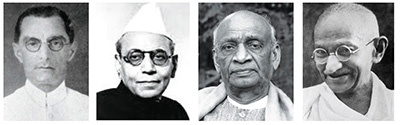
(Above, from l): Khurshed Nariman, B. G. Kher, Vallabhbhai Patel,
Mahatma Gandhi Some photos courtesy Dr Sunil Pandya
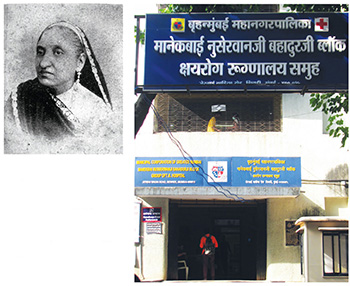
Above: Maneckbai Bahadurji; (right) Block at Sewree Hospital
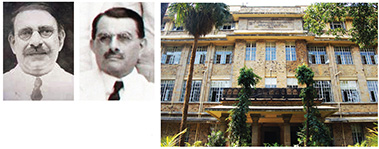
(Above, from l): Drs M. D. Gilder and P. C. Bharucha, physicians at G. S. Medical College (right)
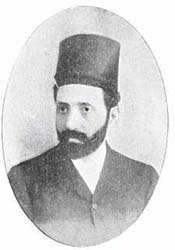
Dr Kaikhusrao Bahadurji
Indian National Congress members
Dorabji and his wife became members of the party and attended at least three annual sessions — Madras (1908), Bombay (1915) and Lucknow (1916).
The couple — Dr Manak ahead of her husband — whole-heartedly supported Gandhian causes. In January 1915 she was in the group of enthusiasts gathered at the docks to escort South Africa-returned Mahatma Gandhi and Kasturba from steamer to Apollo Pier (The Times of India, January 11, 1915). She also attended a reception for the Gandhis organized by Gokhale’s Servants of India Society a few days later (Collected Works of Mahatma Gandhi, Vol 13). Subsequently Manak and Dorabji took seriously to khadi spinning, and Gandhi corresponded encouragingly with them on the subject (Collected Works of Mahatma Gandhi, Vol 35).
In the long term however, it was Dorabji’s legal expertise and professional standing that proved valuable to Gandhi and the Congress party. Instances are detailed below:
The Patel-Nariman controversy, 1937
The so-called "Patel-Nariman Controversy” of 1937 convulsed the Congress party in Bombay. It is doubly relevant to the present article because not only was Dorabji a major participant in the drama, but he was ranged against a high-profile, popular, ambitious Parsi Congressman of the city, namely Khurshed Framji Nariman (1885-1948).
History has treated Nariman kindly — the epithet "Veer” was awarded to him for emerging "victorious” in a libel suit filed against him in 1928 by Englishman Thomas Harvey, superintending engineer in the Bombay Development Department (BDD). Thus "little David” Nariman had been honorably exonerated in the fight against the "big Goliath” British colonial Government. Nariman-ites glossed over the fact that Harvey had been declared "not guilty”. (Harvey-Nariman Libel Case: With a brief history of the Development Department, important extracts from Mears’ committee report, Court proceedings including the statement of defence, judgment in full with press comments, illustrations etc. by S. M. Surveyor).
The "Harvey-Nariman Libel Case” of 1928 turned out to be a skirmish compared to the Vallabhbhai "Patel-Nariman Controversy” of a decade later (1937) — here "Veer” was bested by the "Iron Man,” Vallabhbhai Patel.
The "Controversy” centered on election of Congress leader in the Bombay Presidency Legislative Assembly where the party had secured a majority in the election of 1937. In other words — "Who will be ‘Chief Minister?’ Most observers were certain that it would be a walkover for Nariman, the long-time city Congress party chief who had won in his constituency by a huge majority.
Great was the consternation therefore when legislators elected B. G. Kher, a low-profile Maharashtrian solicitor-politician. At once allegations of conspiracy, machination, sabotage and rank communalism were levelled by Nariman’s many supporters in the Parsi and non-Parsi Press against Patel, who was viewed as the mastermind [Conspiracy Unveiled (Nariman-Patel Controversy by Khurshed D. Anklesaria)].
Enter Dorabji: Patel maintained a studied public silence. Nariman appealed to the sage of Sevagram — Gandhi — who proposed that he (Gandhi), aided by one other person, would arbitrate the dispute, provided Nariman was agreeable.
Dorabji was the person selected by Gandhi as co-tribune. Gandhi confessed that he had approached Dorabji —"though not without much hesitation” — to associate himself with the inquiry "in the public interest.” Dorabji "is a hard worker .... spares time regularly every day and reads every paper and makes notes.... He spares time from the pile of cases with him and reads the papers as if this also was one of his cases.” (Collected Works of Mahatma Gandhi, Vol 72).
The two-member tribunal was to investigate not only the current dispute (1937), but an earlier act of alleged "indiscipline” on Nariman’s part in the general election of 1934, which had almost cost the Bombay Congress a seat.
Nariman responded telegraphically to Gandhi: "Accept your and Bahadurji’s judgement on both issues.” (The Collected Works of Mahatma Gandhi, Vol 72). Needless to say, Patel also accepted the proposal.
As arbiter Dorabji was at pains to demonstrate impartiality. He personally studied the voluminous documents presented by each side and also made them available to the opposing faction. He arranged for witnesses of both sides to be examined and cross-examined as required. Gandhi too ensured that "(t)he greatest latitude was given to Mr Nariman to bring before me any evidence he had.” (Collected Works of Mahatma Gandhi, Vol 66).
By September 1937, Dorabji readied a 14-page report for Gandhi’s perusal and independent verdict. Gandhi expressed full agreement with his conclusions. In October 1937, copies of the verdict were provided to the disputants privately.
The verdict was a jolt to Nariman. Dorabji pointedly reminded Nariman: "Bombay city is not Bombay presidency” — Bombay-centered Nariman had misjudged his influence in the countryside. The charge of major indiscipline leveled against him by Patel-ites in respect of the election of 1934 was "proved.” Nariman’s allegation of injustice in denying him the chief ministership in 1937 was "not proved.” Sardar Patel was exonerated of communal bias and interference in party affairs.
Nariman issued a public mea culpa: "I am grateful to Mahatma Gandhi and D. N. Bahadurji for having taken me into their confidence and shown me a copy of their findings.... (They) were judges of my choice.... I am satisfied with their verdict. In the matter of election of the leader of the Bombay Parliamentary Party in 1937, I am sorry to confess that I misjudged the general position ....(I) am sorry that the agitation against Sardar (Patel) should have taken a personal aspect and even a communal aspect and that I should have been the cause of taking up so much of the time of Mahatma Gandhi and Bahadurji over a grievance which the public have a right to say was more fancied than real...” [Conspiracy Unveiled (Nariman-Patel Controversy) by Khurshed D. Anklesaria].
In the very next sentence, however, he recanted, transforming himself from wrong-doer to wronged:
"... he (Nariman) surrendered to his cruel fate without a murmur, hoping and expecting that in future at least, he would get a fairer treatment and a squarer deal.” (Ibid).
Nariman’s luck had run out. Kher’s election as chief minister of Bombay was ratified by the Congress Working Committee (the president was Jawaharlal Nehru), and Nariman was chastised for conduct which " has been such as to prove him unworthy of holding any position of trust and responsibility in the Congress organization”. The Bahadurji-Gandhi Arbitral "Report” was made public, and Nariman was rendered a non-entity in the Congress party for several years. (Proceedings of the Congress Working Committee held at Calcutta October 26 – November 1, 1937, The Annual Register July-December 1937).
Supporters of Nariman — and there were many, Parsis and others — would have none of it. They were in full cry against Dorabji (specially), who was accused of being in a "mad hurry” to indict Nariman by disproportionately focusing on the events of 1934, thereby prejudicing an impartial view of the current (1937) controversy (Ibid). Dorabji’s verdict (although confirmed by Gandhi), was unwarranted by the evidence, and Nariman’s public apology had been obtained by coercion, they said. Particularly withering was a prominent barrister:
"Bahadurji (has) betrayed a glaring lack of knowledge of criminal law.... (not surprising), because his career has largely been confined to the civil side” (Ibid).
The sharpest barb was that by exonerating Patel of charges of interference and wire-pulling, despite "evidence... Bahadurji has failed in his duty to the public, and proved utterly unworthy of the trust that the public had reposed in him” (Ibid).
Liberal, unconventional, nationalist
In 1932 Bahadurji was among the well-known Parsi lawyers (Dinshah Mulla, H. C. Coyajee and B. J. Wadia) who vetted the Report drawn up by the Parsi Laws Revision Committee. It aimed at equality of status for men and women by reform of Parsi marriage law. These efforts culminated in "The Parsi Marriage and Divorce Act” of 1936 (The Times of India, November 2, 1932).
The Parsee Cremation Society, 1922 was arguably the cause which proved most dear to Dorabji’s heart, and most difficult for his community to support at the time.
As early as 1913, there was talk of special facilities for non-Hindus who opted for cremation. High mortality in the plague epidemic (1896 -) and the influenza epidemic which followed (1918 -) concentrated the minds of some members of the Parsi community to consider non-traditional methods of disposal of their dead. A leading newspaper commented that "the methods of disposal of the dead (during the influenza epidemic) adopted by the Parsis were seriously deficient,” and that a community crematorium in the city be given consideration (The Times of India, October 19, 1918). However, nothing came of the proposal at the time.
In 1922, however, the proposal regained traction with the Parsi Cremation Society initiated by some wealthy and intellectual elites of the community. The president was Sir Dinshaw Petit (1873-1933, second baronet) and the secretaries were Sir Dorab Jamsetji Tata and Dorabji Bahadurji. Hormusji Jehangir Bhabha (1859-1941) celebrated educationist of Bombay and Mysore, grandfather and namesake of the scientist and father-in-law of Sir Dorab Tata was a member, as also some well-connected ladies.
A large sum of money was collected. A formal application for free land near Love Grove (Worli) was made to the municipality for a separate crematorium. The municipal commissioner was reportedly sympathetic, but he faced a strong onslaught from traditionalist corporators — Parsi and non-Parsi — which put paid to the Cremation Society’s ambitions.
Dorabji, however, never wavered in his commitment to the cause.
Minority Rights in India
During discussions on the drafting of the Indian constitution, Parsis were unique among minorities in disclaiming constitutional rights and privileges for the community. Liberal-minded lawyers such as Dorabji and Nariman as also medical men Drs Manchersha Gilder and Phiroz Bharucha were signatories to a public renunciation of special treatment:
"Following the lead given by... Dadabhai Naoroji, Sir Pherozeshah Mehta, and Sir Dinshah Wacha, we Parsis have always asserted that we are Indians first and have asked for neither separate representation in legislative or municipal bodies nor any special treatment in the services.... (We) now emphasize that it is absolutely essential that we should stand by this self-same principle and policy....(On) moral grounds we clearly see that our future is indissolubly linked with that of our sister communities” (Pakistan: a Myth of a Reality by Virendra).
Medical improvements in 1925 and 1951
These relate to two institutions, which are ornaments to our city this day.
In 1916, the High Court-appointed trustees of the estate of Gordhandas Sunderdas approached acting advocate-general Dorabji, offering the Municipal Corporation Rs 20 lakhs to endow a Medical College affiliated to the King Edward VII Memorial Hospital ("KEM Hospital”). The offer came with some conditions, one of which was
"... (t)hat the Professors and teachers at the College be properly qualified independent Indian men not in government service (in other words, members of the British-dominated Indian Medical Service were specifically excluded).
It was providential that three decades earlier Dorabji’s eldest brother Kaikhusrao, had battled the British medical authorities for exactly such an institution. (Bombay Past and Present: A Souvenir of the Thirteenth meeting of the Indian Science Congress, by D. A. Turkhud). The Medical College was inaugurated with much fanfare on January 22, 1926. In his speech the president of the Municipal Corporation Joseph Baptista specially referred to the facilitatory role of Dorabji (The Times of India, January 23, 1926).
The famous "Bahadurji Sanatorium” for consumptives (now a Home for agedParsis) was established at Deolali in 1902 to perpetuate the memory of Kaikhusrao. Many do not know that in Bombay itself there is a substantial connection of the Bahadurji name with tuberculosis relief.
The Bahadurji Block of 60 beds was constructed at the Sewree Municipal Tuberculosis Hospital in 1951, from a handsome endowment by Dorabji anonymously in memory of mother Maneckbai. The Block, substantially expanded and renovated, is very much in use.
To be continued
 Interested in medicine related history, Dr Shubhada Pandya did her doctorate on the hisotry of leprosy in 19th century Bombay. She worked as neurophysiologist under Drs Noshir Antia and Darab Dasur at the Grant Medical College.