
Books
Annals of Ahmedabad
Parsis of Ahmedabad: A Brief History by Rashid Sohrab Medora. Published in 2013 by Meher Medora, 167, Sunrise Park, Opposite Drive-in Cinema, Thaltej Road, Ahmedabad 380054. Pp: xv + 303. Price: Rs 995.
Parsis of Ahmedabad: A Brief History by Rashid Sohrab Medora is a fitting tribute to the Parsi community of Ahmedabad. It is, as the author states, "a labour of love” and showcases a lifetime’s painstaking work of gathering and setting down all that can be gleaned about the Parsis of the city. One is tempted to say that he is a worthy successor of earlier chroniclers like Ratanji Vachha whose untiring efforts have created a rich treasure trove of source material on the Parsi families of 19th century Bombay.
Unfortunately Medora did not live to complete his book and but for the dedication and perseverance of his wife, Meher, it would have remained unfinished and unpublished. This well-illustrated and aesthetically designed book chronicles the lives of the Parsis of Ahmedabad who helped to shape many of its institutions and in turn were shaped by them. "This book makes no claim at being a rigorous research based study,” states Meher. On the other hand she says, "We have tried to cross-check information used in the book to the best of our ability and have attempted to present as accurate an account as possible.” It is this modest claim that makes the book a very rich and valuable archive on the social history of the Parsis of Ahmedabad. Meher was assisted in her quest by Prof Snehal Nagarsheth, Dinyar Patel, Astad Pastakia as editors with editorial assistance provided by Prof Delnaz Jokhi and Azzmin Mehta.
Unfortunately Medora did not live to complete his book and but for the dedication and perseverance of his wife, Meher, it would have remained unfinished and unpublished. This well-illustrated and aesthetically designed book chronicles the lives of the Parsis of Ahmedabad who helped to shape many of its institutions and in turn were shaped by them. "This book makes no claim at being a rigorous research based study,” states Meher. On the other hand she says, "We have tried to cross-check information used in the book to the best of our ability and have attempted to present as accurate an account as possible.” It is this modest claim that makes the book a very rich and valuable archive on the social history of the Parsis of Ahmedabad. Meher was assisted in her quest by Prof Snehal Nagarsheth, Dinyar Patel, Astad Pastakia as editors with editorial assistance provided by Prof Delnaz Jokhi and Azzmin Mehta.
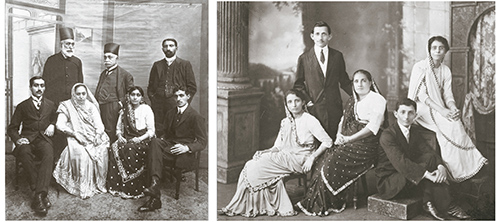
(Left) The Vakils: Sir Nowroji Pestonji Vakil with daughter Alibai, son-in-law Hoshangji Vakil and family;
(above) The Medoras (from left): Manakbai, Sohrabji, Khurshedbai, Jamshed and Dr Goolbanu
The book begins with a very brief history of the arrival of the Parsis to the shores of Gujarat and the founding of Ahmedabad by Sultan Ahmed Shah I, as well as an account of early Parsi settlements in the vicinity of the city. This section could have been dealt with in more depth to gain a more detailed historical perspective of the Parsi community and its place in the wider social sphere of Ahmedabad.
The book describes the advent of the first three Parsi founding families of Ahmedabad: the Kothavalas, Vakils and Karanjawalas. The chapter begins with the dramatic entry of Dosabhai Kothavala in 1780, accompanying the army of General William Goddard sent to destroy the power of the Peshwas. When a stray cannonball fell near General Goddard, the intrepid young "Dosa Boy” with great presence of mind shoved it into a ditch of water nearby. The general, greatly impressed, asked Dosabhai, "Well Old Young Man! What reward should I give you?” Dosabhai, with a touch of Parsi humor is said to have replied, "The cannonball.” And to this day, the cannonball (with its shell removed) has pride of place in the Kothavala family home.
The story of the Vakil family begins with the arrival of Pestonji Faramji Vakil from Surat in 1814. The philanthropic legacy of this Sheth and his illustrious sons has been exhaustively dealt with. This remarkable family contributed in numerous ways to the development of Ahmedabad. Prominent among them was Sir Nowroji Vakil. A quirk of fate rescued him from a humdrum life as an obscure clerk to become a prominent and influential member of the community. He dropped out of school at the age of 14 after being publicly humiliated by his teacher for not being able to locate the river Danube on the map in front of the education inspector. Sir Nowroji worked his way up with determination and perseverance to become a successful railroad contractor for the B. B. & C. I. Railway (Western Railway). The book says "most of the railroads in the range of B. B.& C. I. Railway was completed under Nowroji’s supervision.” His services were appreciated by the Government and he was knighted in 1917, perhaps the first Parsi in Gujarat to be so honored. The wealth he amassed in his lifetime was used to build many philanthropic institutions which benefitted not only the Parsi community but the general population as well.
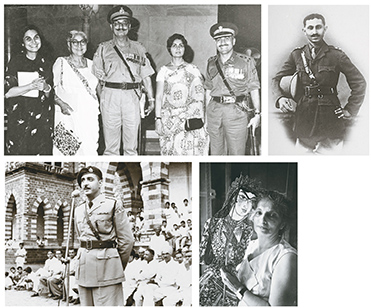
Maj Gen Rustom Khambatta (center) with mother Ruby and sister Dinar (on his right);
Capt Dhanjishaw Mogul; Meher Contractor; Inspector General of Police Pervez Writer.
The Karanjawala family’s contribution to the city of Ahmedabad was also extensive. In 1818 Muncherji Karanjawala settled in Ahmedabad with his wife Soonabai. He built religious structures and was the force behind the construction of the first dakhma in the city which was completed in 1843. With his own money he had a dharamshala built near the atash dadgah established by Kharshedji Nanavati. His descendant, Maneck Ardeshir Karanjawala’s contribution to the Municipal Corporation of Bombay was considerable.
Medora’s book is not just a list of brief biographies of prominent Parsis of the city but also deals with the edifices and institutions they set up. Fire temples, dharamshalas, clubs, religious institutions, stree mandals, hospitals, libraries, clock towers and fountains are but a few of the many structures bequeathed to the city. The genesis of the Ahmedabad Parsi Panchayat and the Ahmedabad Parsi Gymkhana provide valuable historical data.
Through the pages of the book we can piece together many facets of the social history of the community. We get a glimpse of the role women played in Parsi society. Their position in the domestic as well as the public sphere reflected the liberal and more egalitarian values. It is heartening to learn that in 1930 Bai Dinbai Sorabji Lalkaka and Dr (Miss) Goolbanu Dhanjibhai Medora were selected as committee members of the Parsi Panchayat.
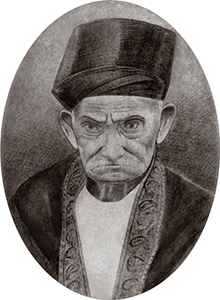
Dosabhai Hormazdji Kothavala
Peppered with ‘oral history’ the book acquires a warmth that brings alive the dead and enables us to visualize them as remarkable and lovable individuals we can connect with. The biographical sketch of Bamansha Shapurji Motana, "probably the first Parsi to be in charge of the Ahmedabad Municipal Fire Brigade” reveals him to be a man of legendary strength. He was said to be so strong that he could break "seven coconuts at one stroke: two in his armpits, two on the inside of his elbows, two behind the knee joints and one between his two palms.” His fire truck was drawn by two splendid white horses stabled in his own compound. Though accidentally blinded in one eye when a jet of water hit it with full force he continued to carry on with his duties undeterred.
Interspersed with the biographical sketches are glimpses of some social customs, like the elaborate tana ceremony that plays an important part in the construction of a dakhma. In the section "Genesis of Kankaria Agiyari: The Vakil-Wadia Misunderstanding,” the unfortunate incident leading to an estrangement between the two families is recounted. Sixty years later a Romeo and Juliet like drama unfolded with romance blooming between Jehangir, the grandson of Sir Rustom Vakil and Shirine, the granddaughter of Ardeshir Wadia. Three of Shirine’s old unmarried aunts and a bachelor uncle were determined to prevent the union. After much difficulty the young couple went to Bombay and got married but the elders never accepted the Vakil son-in-law. Today Shirine and Jehangir are grandparents.
Reading the book we cannot help being amazed at the varied and prolific contribution made by members of this minuscule community in the field of business, banking, the textile industry, government services, the armed forces, the police, education, the arts, medicine, social service and even cattle breeding!
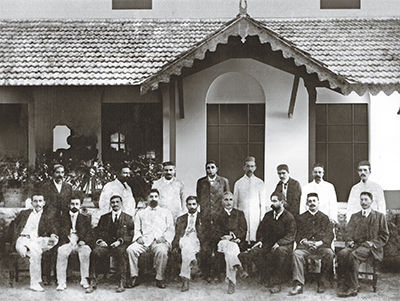
The Ahmedabad Parsi Gymkhana
The book is further enhanced by well chosen vintage photographs of people and places, which, in the words of the founder of the World Zarathushti Cultural Foundation Dr Homi Dhalla, "bring the past into the present.” The handsome looking volume is in an unusual square format and printed on art paper, using a very reader friendly typeface and is enriched with endnotes, reproductions of maps (including an ancient one on cloth), and family trees. However, there are some avoidable proofing errors (Arbab Guiv has appeared as Arab Guiv); a few inaccurate mentions of facts like ranks of service officers (Colonel Jal Cama has been referred to as Brigadier, a temporary field rank he held while in action), and Brigadier Nasli Bilimoria’s wife named as Sheroo, whereas he was married to her sister Rati. Sheroo was the wife of Adi C. P. Wadia. Rati, now nearing a century, is the grandmother of Lord Karan Bilimoria, the first Zoroastrian to be appointed to the House of Lords in UK.
The epilogue added by Meher lends a further dimension. Several Ahmedabadi Parsis who have settled abroad reminisce about their childhood and youth, recreating the ethos of the Parsi way of life they left behind. Their accounts of life in foreign lands reassure us that the Parsi spirit of enterprise is still alive and kicking. Reading this chapter will hopefully enable Ahmedabad’s Parsis to connect with each other even in distant lands.
Not only will the book be of immense value to students of Parsi history, but it will assume a more personal meaning for those who wish to get in touch with their Ahmedabadi roots. It brings to life ancestors long dead but not quite forgotten. Images, long frozen in musty albums, take on a new life and begin to tell their tale connecting the living with the dead, the present with the past.
◆ ◆ ◆
From the archive