
In Memoriam
Farhangi’s fortitude
Died: Manouchehr Farhangi, 82, entrepreneur, educator and philanthropist, of stab wounds in Madrid, Spain on March 19, 2008.
Man of a thousand benefactions, Manouchehr Farhangi fell prey to stab wounds at the hands of a woman. According to one of the Iranian websites, he had tried to stop the misuse of the old Iranian flag. The killing has been popularly construed as a political assassination.
"He had a smile for everyone, a joke to share and, if needed, a loan or a gift to see someone through hard times,” according to the tribute in Hamazor (#2, 2008), the newsmagazine of the World Zoroastrian Organisation (WZO). The benign octogenarian had chaired a meeting of the board of trustees of his International College Spain (ICS) barely a week before answering a ring at his door to encounter a murderess. The 700-student institution, accredited by the national and European boards of education, enjoyed a stunning ratio of seven students per staff — one that would be the envy of every serious student in India.
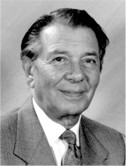
Manouchehr Farhangi: a life of service
Farhangi had expressed the desire that there should be no mourning when he died. Rather, there should be a celebration. Accordingly, the California Zoroastrian Center organized a celebration on April 20 where family and friends, Zoroastrian and non-Zoroastrian Iranians and the Iranian media participated. Dr Rustom Vahidi, newly arrived from Chicago to take on the job of residential priest, recited verses from the Gathas, translated into Farsi by Fariba Goshtasbi, which emphasized the importance of productive living and being progressive, states Hamazor. Among those who paid tribute were former Iranian deputy prime minister Dr Farhang Mehr, founder of the Zarathushtrian Assembly (ZA) Dr Ali Jafarey, Sydney based philanthropist Homer Abrahamian who has made it his life’s mission to establish a statue of Cyrus the Great in all the major cities of the world, former vice president of Federation of Zoroastrian Associations of North America (FEZANA) Dr Ardeshir Anoushiravani and others.
The Sydney based Australian Zoroastrian Association (AZA) of New South Wales celebrated Farhangi’s life on April 5, 2008 at the Bicentennial Olympic Park at the site of the statue of Cyrus the Great to which he had been a donor. The Kerman born philanthropist was remembered by AZA as "a person who advanced Zoroastrian culture and heritage,” as notes an e-mail to Parsiana from the AZA management committee.
Like other Zarathushti millionaires of Iran, Farhangi faced a new world in 1979 when the Islamic revolution upturned all they valued in their homeland. In the late 1960s Manouchehr, in partnership with his brothers Mehraban and Ardeshir, had bought a substantial plot of land on the shores of the Caspian Sea where he created a tourism complex called Dehkadeh Saheli. By 1979 the resort had over 350 villas and 70 apartments and more construction activity was in progress when the new revolutionary regime demanded an immediate halt. The reason? Men and women were not allowed to swim together in the sea, notes the Hamazor article. Not only was the construction work at a standstill, Farhangi’s office was taken over, his home ransacked, his valuable library looted and destroyed. The socially conscious entrepreneur, distinguished by his desire to build and offer products of high quality, had to helplessly watch his other companies — export import businesses, a pharmaceutical factory reckoned to be one of the largest in Iran — also being confiscated: he had no recourse in law.
Accepting a mission with some teachers and parents from the Iranzamin School in Tehran to reestablish the institution in Spain under the name International College Spain, Farhangi is said to have hired premises in Estepona on the Andalucian coast with enough capacity, including boarding facilities, to accommodate over 100 refugee staff and students from Iran. The organization demanded complicated legal, financial, educational inputs, and was largely financed by Farhangi. A few years later, faced with a dwindling student ratio, he shifted the institution to La Moraleja, Madrid, with 40 students and 14 staff members, becoming one of the earliest in the world to adopt the International Baccalaureate program at every level from Kindergarten to Grade XII. Here it has found new strength, harmonizing 50 different nationalities, earning high academic results and record university entries, becoming arguably the most prestigious international school in Spain, as notes Hamazor. In 2007 the European Council of International Schools presented Farhangi its Award for the Promotion of International Education.
While Mehr recalled Manouchehr’s progressive views and philanthropy -- all the brothers being generous, Mehraban having been a very substantial donor to the WZO (World Zoroastrian Organisation), Ardeshir, an active contributor to the building of the Darbe Mehr in Westminster, California and Manouchehr promoting all Iranian and Zoroastrian causes — Jafarey spoke of Manouchehr’s candor, straightforwardness and positive attitude. It seems on one occasion when he wanted a ZA representative to perform the navjote of a potential convert in Canada, he rejected Jafarey’s offer to perform the ceremony as he did not find the latter’s accent and rendition of the Avesta a very pleasant experience, records Hamazor. But he did invite Jafarey to perform the wedding of his son in Spain, saying, "For this purpose, you will do!”
Rustam Kasravi, a beneficiary of Manouchehr’s help in Spain while awaiting immigration to the US, recalled an incident when news of an Iranian family in dire straits in one of the coastal towns reached Farhangi. With the aid of another Iranian of high standing the family was located living under a bridge, brought to Madrid and on learning that the man had been the head of Islamic Studies at Tehran University, a similar course instituted in Madrid and the professor officially reinstated in a position of dignity.
Three days before his own tragic death Farhangi had called Abrahamian to express his apprehension that the latter may be on the target list of political assassins. Abrahamian remembered Farhangi’s support to many an Iranian intellectual in the diaspora involved in the promotion of ancient Iranian values by paying for their living expenses, publications, travels, etc, records Hamazor. Iranian TV personality Mehrdad Parsa endorsed the view, noting that Manouchehr was helpful to all needy Iranians irrespective of their religion.
According to Anoushiravani, whose wife Shida is Manouchehr’s niece, the latter believed that life was meant to be lived and enjoyed every moment. Do you really enjoy working so hard? Anoushiravani had once asked him and got the memorable answer, "Every moment of it gives me satisfaction and reason to do more.” On another occasion he had asked his nephew-in-law, known to be a student of the Gathas, "Do you consider me who has very little knowledge of the Gathas...who does not wear his sudreh and kusti, a Zarathushti or not?” He had also noted, "I cannot understand people whose mind is in celebrating grief, death and destruction. After all, a healthy mind is in a happy body/existence... Being steeped in mourning and having your holidays as days of one holy man’s death after another, does not result in a healthy mind.”
Farhangi is survived by his wife Far-anak, and sons Ramin and Ramesh.
◆ ◆ ◆
From the archive