
In Memoriam
The price of commitment
Died: Prof Kasra Vafadari, 59, former chair of Iranian History and Religions Before Islam at the University of Nanterres, Paris, of stabbing on May 16, 2005.
Died: Prof Kasra Vafadari, 59, former chair of Iranian History and Religions Before Islam at the University of Nanterres, Paris, of stabbing on May 16, 2005.
"I first met Kasra Vafadari during the revolutionary days of February 1979. He was imbued with the joys of this promising time of change. Despite his gentle academic demeanor, he took note of and responded to human and social concerns and events. He was probably the only prominent Zoroastrian who joined the early committees in Saedabad. Kasra easily coexisted with protest, yet remained apart. He had the sensitivity of an artist that can see the oppressed and speak to them,” noted Babak Zahraie at the Kasra Vafadari Memorial organized in Virginia, USA on June 26, 2005.
"Kasra came of age in the tumultuous and wondrous sixties, as a student at the Massachusetts Institute of Technology (MIT) in Cambridge. The civil rights and anti-Vietnam War era with its new, humanistic values, radical culture and politics shaped his youth and turned about his life. He would repeatedly return to the lessons learned, and the ideas formed in his youth. The last 40 years of his life reflect the significance of that impact. Kasra became a man that defied time; he became more open and progressive as he aged. His radiance and warmth drew the youth in Iran and abroad. They came to hear his thoughts but they stayed to see his smile and learn from his wisdom,” continued Zahraie.
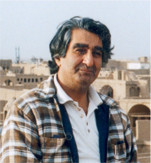
Vafadari: brought ancient history to life
"He was the first in the 20th century to rise on the Iranian scene on specific Zoroastrian grounds, step out of the narrow sectarian framework and address Zoroastrian youth with the basic ideals of love and freedom. He gave the young Iranians the vision of being proud of their ancient history by bringing the ancient history to life instead of looking to the West and the United States. He wanted Zarathushti youth to stand on their own cultural heritage and then seek exchange with other cultures. Kasra was a hope for not only young Zoroastrians but for all Iranians. He was trying to bring to light the undermined and forgotten Iranian culture. He started an internet site for the young Zoroastrians. For his last birthday, last March, he organized a celebration in the ruins of Persepolis and invited foreign media, just to introduce them to the great Iranian heritage,” writes Kasra’s sister Kateh in an email to Parsiana. Much of the following is her account of Vafadari’s life together with a few details learnt at the memorial ceremony held at the Zoroastrian Centre in London on July 3, 2005.
The eldest of four sons and one daughter born to Mehrangiz Firoozgar and Ardeshir Vafadari, Kasra was sent to his uncle Shahrokh Vafadari in England in 1956 for his primary and secondary education at the age of 10, recalled his cousin Rebecca Vafadari. When he was in England he studied French, German and Esperanto. He rode the bicycle to school and loved to listen to classical music.
Graduating from high school, he entered MIT to study physics in 1964 and became involved in the Vietnam anti-war movement. He left MIT and the study of physics and transferred to Boston University to complete his degree in English literature and social sciences. Drafted to join the US army to fight the Vietnam War, he refused to participate as a conscientious objector and as a Zoroastrian.
Kasra left the United States in 1970 for Ireland, where he studied for his Masters degree in Education at Trinity College, Dublin. Thereafter he went to Paris, where his brother Kaveh was living at the time. There he met Laurence and married her despite her family’s objections.
In 1975 Kasra and Laurence, are said to have returned to Iran where they lived simply on his father’s farm in Saeed-Abad, on the outskirts of Tehran. He served two years of the compulsory military services for the Iranian government, later worked for the Melli, now Beheshti University in Tehran and took part in the 1979 revolution against the Shah and monarchy, supporting a democratic and republican government for Iran. He became a member of Saeed-Abad committee to defend the neighborhood. He did not belong to any particular political group or tendency, but was against autocracy and for democracy in Iran. Following the cultural revolution that closed the Iranian universities he was left with no job and had no choice but to leave Iran with his wife and two daughters, Afsaneh (Cassandra) and Ariana, for Paris.
In 1992 he went back to Iran with Laurence for a visit. After that he started going back to Iran on every occasion he could find, with Laurence, with his daughters or by himself. He became interested in the Zoroastrian cause and started doing research in Iranian Zoroastrian history, religion, tradition and way of living, travelling around the country and meeting all kinds of people. Eventually when his daughters were grown up and started their own independent lives Kasra decided to go back to Iran with Laurence, but this time she did not want to live in Iran, and the two separated.
In 1997 Kasra ran for election as the Zoroastrian representative in the Majlis and won the majority vote. But he was labelled and told by the authorities not to accept the position. He was very disappointed and furious and could not understand it and wanted to fight back, notes Kateh. This hampered his plans and he would have achieved a lot more, she says, if he had been allowed to officially lead the Zarathushti community. However, he did not flinch from his goals, and deciding not to bother with the bureaucratic and controlled organizations, stayed independent.
He started his own research classes on Zoroastrianism in his late father’s house, where his mother lived, with enthusiastic Iranians and Zoroastrians. He made it possible for the young people to get together and practice music, singing, exercise and plays. He produced a number of short documentary books on Zoroastrians and Zoroastrianism, travelled to many parts of Europe and participated in many conferences on cultural, social, and historical themes.
At a conference in the School of Oriental and African Studies (SOAS) on February 12, 1999, when Vafadari was supposed to open the afternoon session lecturing on the situation of the Zoroastrians in Iran, Kasra went to have coffee with two unidentified men who wanted to talk to him during the coffee break and did not show up for the conference, according to the conference organizers and Laurence, who was with him. The police were contacted and Kasra returned safe, after eight hours. Dr Hosein Lajevardi, the president of the Paris-based Association of Iranian Researchers, says that Kasra had informed him that his two alleged abductors had warned him against taking part in the conference, threatening that if he spoke, not only would he put his own life at risk, but he would also create problems for the Zoroastrian community that enjoys limited freedom in today’s Iran.
According to Mandana Moavenat, an Iranian Zoroastrian studying at SOAS, Vafadari addressed not only Zoroastrian youth but others as well, organizing lectures by famous people whom he invited at his own expense. He had started his website yathaahu.com and had twice conducted tours to Atash Kadeh Gushtasp in Azarbaijan, along with Perviz Varjavand of the US. He had started conducting monthly jashans and social evenings and at the last Ardibehst jashan had announced that he was going to France for a consultation with his cardiologist.
He never returned. He was murdered just prior to his flight home. Kasra is survived by his wife Laurence, daughters Afsaneh and Ariana, sister Kateh and brothers Kaveh, Goshtasb and Karan.
◆ ◆ ◆
From the archive