
Felicitations
A culture that binds
The Indo-Iranian Friendship Society holds a public reception for the visiting Iranian Vice President
"Allow me to invite each one of you to come to Iran, especially the younger people. Maintain your link with Iran. If you are introduced by The Indo-Iranian Friendship Society (IIFS), your trip will be completely free,” S. Rahim Mashaee, Vice President of the Islamic Republic of Iran and head of its Cultural Heritage and Tourism Organization, addressed the largely Parsi audience at the Walchand Hirachand Hall of the Indian Merchants’ Chamber on May 2, 2008. The occasion was a reception in his honor held by the IIFS.
The man who Godrej Dotivala, secretary general of the IIFS, introduced as the "most westernized of all the ministers we met” on a trip to Iran organized by the Society, chose to speak in Persian with an interpreter trying hard to keep up with the flow of words. Said Mashaee, "I can’t express my thoughts, feelings, aspirations in the English language. That is why I am happy to speak in a language that has the power to express the convergence of knowledge and love…I come from the land of love, of light, of science, of knowledge…All people are answerable to the land which represents human rights,” noted the Vice President though he did not mention Achemenian Emperor Cyrus or his cylinder which is revered as the first bill of human rights. "Today’s function is emblematic of the friendly light which will never die as also the reverence for human values,” he added. Mashaee’s long discourse did not make for easy interpretation to a restive audience but the few who understood Persian well, like Islamic scholars Prof Zeenat Shaukatali of St Xavier’s College and retired Prof Sabar Havewalla, were truly appreciative. One of the points the Vice President made is that the force that unites people is godly while that which divides is evil. Hence the move towards globalization goes to show that God is winning, Shaukatali told us.
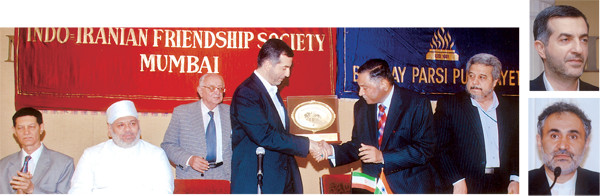
Burjor Antia (right) presenting salver to S. Rahim Mashaee. Others (from left) are Homi Dhalla, Dastur Khurshed Dastoor, Godrej Dotivala and Seyed M. Nabizadeh. Right: Mashaee (top) and Ali Mohammadi
In his welcome address the consul general of Iran in Bombay Ali Mohammadi, a guest of honor on the occasion, referred to the Navroz celebrations hosted by the Iranian Zoroastrian Anjuman annually where the official representatives of Iran are honored guests. Dotivala spoke of the activities of the Society which had been established in 2005 by Bombay Parsi Punchayet (BPP) chairman Minoo Shroff and Mohammed Shokrani who was then the Iranian consul general in Bombay. The Society has been hosting several Iranian delegations and dignitaries and had organized a very successful trip to Iran. He also welcomed the diplomatic representatives of Afghanistan, Korea, Malaysia, Egypt and Ghana who were present that evening.
Chief guest Seyed Mehdi Nabizadeh, Iranian ambassador to India, referred to the long standing relationship between India and Iran dating back to over 3,000 years, well before Islam. "If you have any visa problem, it is my duty to provide a solution. We want to make it possible for everyone to go to Iran,” he noted. While cultural relations between the two countries continue to thrive, Nabizadeh stressed the need for economic expansion to enable business also to prosper at both ends.
Other guests of honor that evening were IIFS vice president and Akbarallys’ chairman Fakhruddin Khorakiwala, Dr Homi Dhalla, president of the World Zarathushti Cultural Foundation, real estate developer Zarir Bhathena and Jimmy Mistry, founder of the Parsi Resource Group. Khorakiwala urged an expansion of tourism – "International relationships are built and expanded through tourism”— and exchange of handicrafts between the two countries. He was also in favor of an early start to the common gas pipeline that would help the economies of Iran, Pakistan and India. Glad that Parsis "had not forgotten their fatherland,” Khorakiwala referred to the dwindling community which "in the next 50 to 100 years may not exist here,” and suggested it be exempt from family planning. Bhathena who is on the B. D. Petit Parsee General Hospital management board was quick to assure him that "since the last five years the birth rate is going up. I don’t think the Zoroastrian community will die out in 300 or even 500 years!”
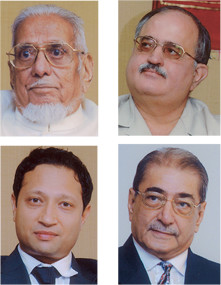
Clockwise from top left: Fakhruddin Khorakiwala, Zarir Bhathena, Behram Dastur and Jimmy Mistry
Referring to the historical contribution of India and Iran to the "culture of peace,” Dhalla spoke on how they can contribute to "this strife-torn world.” Noting that "mysticism, Sufism are based on pure love,” Dhalla said "their message is relevant to our times.” Stressing the urgent need for dialog, Dhalla added, "There can be no peace among nations without peace among religions. And there can be no peace among religions without a dialog between them.” He rued the way human rights are being trampled underfoot in various countries despite being signatories to the United Nations’ Universal Declaration of Human Rights and referred to the "scourge of female feticide” which he maintained was the end result of the social discrimination against females, even as he saluted Iranian campaigner and Nobel prize winner Shirin Ebadi for her tireless work in the field of human rights.
But if the success of the evening was to be judged by the impact of the presentation on the visiting Iranians, it was Mistry who hit right on target with his audio-visual presentation evoking the grandeur of Per-sepolis which he had first tried to recreate at his daughter’s navjote and is now seeking to embody in a building he is constructing in Dadar. He said his aim was to "let Parsis experience the true glory of Persia.”
BPP trustee Burjor Antia who presented a memento to the visiting Iranian Vice President — a host of other Zoroastrian organizations also presented him with shawls and flowers — brought the evening to a close with his remarks on the centuries of association between the two countries, the long years when Persian was the official language of India, the impact of the association on art, architecture, literature and philosophy. "The world is my country and not to harm anyone is my religion,” he concluded.
◆ ◆ ◆
From the archive