
Zoroastrians Abroad
"Even a priest has to use logic"
While enunciating his belief in ancient traditions Mobed Mehraban Firouzgary notes change has to come
Iran’s seniormost mobed, who has been authorized by the country’s Justice Ministry as the sole Zarathushti marriage license issuing authority in Tehran, Mehraban Firouzgary says, "The religion teaches me that I have come to this earth with its equal distribution of good and evil, to cultivate my vohu mano (good mind), to follow the path of Asha, without recourse to the use of force for any gain. I am debarred from living an inactive or ascetic life. I must keep myself active in speaking good words and performing good deeds; in creating a healthy social order and a cheerful community. To me, happiness is a God given gift.”
Speaking on the subject, "Zarathushtis of Iran: a community that thrives on festivities and believes in charity,” at the Eighth World Zoroastrian Congress in London, Firouzgary said they are "given a chance to be in festive mood every other day. But the privilege is used less and less as life is becoming increasingly materialistic and complicated.” Speaking of earlier years when people were engaged in agriculture and small businesses, he said Jamshedi Navroz celebrations continued a full 21 days after the event and began a month earlier as house cleaning and "soul cleaning” were seriously pursued. "It is our religious duty to eliminate hard feelings. At Navroz time, family feuds are forgotten. During the afringan days a grand religious atmosphere prevails, good food is exchanged and provisions are made for the needy. There is no mourning — there is an ancient belief that tears for the dead form a strong current of water hindering the progress of the soul. In the old days piped music used to accompany a funeral.” But prayers for the dead, religious lectures and the partaking and sharing of sanctified food gave "fresh energy with which to face the outside world.”
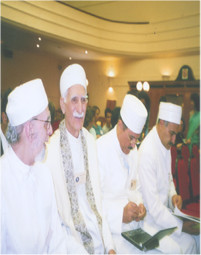
Firouzgary: "life is getting materialistic”
Oriented with the vernal equinox, the Jamshedi Navroz territory includes Tajikistan, Uzbekistan, Afghanistan and many other countries, says Firouzgary. Earlier, the Kadmis in Iran used to celebrate Jamshedi Navroz as a national celebration because their religious calendar differed from that of the others, he notes. However, when the Islamic government accepted the Zoroastrian calendar months, everyone in Iran accepted the (common) Zoroastrian calendar.
"Rohinton Rivetna had invited me [for world body (WB) consultations] from the beginning,” recalls Firouzgary. "The anjuman president in 2003 was Abadian. But the anjuman was divided . Some people felt that the WB may create divisions and before we could come, we got messages that this should not be done. When we came to Delhi for the PARZOR meet, we met (some people) who gave the impression that the new body will interfere in World Zoroastrian Organisation (WZO) affairs. Now we have a new start.” Noting that former Tehran Anjuman president Dr Ardeshir Khorshedian likes the idea of the International Zoroastrian Organization (IZO) "provided there is no domination,” Firouzgary says that the constitution will be translated when it is sent to them, then put to the vote of the community. After that they will write to the government for permission to join the foreign body. "Any association has to be registered with the government. The government will take a year or so to look it up…We suggest, send a draft to the Kankash e Mobedan (the Iranian Council of Mobeds) because the other anjuman has just taken office, though it has more authority for such things. Its new president Allahayar Daneshmand is a retired engineer.”
Though Firouzgary is a member of World Alliance of Parsi Irani Zarthoshtis (WAPIZ), he doubts if the Kankash e Mobedan can join the body. He says that he has told WAPIZ that one can’t bring back old traditions: "As a mobed I cannot agree to conversion or intermarriage. I am automatically with you in these two respects. But if you want me to personally persuade people to enforce menstrual restrictions, etc it is too late. As a priest I cannot go against these things but even a priest has to use logic… The dakhmas in Yazd and Kerman went out of use in the 1970s. The dakhmas in Tehran fell into disuse much earlier because they were surrounded by residential localities… As long as I live, I won’t break traditions. But it is my belief that the next generation will do away with more traditions because life is getting more materialistic. It is difficult to maintain strict rules. They were good in those days. They were the best means of preserving hygiene. But now things are different. Taro was a preservative,” he reminds us, referring to a statement by K. R. Cama Oriental Institute trustee Homai Modi who had informed the gathering the prior day that she had learnt in the process of conservation that some of the best yellow color ever used in paintings and engravings in the past was created by using the yellow urine of a cow which had been fed on large quantities of mango.
That migration and small families are diminishing the Zarathushti community in Iran, is particularly saddening to Firouzgary who says he was the 11th child of his parents — "there was nearly a 40-year age difference between my brother and me!” In an interview with Parsiana he recalls that in Iran in the aftermath of World War I it was tough for the minorities. When he was a boy, people thought that "in India money grows on trees!” His father had come to Bombay, working as a full time priest at the Dadysett Agiary. His eldest brother Sorab was doing the same at the Mazagon Agiary until he married a girl from Nasik and left mobedi to look after her family’s bakery and restaurant in Nasik.
Their father had wanted to bring the whole family to India. Accordingly, he pulled Mehraban out of the fourth standard in the primary school where he was studying in December 1947, to bring him to India and get him admitted into the Cama Athornan Madressa. They stayed with Sorab in Nasik until the following June when the Cama Madressa’s principal refused admission to Mehraban because he was already 12 years old and couldn’t hope to become a navar before puberty. A dejected father and son were lunching at the Café Mondegar in Bombay where the boy was offered a job. After three months at the Café, the family decided to send him to Boys’ Town in Nasik as a day scholar, staying with Sorab and learning all his prayers in the meantime. After matriculation he went back to Iran where he did his bareshnum and qualified as a mobed before returning to India to complete his interscience from Jai Hind College and graduating in electronics and radio engineering from St Xavier’s Technical Institute. After about 10 years as a service engineer with J. N. Marshall he decided to go back to Iran which had developed a lot under the Shah.
Firouzgary had been married to Piroja Nandar Irani and had an infant son — Farokh — when he was transferred to J. N. Marshall’s Delhi office. The intense heat of the Delhi summer was more than Piroja could bear. She fell into a coma, was hospitalized, but did not survive. Her remains lie in the Delhi aramgah, notes the Mobed. Farokh now settled in Houston, has two children, he adds.
Later in life Firouzgary married Mehrangiz. Their son Meherdad holds a doctorate in pharmacy.His wife is similarly qualified. They are a DINK family (double income, no kids) in Iran. But Firouzgary notes that they are a case in point as "the trend is for young people to marry later in life and have few children…”
◆ ◆ ◆
From the archive