
In Memoriam
The prudent patriot
Died: Dr Farhang Mehr, 94, Iran’s former deputy prime minister who left the country during the Islamic revolution, erstwhile president of the Zoroastrian Anjuman of Tehran, editor of Humata, the journal of the Center for Ancient Iranian Studies, and professor emeritus of Boston University (BU); on March 4, 2018 in Southern California.
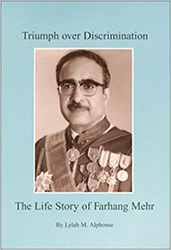
"I resisted exchanging my religion for a higher political office, and I refused to sacrifice my heritage at the altars of prestige and political acceptance. As such I was able to set an example for other Zarathushtis in Iran, one that I hope will continue,” Mehr had expressed in his biography Triumph Over Discrimination: The Life Story of Farhang Mehr authored by Lyla Alphonse. Erstwhile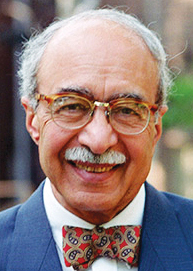 deputy minister in charge of finance and economic affairs, he was prohibited from serving as minister of finance due to religious discrimination. Then Prime Minister Amir Abbas Hoveyda appointed Mehr deputy prime minister of Iran, the first non-Muslim to occupy the position.
"I believed then and still believe in a civil society… (where) Zarathushti citizens should be politically active. Without power or access to power, survival and progress are unattainable,” declared Mehr who eventually resigned from government service and became chairman of the board of Bimeh-ye Iran, the largest insurance company in Iran.
He was in his late 50s when he was forced to flee from Iran to avoid religious persecution. Although the revolutionary authorities had reappointed him president of the Pahlavi University in Shiraz in 1979, he became a victim of later purges. Risking his life, he took the escape route via Turkey until he found freedom in the United States. Once his wife and children joined him, they settled in the Boston area where Mehr taught international relations from 1981 to 1997, teaching courses on the international politics of oil and Iranian history at BU’s Frederick S. Pardee School of Global Studies. His "appointment as a professor at BU allowed him to reconstitute his life,” commented Houchang Chehabi, Professor of International Relations and History at the Pardee School, in the obituary on Mehr on the School’s website. Mehr had earlier taught at the Tehran and National Universities and at the Military Academy in Iran.
"When I left Iran, I also left my dreams for that country unrealized. But I carried within me my dreams for the future of Zoroastrianism, and I continue to work toward strengthening the fabric of the Zoroastrian community in the diaspora,” Mehr had remarked in an interview in 1999 prior to the publication of his biography. Author of more than 80 articles and a dozen books, Mehr’s The Zoroastrian Tradition, An Introduction to the Ancient Wisdom of Zarathushtra is recommended reading by Bozorg Bazgasht Organization, a part of Det Norske Zarathushthriske Trossamfunn (Zarathushtrian Association of Norway). The Association’s "goal is to help people all around the world to learn and convert to the Zarathushtrian religion,” if the candidate has educated himself/herself in Zarathushtrian theology, ideology, philosophy, history and basic prayers known as ‘Avestaye Bayesteh’ which (are) daily prayers one should learn before being initiated.”
"I resisted exchanging my religion for a higher political office, and I refused to sacrifice my heritage at the altars of prestige and political acceptance. As such I was able to set an example for other Zarathushtis in Iran, one that I hope will continue,” Mehr had expressed in his biography Triumph Over Discrimination: The Life Story of Farhang Mehr authored by Lyla Alphonse. Erstwhile
deputy minister in charge of finance and economic affairs, he was prohibited from serving as minister of finance due to religious discrimination. Then Prime Minister Amir Abbas Hoveyda appointed Mehr deputy prime minister of Iran, the first non-Muslim to occupy the position."I believed then and still believe in a civil society… (where) Zarathushti citizens should be politically active. Without power or access to power, survival and progress are unattainable,” declared Mehr who eventually resigned from government service and became chairman of the board of Bimeh-ye Iran, the largest insurance company in Iran.
He was in his late 50s when he was forced to flee from Iran to avoid religious persecution. Although the revolutionary authorities had reappointed him president of the Pahlavi University in Shiraz in 1979, he became a victim of later purges. Risking his life, he took the escape route via Turkey until he found freedom in the United States. Once his wife and children joined him, they settled in the Boston area where Mehr taught international relations from 1981 to 1997, teaching courses on the international politics of oil and Iranian history at BU’s Frederick S. Pardee School of Global Studies. His "appointment as a professor at BU allowed him to reconstitute his life,” commented Houchang Chehabi, Professor of International Relations and History at the Pardee School, in the obituary on Mehr on the School’s website. Mehr had earlier taught at the Tehran and National Universities and at the Military Academy in Iran.
"When I left Iran, I also left my dreams for that country unrealized. But I carried within me my dreams for the future of Zoroastrianism, and I continue to work toward strengthening the fabric of the Zoroastrian community in the diaspora,” Mehr had remarked in an interview in 1999 prior to the publication of his biography. Author of more than 80 articles and a dozen books, Mehr’s The Zoroastrian Tradition, An Introduction to the Ancient Wisdom of Zarathushtra is recommended reading by Bozorg Bazgasht Organization, a part of Det Norske Zarathushthriske Trossamfunn (Zarathushtrian Association of Norway). The Association’s "goal is to help people all around the world to learn and convert to the Zarathushtrian religion,” if the candidate has educated himself/herself in Zarathushtrian theology, ideology, philosophy, history and basic prayers known as ‘Avestaye Bayesteh’ which (are) daily prayers one should learn before being initiated.”
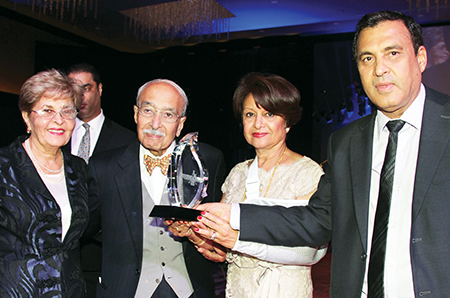
Dr Farhang Mehr (top and above presented memento at the XVII North American
Zoroastrian Congress in 2015 with from l) Parichehr Mehr, Zane Dalal,
Shida Anoshiravani and Khushroo Lakdawala Photo: Jasmine D. Driver
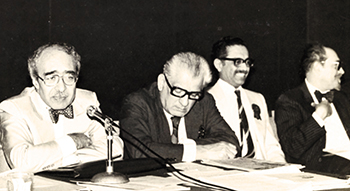
At the Fourth World Zoroastrian Congress in 1985 (from l):
Mehr, Peshotan Nargolwala, Shahpur Captain, Prof Kaikhosrov Irani
Involved with the Federation of Zoroastrian Associations of North America (FEZANA) since its inception, and also with the local Zoroastrian associations where he resided, he was one of only six recipients of the FEZANA Lifetime Achievement Awards presented for "service to the Zarathushti community worldwide,” acknowledged FEZANA. The third North American Zoroastrian to win the Lifetime Achievement Award since the awards were instituted in 1988, Mehr was honored at the 12th North American Zoroastrian Congress hosted by the Zoroastrian Association of Metropolitan Chicago (ZAC), July 4-7, 2002 (see "North American Awards,” Parsiana, September 2002). The highly respected awardee was commended since "his preeminence enabled him to imprint reforms of lasting impact on Iran’s economic, education, financial, insurance and oil sectors... As his career progressed, his personal example and efforts persuaded Islamic officials to open doors of high public offices closed for centuries to other Zarathushtis, and initiate religious equality and social acceptance of Zarathushtis.”
 The citation forwarded by then FEZANA awards committee chair Dinshaw Joshi noted, "His wisdom, leadership and service... has contributed immensely to raise public recognition of the Zarathushti community in North America... His scholarly advice, urging rationality, prudence and moderation on contemporary religious and community issues, is heeded equally by adult and young Zarathushtis around the world. His dedicated community leadership has enabled Zarathushtis in Iran to face their future with greater confidence, encouraged Zarathushti youth to be active in shaping the community’s destiny and for Tehran’s Mobed Kankash to modernize its outlook on religious and community matters. Further, through his leadership, world Zarathushti congresses have become a norm and countless Iranian Zarathushti families have found safe asylum in western countries.”
 He was born in Tehran to Mehraban and Paridokht Mehr. After graduating in mechanical engineering from the Tehran Polytechnic (now known as the Amirkabir University of Technology), he obtained a bachelor’s degree from Tehran University’s School of Law, Economics and Political Science. Then he went to England where he earned an LLM from the London School of Economics, University of London, and a Doctor of Philosophy from the University of Southampton. Nearly two decades later he was awarded LLD (honoris causa) by the University of Pennsylvania, states Wikipedia.
In his youth he had organized Sazeman-e Javanan-e Zartoshti with the goal of fostering unity and awareness amongst Zoroastrian youth, particularly in their struggle to obtain more rights in Iran. In 1949 when he was elected to Anjoman-e Zartoshtian-e Tehran, he was its youngest member. The following year, "while in the UK he joined the Zoroastrian Trust Funds of Europe (ZTFE). On his return to Iran in 1957 (he) again assumed an active role in the Zoroastrian community and was elected chairman of the Tehrani Zoroastrian Anjoman, a position he held until the Islamic Revolution of 1979,” noted a communiqué from ZTFE president Malcolm Deboo. "Even with all the prejudice he incurred,” he remained "an Iranian patriot,” reiterated Deboo.
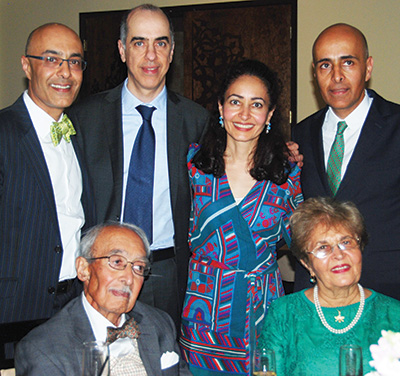
From l: seated: Farhang and Parichehr; standing: Mehrdad,
Esfandiar Sorouchyari, Mitra and Mehran Mehr
A founder member of the liberal World Zoroastrian Organisation, in his biography, Mehr had stressed, "We should maintain a community of Zarathushtis in mind and in heart, treading together the path of truth and righteousness. As a single entity we should be showing love, upholding justice, exercising compassion, working for peace, engaging creatively in constructive work… In a quest for survival and in an attempt to fight social ills, the Zoroastrian community has split into three distinct ideological groups: traditionalists, reformists and moderates. The division in and of itself is not a threat to the solidarity of the Zoroastrian community; it is merely a sign of spiritual awakening and religious revival… The acceptance of people born to non-Zarathushti parents is not a threat to the survival of the religion. The tradition of non-acceptance is a threat to our very existence.”
At the World Zoroastrian Congresses, Mehr shared his voice of reason. As he had remarked at the Eighth World Zoroastrian Congress in London in 2005, "There is no distinction between Parsis and Zarathushtis…We are an extended family. We must support and help each other…This inheritance, this culture we must preserve. The goodwill, truthfulness, charity, we can’t let them go waste (see "Dialog and divergence,” Parsiana, July 21, 2005).” Addressing the Iranians in London, he had stated, "Our religion is the religion of wisdom. The Prophet has told us that each of us has his/her own wisdom, we must think for ourselves. That is why we have so much freedom in our religion which you do not see with others.”
The rational reformist is survived by his wife Parichehr, sons Mehrdad and Mehran, and daughter Mitra.
◆ ◆ ◆
From the archive