
In Memoriam
Paeans to the Policeman
He saw India defeat Pakistan on the television screen from his room at the Jaslok Hospital and retired to bed. This World Cup series cricket match was the last encounter between the neighboring countries that Khusro Faramroze Rustamji witnessed before he passed away in his sleep on March 2, 2003. Three decades earlier Rustamji was on the field himself, the battlefield, when as the founder director general of the Border Security Force (BSF) he had played a key role in the nation’s victory at the Indo-Pakistan War of 1971.
Then defence secretary K. B. Lall had written in his letter dated January 6, 1972, "A special word of thanks to the director general of the BSF and to the men and officers under his command is overdue. It is their initial initiatives, their boldness, courage and... imagination which provided eventually an opportunity to the Defence Services to do their part...”
When then Prime Minister of India Lal Bahadur Shastri selected Rustamji to create a force that would patrol the borders of West Pakistan, East Pakistan (now Bangladesh), Burma, Jammu and Kashmir, Punjab, Gujarat, Rajasthan, West Bengal, Assam, Nagaland and Tripura, Rustamji reportedly convinced the Prime Minister that this police culture could not do. Nor the army culture. The BSF needed "a culture of its own with officers and men from the police, the army, the navy and air force...” He wanted a totally impartial force.
As recalled Birbal Nath, retired director general of the BSF, in his condolence letter, "Literally we sat at his feet when we joined the BSF. He not only taught us the profession but human values of integrity and togetherness. He was a leader who transmitted to us all what is the best in our civilization.”
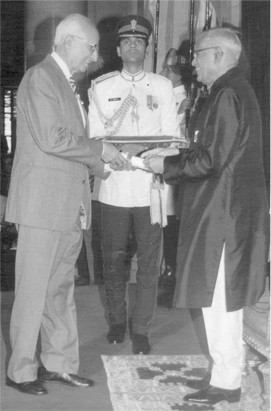
Rustamji (left) being conferred the Padma Vibhushan in 1991
The day he took over as director general of the BSF there was nobody but himself in this force. The day he left nine years later there were about 60,000 officers and men, each officer hand picked by him and a special team, each constable enlisted by a trusted deputy and tested for education, fitness and courage, noted a brief biography of Rustamji readied for a compendium. After a decade with the BSF he served a three-year term as secretary in the ministry of home affairs. "Rustamji left a deep impression of his caliber and professional competence which has rightly earned him the title of ‘doyen of Indian police,’” noted N. Gopalaswami, home secretary to the Government of India.
The 86-year-old veteran policeman was accorded a state funeral with full police honors on March 2, 2003. A special emissary from Delhi represented the BSF at the funeral. The air outside Chandanwadi Crematorium resonated with the gunshots as the lone bugle hauntingly sounded the Last Post. "This honor was a tribute to his years and years of service to the police force of which he was a proud member and to which he was committed way beyond his retirement. The reverence which the police had for Rustamji was eminently felt by the presence of the seniormost officers, both past and present,” wrote Farzana Contractor in the Afternoon Despatch and Courier of March 3. Former police commissioner Julio Ribeiro said at the Crematorium, "We always turned to him for guidance and the police force not only in Bombay, but in the state and in India has suffered a great loss.” Many police officers rang up his residence to convey that they felt as if they had lost their own father.
At a condolence meeting held at the headquarters of the Maharashtra director general of police, senior police officers, past and present, spoke glowingly of Rustamji, as reported in the Afternoon of March 20. "Apart from being a father figure to the force, he was the one whom we often sought advice from,” said Shreekant Bapat, Bombay’s police commissioner during the 1992 riots, describing Rustamji as "a visionary and an officer far ahead of his time.” Former police commissioner Satish Sahney noted, "His presence was reassuring and only with time will we realize the kind of loss we have suffered,” while another former commissioner Ronald Mendonca talked of the support Rustamji always gave junior IPS (Indian Police Service) officers. Outgoing joint commissioner of police (crime) Shreedhar Wagal recalled being impressed by his amazing physical fitness and mental alertness: "He used to keep himself abreast of situations and there were certainly new things to learn from him.” As commented former commissioner M. N. Singh, "He was an intellectual and a thorough professional, but what struck me most was his nobility and humility.”
Nagpur born Rustamji was selected for the Indian Police in 1938 after he did his postgraduation in zoology from the Nagpur University. "An officer with an incisive mind, he was in charge of the security of India’s first Prime Minister Pandit Nehru,” recalled Keki Dadabhoy of Secunderabad adding, "He will always be remembered for his remarkable contribution in the management of men.” In 1949 he was deputed to Hyderabad state as the deputy inspector general and a decade afterwards he was promoted as inspector general of police, Madhya Pradesh.
"The basis of good police work is knowledge of the area and public support which means a good relationship with the Press... details of crime and criminals, relations, informers, receivers, supporters, all properly recorded and brought up-to-date from time to time,” he had learnt early. "The police make the best scapegoats and police become the worst sufferers,” realized Rustamji, "The one lesson which nobody is prepared to learn is that the police must not trust politicians who say that the law can be ignored,” Rustamji was quoted in the biography.
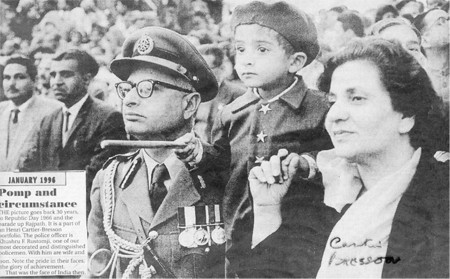
Rustamji with Naju and Cyrus witnessing the Republic Day parade. The 1966 photo by Henri Cartier-Bresson was reproduced in the media 30 years later
He had served a five-year term as member of the National Police Commission and was in 1990 appointed member of the National Integration Council. The proposals of the Police Commission which were kept in cold storage for years thereafter had recommended "a method of reducing, if not eliminating, the grip of the party in power on the police which is exercised by the use of unabashed transfers, promotions or protection of those who help them in corruption and transfer to oblivion posts those who show an inclination to be subservient to the law and not to them,” mentioned Rustamji’s biography. Over the years he was conferred medals for distinguished conduct and distinguished service, he was honored with the Padma Bhushan in 1971 and with the Padma Vibhushan in 1991, according to his bio data. The Padma Bhushan recognized his exemplary contribution to the police force while the Padma Vibhushan was in honor of his commitment to social and humanitarian causes.
After his retirement from the police force he served as director of different companies controlled by Nusli Wadia of Bombay Dyeing, was chairman of Goodricke Tea in Assam and was regular with his articles and columns, writing for newspapers on socially relevant issues like the plight of the undertrials languishing in the Tihar jail for want of a court hearing, mentioned his daughter Kerman. "We will greatly miss his brilliant contributions to our feature service,” noted a condolence letter from the India News and Feature Alliance adding that "the readers... admired him for his candid comments on topical issues and the courage of his convictions.”
"He always believed in taking the path least travelled,” remembers Ker-man, describing her father as "a maverick who taught us to lead and not to follow...He just could not get enough of life. He wanted to go to Nepal, to Tibet, to the Himalayas.” When he visited Kerman in Hyderabad he regretted not being taken to see the Film City. A trip to any state invariably meant a meeting with the director general of police there. And yet the national figure was equally comfortable having discussions with the rickshaw driver or cabbie to ascertain their views on different issues. In 1997 he inaugurated the Rustamji Institute of Information Technology at the All India BSF Training Centre at Tekanpur near Gwalior. In his will he has bequeathed a corpus of four lakh rupees to the Institute to be used to annually finance the education of a female student.
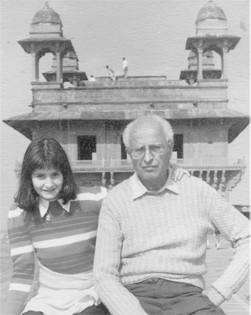
Rustamji with granddaughter Zenobia
To Kerman her father was always "kind, gentle, caring...He would never be shocked about anything. He would let you work out your own problems; look at things neutrally; never be judgmental... He was diplomatic and yet frank. His actions were totally from the heart. Very spontaneous, he was full of laughter and jokes. He would always like to start his speech with a funny anecdote...”
Having enjoyed the Rustamjis’ hospitality on innumerable occasions when she and her family visited them at different postings Freny Dalal-Paghdiwala remembered the awe and respect the considerate and generous Rustamji commanded from them as juniors. Everybody in the house had to be at the table at the appointed hour for every meal when nutritious food (that would include some rare variety of home grown raw spinach) would be served. In the evenings though the youngsters would be taken out for a treat! For personal outings with the family, it was always his private car that was used and never the state allocated Impala that was reserved for official trips.
Routine and regular exercise dominated his lifestyle until a couple of months prior to his demise. The physical illhealth of his wife Naju who required biweekly dialysis was very stressful for him, observed Kerman. "There was great love between him and Naju,” it was reported on the Diary page of the Afternoon of March 4, "He looked forward to rushing home to her. All through her recent illness, on days when she was not undergoing dialysis, Khusro would often take her for a drive to Worli Seaface in the evening. We used to think that for anybody in their late 80s, one sunset was as good as the next one. But not for this couple. They loved life, they loved each other.” In fact, he had developed a crack in his spine when trying to rush to Naju’s aid (to lift her off the floor where she had fallen) he had slipped. Rather than have others worry about his condition he continued with his normal chores until the pain became unbearable and he had to be hospitalized.
A daily walk was a must with the tall, 6’2” policeman and until the age of 75 when he had fallen off a horse and fractured his ribs, Rustamji would regularly go riding too. When he was posted in Bhopal the family had different pets that included dogs, a panther, a deer and a horse! After he had settled in Bombay, bazaring at Bhaji galli (at Grant Road) was a part of his routine too and the fishermongers there knew that he came shopping not only for his family’s needs but also those of his servants!
He may not have visited a fire-temple on a regular basis but he followed the path of good thoughts, words and deeds, observed Kerman who considered him "a little short of agnostic. He did not believe in rites and rituals. In the absence of vultures he felt dakhmenashini was archaic. He had a Hindustani approach to life, believing that caste and creed would pull us down and not help us as a nation.”
"We in India have not yet comprehended that in today’s world the community has to adapt, accept, even compromise in the interest of maintaining harmony, and helping each other in joy and sorrow,” Rustamji, a former president of the Delhi Parsi Anjuman, had conveyed in an article, "A difference of approach” (Parsiana, October 1996).
As summed up P. R. Parthasarathy of the IPS, "The more we tried the more we realized what a big and unbridgeable gap there was between him and us. His thinking was so pure and devoid of an evil thought. Even in his criticism he was soft to the extent of ending up being ‘generous.’”
The upright police officer is survived by his wife Naju, daughter Kerman and son Cyrus.
◆ ◆ ◆
From the archive