
History
Commemorating a Khan Bahadur
The first Indian head of the Bombay Criminal Investigation Department, Kavasji Petigara was fondly remembered by the police department on his 75th death anniversary
Commissioner of Bombay police Dattatray Padsalgikar was a young officer in the force when he chanced upon a life sized marble statue of Khan Bahadur Kavasji Petigara, the first Indian officer to head the Bombay CID (Criminal Investigation Department), at Dhobi Talao, when he was driving past the busy traffic junction. His admiration for the police officer "grew and grew as he read about him.” Speaking at a function organized by the Bombay police to commemorate the 75th death anniversary of Petigara at Framjee Cawasjee Institute on March 29, 2016, he called the occasion a "memorial service to an icon of the police force.” When he "discovered by chance” about the upcoming anniversary of the passing away of Petigara, he "chose to pay tribute in my own personal way” by organizing the event. "He epitomized the presence of Parsi officers in the Bombay police force,” said Padsalgikar and surmised that Petigara "watches over the city even today to ensure it stays safe,” a city he had served for 33 years.
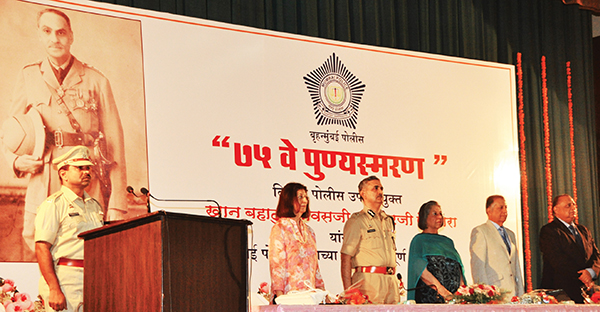
Remembering Petigara, from left, compere, Dr Narges Mahaluxmivala, commissioner Dattatray Padsalgikar,
Ava Gidwani, Kavas Petigara, Homi Ranina
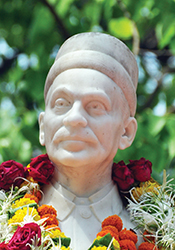
Garlanded statue
Padsalgikar recalled the police officer’s close friendship with Mahatma Gandhi who often "insisted that he be arrested by Petigara when he courted arrest.” Not once, but several times during the freedom struggle, the Khan Bahadur found himself in the unique situation of having to arrest the political leader, revealed the commissioner. He reminded the audience that a letter signed by the police officer, recommending that the political leader be allowed to travel to England to attend a round table conference, is available for public viewing at Mani Bhavan, the memorial to Gandhi in downtown Bombay.
Dr Narges Mahaluxmivala, a granddaughter of the Khan Bahadur, who was present at the memorial service along with other descendants of Petigara, has few memories of her ancestor. Recalling that she was five years old when the police officer passed away in 1941, she said she "clings on to one of him in a Parsi topi and white clothes, pacing in the garden of our home while saying his prayers.” What she recalled the most in her growing up years, from anecdotes narrated by her parents, was his unique integrity as a police officer and indeed throughout his life.
Avan Gidwani, another granddaughter of Petigara, who was born after he had passed away, proudly recalled that she was named after her grandmother Avamai (Petigara’s wife) and said that "she was brought up with him as a legend …always larger than life for all of us.” Kawas, a grandson named after his illustrious ancestor, spoke of police chief as "a tough act to follow, and I am still trying,” he quipped. Referring to his grandfather as a man of "enormous strength of character, yet simple and approachable,” he said that he was trusted, respected and loved by his higher-ups in the police force, fellow citizens and freedom fighters of his generation alike.
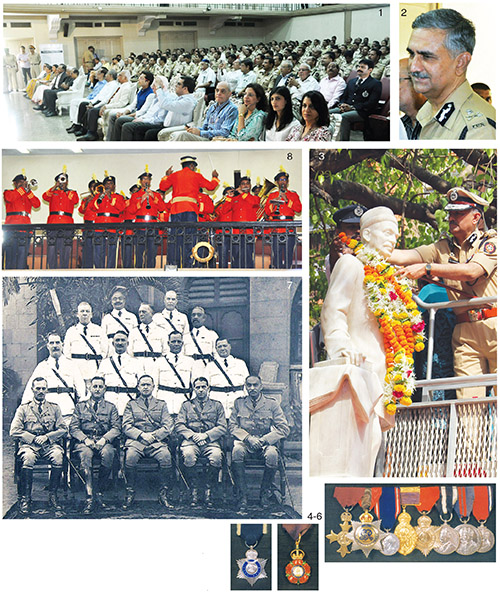
Clockwise from top left: 1) A view of the audience; 2) Padsalgikar;
3) Padsalgikar garlanding statue of Petigara Photo courtesy Bombay Police;4-6) various medals of Petigara;
7) commissioner, deputy commissioner and superintendents of Bombay Police, 1929,
Petigara sitting extreme right; Photos 4-7 from Kavas Petigara’s private collection8) Police band
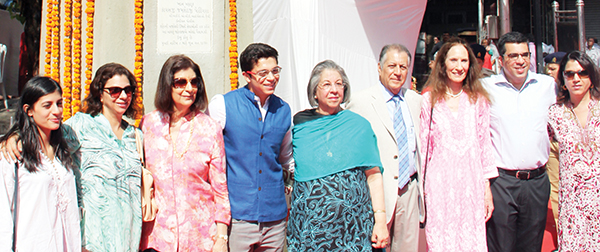
Petigara family, descendants and admirers
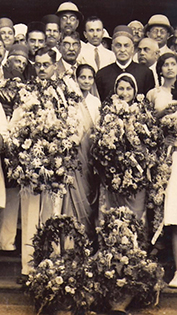
Wedding of Kavasji and Avamai’s only child Noshirwan with Shirin Nadirshaw
Photo from Kavas Petigara’s private collection
Speakers from the police department recalled Petigara’s career which started in 1903 as a plainclothed policeman who joined the CID six years later when the department was created. By 1920, he was promoted to superintendent of police, Special Branch (known then as political wing of the CID) and in 1928, he was promoted as deputy commissioner of the Branch, the first Indian to hold that post. A standee (banner) put up in the auditorium displayed a report from The Times of India of November 25, 1936 quoting the then commissioner of police W. R. G. Smith who, on Petigara’s retirement from the force said that "the secret of his success lay in his devotion to work, which he carried out faithfully and loyally. He never departed from the straight path of duty and never spared himself.”
Trustee of Framjee Cawasjee Institute Homi Ranina "wished that at least one member of Petigara’s descendants joins the police force,” and as an aside reminded the audience that the Institute stood on the reclaimed lake (Dhobi Talao) that gave the area its name.
Prior to the commencement of the function, the statue of Petigara, located just outside the Institute, erected by public subscription "in appreciation of the valued services rendered by him to the city” was garlanded by Padsalgikar, Bombay Parsi Punchayet chairman Yazdi Desai and Ranina, in the presence of the Petigara family members and top officers of the police department. The statue was erected in 1940, a year prior to his passing away at the age of 63.
The function ended with the red-uniformed police band playing the national anthem from the gallery of the auditorium.
According to police historian Deepak Rao, quoted in The Indian Express of March 20, 2016, Petigara’s "work was so impressive that in 1932, even as other officers were preparing to give the Imperial Service Examination, he was nominated to the Imperial police.” Among the various decorations bestowed on Petigara, Wikipedia lists the Kaiser-I-Hind medal (1923), Imperial Service Order (1926), Order of the British Empire (1931), Companion of the Indian Empire (1933) and the King’s Police Medal (1936). In Enduring Legacy — Parsis of the 20th Century, volume II edited by Dr Nawaz Mody, former head of the department of civics and politics, University of Bombay, ex commissioner of Bombay police D. S. Soman says that Petigara "set a benchmark for his successors to follow. It has not been equaled so far.”
◆ ◆ ◆
From the archive