
Institutions
Jerbai’s legacy lives on
As Nowroze Baug celebrates its centenary the residents speak of the values and deeds that make their colony a trailblazer
"The guests have been introduced to Nowroze Baug (NB). Now let me introduce Nowroze Baug to them,” so saying Faranak Contractor spoke of the soul of the Zoroastrian colony in Lalbaug which is celebrating its 100th birthday.
Terming NB the "cynosure of all eyes” the English literature professor termed the colony a "haven of peace, compassion and spirit…
"Show me a baug where the tenants have contributed for the (maintenance) of poor Parsis, paid for their prayers even till their varsi (first death anniversary). Where a mentally unstable resident is looked after by the tenants, where a tenant says ‘use my flat for a homeopathic clinic’… where two-thirds live in joint or extended families, where the divorce rate is less than two percent… this is the heart of Nowroze Baug.”
The centenary inaugural function held on February 8, 2008 at the colony founded by "faresta (saintly)” Jerbai Wadia in memory of her husband Nowroze was organized by the Nowroze Baug Centenary Celebration Committee, chaired by Nariman Mehta, president of The Nowroze Baug Play Centre, who expressed "deep gratitude and thanks to the… illustrious Wadia family.”
Compere NB resident Purvez M. Daver recalled his youth in the colony where he and others "played together, fought together and found our mates… four generations have lived here… we’ve seen and heard it all.”
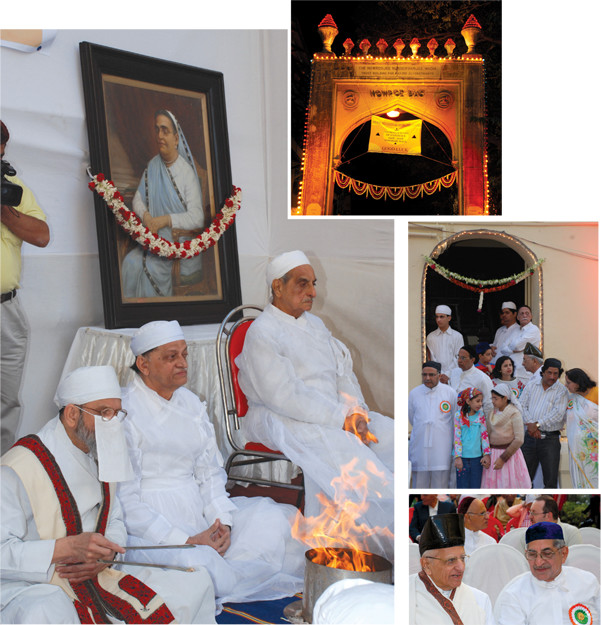
Clockwise from left: Dastur (Dr) Peshotan Mirza conducting the jashan. Jerbai Wadia’s portrait in background; the illuminated gate of Navroze Baug; a section of the crowd; Minoo Shroff (left) and Nariman Mehta
The illuminated A and B blocks where the function and a jashan were held are "100 years old,” said Daver. "The other (blocks) are 80 years old.” A fund collection drive to raise money for any unforeseen contingencies raised over eight lakh rupees from NB residents, he noted proudly.
Another three lakhs came from non-residents [including a lakh each from lawyer philanthropist Shahrukh Kathawalla, Bombay Parsi Punchayet (BPP) trustee Burjor Antia and the Central Bank of India]. Daver narrated how the late Nowroze Wadia left around three-and-a-half lakh rupees in his will for housing "poor and deserving Parsis.” His wife Jerbai "fulfilled his wishes (and) bought the land.”
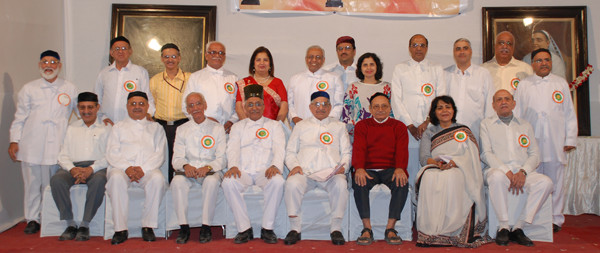
Nowroze Baug Centenary Celebration Committee members Photo: Sarosh Daruwalla, Mazda Audio Video Lab
In memory of her son Rustom, who expired in her lifetime, she built Rustom Baug. Two other Wadia baugs were named after her sons Cursetjee (Cusrow Baug) and Nusserwanji (Ness Baug). Her sons in turn built Jer Baug in her memory.
"If Cusrow Baug is the queen (of all the baugs) then Nowroze Baug is the king,” said Daver. "We were the first baug to give free exercise books, medical aid to the deserving and to provide homeopathic medicines for residents and outsiders.”
Plans for a sports pavilion are on the anvil. "It would be fitting if in the 100th year we could lay the foundation stone” for the pavilion, he added.
Dastur (Dr) Peshotan Mirza who performed the opening jashan ceremony along with eight other priests greeted the crowd with a pun, "Nowroze mubarak hojo (May the New Year be auspicious).” Speaking mainly in Gujarati, Mirza referred to the assistance rendered by NB residents in cleaning fire temples and dakhmas in India. "The NB residents are always ready” to help, he stated.
Noting our forefathers left Iran over a 1,000 years ago "to preserve and protect our religion” he lamented the trend to migrate overseas "in search of greener pastures so as to accumulate greater wealth.” These emigrants then forget their religion and became opponents of traditional Zoroastrianism, he said.
"It is our religious responsibility to impress on our youth to marry within the community at the right age and expand the family to the right size. This should be our religious motto,” Mirza asserted.
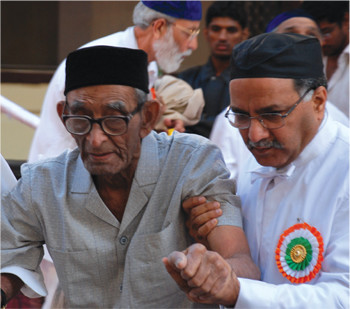
Ninety-one-year-old Nowroze Baug resident Darabshaw Siganporia
BPP chairman Minoo Shroff regarded the Wadias "the foremost contributors to the Parsi community.” Terming the 1,600 or so apartments in all the Wadia colonies "a munificent donation,” Shroff noted the baugs provided "secure areas” for "harmonious living.” He complimented the spirit of self-help in NB. This characteristic was "not manifest in all the baugs,” he added. Shroff urged the residents to preserve Jerbai Wadia’s legacy and "see that the premises are well maintained.”
Regarding Mirza’s assertion that religious fervor was weakening amongst overseas Zoroastrians, Shroff said, "I beg to disagree. They are proud to be Zoroastrians. They keep our fires burning literally. In the US and Canada I found divas burning. I do not find it here.”
Describing Jerbai as "a woman who lived in a man’s world and excelled,” BPP trustee Dinshaw Tamboly said she was "drawn to the plight of poor Zoroastrians especially those residing in rural Gujarat. (She) lived in an era when women’s education was unheard of. Women were homemakers, little else.” Jerbai herself had no "formal schooling but was literate in English and Gujarati,” said Tamboly.
With "hardly any facilities for education” in Gujarat, Jerbai knew that people would settle in Bombay only if they were offered security and low cost housing. She personally oversaw the allotment of flats and fixed the rents. "In deserving cases she even forsook the rent,” remarked Tamboly.
Dhun Gagrat who has been associated with the R. N. and N. N. Wadia Trusts for 51 years, said the Wadia family "always helped” when approached for assistance. Jerbai was born on January 10, 1852 and was married in May 1868. In 1877 Bombay Dyeing was established and in 1899 after the death of her husband Nowroze, she began work on constructing NB, said Gagrat. She was the sole executor of her husband’s will. After the first two buildings, more buildings were constructed in the next 20 years, he added. Three hundred and fifty-eight families reside in NB, totaling around 1,500 Parsis/Iranis.
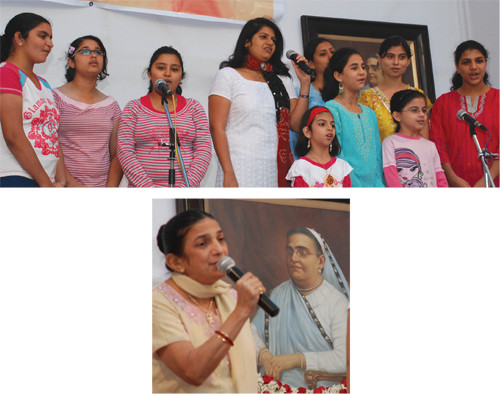
(Top)Young residents reciting monajats; (above) Sanober Reporter singing one of her compositions
"Our forefathers came to India from Iran with religion in their hearts. They were steadfast in their (adherence to) religious customs and traditions,” noted Antia. "But recently over-wise and over-smart (Parsis) are questioning” our religious beliefs and practices. [Though he did not name the persons it was an obvious reference to the activities of the Association for Revival of Zoroastrianism (ARZ) and the Association of Inter-Married Zoroastrians (AIMZ) and the speakers they chose to promote, namely his brother, Dr Kersey Antia. Kersey who performed the navjote of American Joseph Peterson in 1983 spoke on "Acceptance in Zoroastrianism” on February 2, 2008 in Bombay.] For the community to survive, Parsis/Iranis must "marry within the community,” Antia stressed.
Rohinton Mehta, a fifth generation resident of NB, felt the residents were "kétlaa (very) lucky” to be living in such a congenial environment. In contrast there are Parsis/Iranis "staying in kachaa (makeshift) houses next to dirty gullies.” Yet despite all the benefits the community draws from the various trusts, people "attack the trustees. This is shameful. We should praise them.”
He recalled that when the NB residents felt their grievances were not being attended to they "formed a maintenance committee” of which Mehta was a founder member. He and his brother, Hormus, have contributed 10 lakh rupees for improving the colony’s infrastructure.
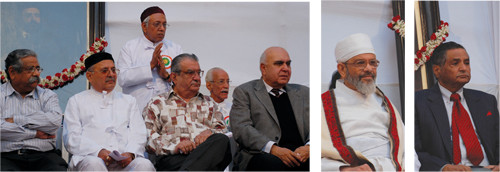
Far left: BPP trustee Dinshaw Mehta, Rohinton Mehta, Purvez Daver (standing), Dhun Gagrat, Phiroze Taraporewalla (seated, back row) and Dinshaw Tamboly; Dastur (Dr) Peshotan Mirza; Burjor Antia
A builder by profession, Mehta stated that all the buildings in NB "have outlived their life… they can survive another 10 to 15 years more.” He noted that if all the existing structures were torn down, NB would gain 50 percent more FSI (floor space index), which means double the present square footage of built up construction. Plus the funds so generated from the sale of the extra FSI would result in a 40 crore rupee profit for NB.
An oasis
The residents of NB "include doctors, lawyers, engineers, businessmen, builders, film stars, singers and beauty queens,” said Contractor. "We’re a fine combination of beauty and brains” and since "more people can see than think,” this was all for the better.
Noting that the residents had dug bore wells due to a chronic water shortage earlier, the professor noted, "If all Bombay goes dry, we will be an oasis.” A water logging problem during the monsoon was tackled by the Mehta brothers, who installed storm water drains.
Contractor noted how Nariman and Perin Mehta offered their flat to run a homeopathic clinic. "They had no surplus space,” she pointed out, the flat being only around 400 square feet. Nariman, in addition, functions as the doctor’s personal assistant while Perin performs the work of the compounder.
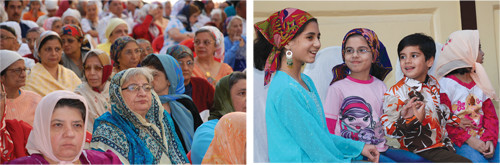
Sections of the crowd at the centenary celebrations
The families of NB comprise "strong mothers and loving fathers,” she stated. The children learn "discipline from their mothers and forbearance from their fathers… love and compassion are germane” to the NB residents. She recalled that the late Neville Wadia, Jerbai’s grandson, paid "the greatest compliment” to NB terming it "the most progressive and dynamic of all the baugs.”
Referring to the quarrels that plague the Parsi community, Contractor said, "When God wants you to evolve he will send you a challenge, a controversy.” It was up to the community to overcome this.
She said when her colleagues at the Baba Ambedkar college in Wadala read about all the dissension in the community, they asked her, "Are you failing the community or is the community failing you?” She referred to the high regard non-Parsis held the community in, noting that she was selected to chair seven of the 10 committees in her college because the people "felt reassured” knowing she was a Parsi. "Don’t (sully) or tarnish” that reputation, she pleaded, "keep the torch” burning brightly.
Amongst the people felicitated on the occasion was 93-year-old Limjibhai Dastoor, one of the oldest living resident of NB. An electrical engineer who worked for Bombay Dyeing he spoke to The Times of India (February 9, 2008) reporter of how "neighbors would knock on his door at all hours of the day and night calling on him to repair fans and lights.”
(An unfortunate incident occurred that evening when The Times of India photographer was prevented from approaching the stage to take photographs of the jashan. He was upset as the organizers had invited the paper to cover the event and now were keeping him at a distance while all the Parsis/Iranis present were allowed to even go on the stage and click pictures. As soon as Nariman Mehta was informed of this wrongful exclusion he permitted the photographer to approach the dais. But by that time the jashan had just got over. Mehta lamented that people were unaware this was not a consecrated area.)
NB social worker Phiroze Taraporewala proposed a vote of thanks and noted that writer Marzban Giara is preparing a book on Jerbai Wadia.
The NB residents are collecting funds for the upkeep and maintenance of the buildings. Donations may be sent in the name of either "Nowroze Baug Centenary Celebration Committee” (P/2 Nowroze Baug, Lalbaug, Dr G. S. Rao Road, Bombay 400012, e-mail: nowrozebaug.100@gmail.com) for which no 80(G) income tax benefit is available or at the same address to "The Nowroze Baug Play Centre A/c NBCC” which has an 80(G) benefit.
◆ ◆ ◆
From the archive