
Welfare
Educate and empower
Intensive self-help programs succeeded in raising awareness among the rural women of Rajasthan
My father died in a road accident when I was only six years old. A renowned philanthropist and an honorary magistrate, he was given the title of Khan Bahadur by the then colonial government. He was very fond of the main character from Alice in Wonderland and named me Alice as he wanted me to grow up to be like her. Perhaps I inherited the genes for social work from my father. Owing to my father’s death and the hostile attitude of relatives I had a rather deprived and difficult girlhood. My mother and I had to leave home because of the continued hostility of my uncles and aunt, my mother being a non-Parsi. Krishna Garg and I married on our own. He hails from the same town as I, Nasirabad, near Ajmer. We have two daughters, both happily married, and a grandson and granddaughter. Although I never renounced Zoroastrianism, the circumstances and inflexibility on the part of the community compelled me to stay away from it.
I was a school teacher for eight years and took up voluntary social work in 1972 with various welfare activities for women, orphans and destitute children, running homes for destitute children and schools for children from poor families in Jaipur. Earlier I worked with untouchables and the so-called saansi criminal tribes. For the last 20 years or more the focus of my work has been empowerment of the girl child and women. These activities are spread over five districts of Rajasthan. Running a resource cum training center, taking up social field study and research and publication of research and study reports are my occupation. I have published two books The Mehtars of Jaipur and Hamne Rah Banali and other papers.
I began social work to educate and empower children from the poor and so-called low caste families. When I discovered that their environment at home does not encourage education, I decided to do something about it by organizing an untouchability drive to spread awareness in both the oppressed and the oppressing communities about human rights and natural justice. Of course, I had to face stiff resistance from the latter. Finding women very responsive to the drive, I decided to work for the welfare of families through empowerment of women and, of course, children by founding the Bal Rashmi Society, of which I am the honorary secretary.
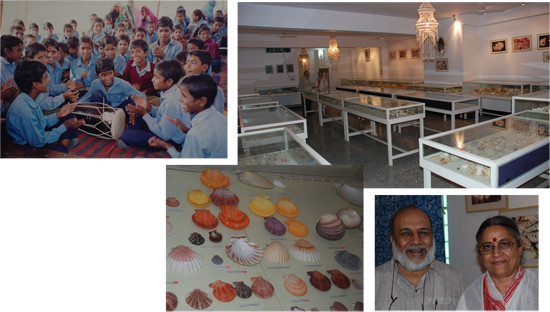
Clockwise, from above: Children at Bal Rashmi Society’s Aravali School; seashells museum; Alice and Krishna Garg; seashells on display
Gradually we at Bal Rashmi grew in strength and size. Today we have a full-fledged program for promoting school education in the entire Tonk district of Rajasthan, especially in the rural areas that are overlooked by most development programs. We encourage girls and boys, particularly the former, not to drop out of school, help local schools in improving the quality of education, organize summer camps to help with English, science and mathematics in which they are weak, provide books, school uniforms and nutrition. We run a unique Camel Cart Mobile Library which covers six villages in a week. It is the only one in the country and has been internationally acclaimed. We also run a number of middle and primary schools for the poor which have nearly 50 percent of girls as students. The latest addition to our list of schools is an English medium convent type of public school for poor children. We also run a home for orphans and destitutes.
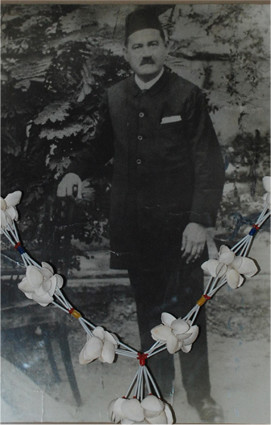
Rustomjee Kuka: Alice’s father
We have an intensive program for empowerment of women through self help groups for economic independence; meetings; group tours for awareness; Mahila Mandals (women’s associations) and Kishori Mandals (associations for adolescent girls) for social and political awareness and action; effective participation in village level planning and decision making through training programs; bringing down the infant and mother mortality rate through a comprehensive reproductive rights and health program. Rajasthan has one of the worst records in this regard. We also provide support to poor widows. Our latest effort to light up the homes of the poor through solar panels and the revolutionary WLED (White Light Emitting Diodes) lamps has been a great success and is producing the desired results. We envisaged that light would not only be a facility but would enhance family income by lengthening working hours, help school children and would also affect the size of the family.
Poor communities benefit from the harvesting of rainwater, reviving of old water bodies that have fallen out of use for want of maintenance, organizing free health camps in the field and camps for cataract operations for the old and corrective operations for polio affected children. These programs are run with grants from private funding agencies only, to preempt political interference and the resultant anxiety. One major village level planning project is run in association with UNICEF.
Aside from being associated with several social welfare agencies I am a trustee of the Consumer Education and Research Centre, Ahmedabad; member, state level advisory committee for care of neglected children; life member of the Indian Federation of UN Association, New Delhi and advisor to the Youth League Recreation Centre, Buldana.
The most notable recognition I have received came in the form of the Saraogi Award for work on women and children; the Pan-Am Neerja Bhanot Award for Bravery (fighting against the political might and muscle of the government); and the Jamnalal Bajaj Award for Rural Development.
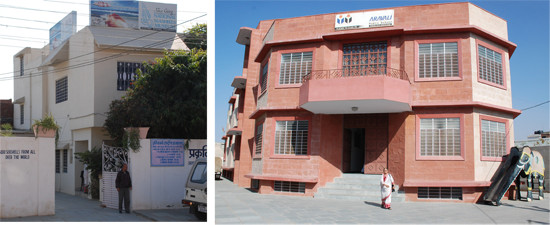
Seashells museum (left) and Alice Garg outside the Aravali School
With the cash component of the awards, aggregating seven lakh rupees, The Rustomjee Memorial Trust came into being, of which I am the managing trustee. I was able to pursue my dream of starting a museum to house the shell collection built-up by Krishna and myself over 40 years. We have a very sizeable collection — over 2,000 different specimens from five of the seven classes of molluscs: from the largest clam shell to the tiniest (one needs a magnifying glass to see them); the largest gastropod, the Australian trumpet; shells from the most intricately patterned and colorful to the plainest drab looking, from the warm Indian Ocean to the cold Arctic Sea.
My elder daughter Vatsala offered me the small house that she owned for housing the museum. With some additions and alterations it was brought into good enough shape to house the museum. I designed all the display cabinets myself while Krishna helped with making pictures and posters for display. On the insistence of Krishna, family and friends I agreed that the museum be named after me as it was primarily my own work and money.
The museum has made a modest beginning but has a long way to go. We hope that in addition to being an attraction for viewers the museum will eventually become a center for the study of conchology and a national center for promoting the conservation of sea and river molluscs.
◆ ◆ ◆
From the archive