
Welfare
The sincere sarpanch
As the first Parsi lady sarpanch of Asundar, Shirin Asundaria is striving to improve the living conditions of the villagers
"We want Shirinbai as sarpanch (village head).” This consensual agreement amongst the 1,000 residents of Asundar (on the outskirts of Navsari) earned the village a reward of Rs 1.25 lakh from the Gujarat government which would otherwise have had to incur costs on voting, relates Shirin Asundaria who took charge as the first Parsi lady sarpanch on January 10, 2007.
The Asundaria family are the only Parsis residing in this hamlet which has a large population of Halpatis (tribals). "For the last 15 years there had been a Halpati as sarpanch,” mentions Asundaria referring to the different criteria the government adopt to qualify a candidate for the seat of a sarpanch. Prior to that Shirin’s husband Aspi had officiated as sarpanch. With the government deciding that Asundar must now have a lady as its sarpanch, the responsibility fell on Asundaria who was known among the locals for her social welfare activities. The erstwhile sarpanch Govanbhai Halpati is now the deputy sarpanch.

A seven-member team appointed by the sarpanch sits in attendance at the monthly meetings to look into the problems facing the populace and to introduce schemes for the development of the village. Health, housing and education come within the purview of the sarpanch who has to report to the district development officer. The sarpanch’s office premises are next to the one assigned to the government appointed talati-cum-mantri. Repair of water tank, cleaning of roads and gutters, increasing the depth of the creek to avoid flooding, obtaining a new ration card when the old one is lost are the regular issues facing the sarpanch. A more traumatic scene is to see a hut being enveloped in flames. Sleeping beside a burning fire in an inebriated state the villagers are unable to ward off calamity in time, explains Asundaria. The poor people’s love for liquor is legendary. Families brew and distill their own versions of country liquor which if not done properly can cause death when consumed, the sarpanch adds.
The populace in the village is differentiated as "APL (above poverty line) and BPL (below poverty line).” More than 800 classify as BPL, "earning barely Rs 25-35 as daily wages by working in the fields or doing masonry work, making ends meet with difficulty. BPL families get rations of wheat, jowar and bajri,” relates Asundaria. If there is food for the day in the house, there is little incentive to work. With 104 toilets built for the BPL and three for the APL, there is a difference in sanitation levels too. There is a police chowky in their area. The hospital is at a little distance and the fire brigade service is summoned from Navsari, at a distance of nearly 10 km.
Age wise, senior citizens outnumber the youngsters, many of whom work as child laborers instead of attending school. When a girl child is sent to school, the government pays Rs 700-800 as monthly incentive. Working on the advisory board of the state run anganwadis (education centers), Asundaria explains how the official list of children may show 75 although only 10-15 actually attend the classes conducted by one teacher and her helper. To recognize the dedicated efforts of the anganwadi teacher whose monthly income is a mere Rs 1,000, Asundaria gifted her a buffalo so that she could supplement her meager earnings. The anganwadis are supposed to distribute nutritional food under the govern-ment’s Integrated Child Development Service but if they receive substand- ard fare, Asundaria brings in better quality dietary supplements at her own cost. Twice a month the children are examined by a nurse. At the time of compulsory polio immunization drive for children under five the sarpanch is invariably involved. Promising students progress from the anganwadis to the Gujarati medium High School and on a rare occasion to college.
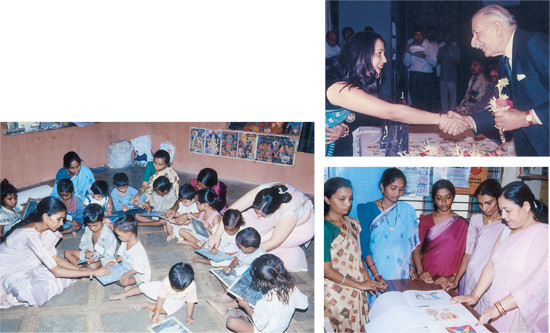
Shirin Asundaria (top and alongside) with Field Marshal Sam Manekshaw, the ladies and children of her village Asundar
Asundaria takes pride in referring to the accomplishments of one Halpati girl who completed her MA and is presently studying law in Navsari. "To encourage her we gave her a cash gift of around Rs 1,000 plus a shield,” she reports. A special batch for women gives the illiterate ladies the confidence to sign and learn the basics. To create awareness about health and diet, they hold a competition for best cooked, nutritious food. To impress on the villagers the importance of exercise, sports activities are also encouraged and among the women, the creativity award brings forth their originality. "É loko maa awareness ghani aavich (considerable awareness has been created in them),” the nominated village head is pleased with the progress.
"Seeing these poor people I took charge,” Asundaria explains her reasons for taking over as sarpanch of Asundar which has been her home since marriage. "I’m happy with what I’m doing. I don’t want to join politics.” Their family run dairy with 50 cattle has been supplying milk to different pockets in Navsari for the last 50 years. Besides they have ancestral agricultural lands to cultivate which keeps her husband occupied throughout the year. In fact when he is overburdened, he has to send for one or more of his three grown-up sons — Rohinton, Kaizad, Jamshed — who are in Bombay.
On her trips to Navsari to visit her in-laws or to Bombay to meet her sons, Asundaria gets to interact with other Parsi families and visit the fire temple. Soon though she feels the need to return to Asundar, to the well-known estate of "kootrawala bawaji (the Parsi with dogs)” on the road linking Navsari to Surat, to resume her responsibilities.
Believing in continuing with Parsi customs like "divo, chalk, chandan,” Asundaria (née Vania) is firm that her sons should marry only Parsi girls although she was born of an Anglo-Indian mother and has her roots in Delhi, known for its liberal outlook. Soon after she had completed her schooling from St Mary’s, Agra, she was married off when she was 18 for her paternal grandmother was not in favor of the young girl shifting base with her parents each time the father received a new posting when working for Sikkim Distilleries. She has candidly told her sons, "Parsi hasé tau ghér ni bilkat malsé (only if there is a Parsi bride will you inherit the ancestral wealth).” Attests Rohinton with a smile, "Gher ni bahar karvaani dhamki aapich…Na chhootké sodhvi parsé (There are threats of throwing us out of the house…Left with no choice we will have to find Parsi wives).”
◆ ◆ ◆
From the archive