
Welfare
Born unfree
For the animals, The Bai Sakarbai Dinshaw Petit Hospital is their best friend
Parsi charities are created with foresight, to last not for the moment but for generations.
A haven for the animals in the city, the "bel ghoda (cattle-horse) hospital” at Parel is a "Mecca” for animal welfare workers. The only animal hospital in the city and the largest in Asia it has 133 years of unbroken spirit and service, started by the Petit family, merchants and philanthropists of the time.
The Bombay Society for the Prevention of Cruelty to Animals (BSPCA) was founded in 1874 and The Bai Sakarbai Dinshaw Petit Hospital for Animals (BSDPHA) was built in 1883 by Sir Dinshaw Manockjee Petit who gifted the land on which the Hospital was built to the BSPCA. The Hospital, named after his wife Sakarbai, was inaugurated on December 10, 1884. Family and community involvement is still a large part of the functioning of the institution. Though the Petit family has educational institutions and hospitals to their name, this hospital has made its mark in the history of the city and continues to write its own pages in the history books of animal welfare.
The two bodies are situated in Parel amidst dense greenery. The Society was established to check the abuse of animals which were at that time the only means of transport. An executive committee, with a president at the head (ex-presidents include the late J. R. D. Tata and Ratan Tata) govern the Society. The secretary of the Society implements policies determined by the committee and ensures efficient functioning of the Society and Hospital with an assistant secretary and manager on campus.
The Hospital employs approximately 200 administrative and medical workers [ward boys, livestock supervisors (LSS), mukadams, dressers, etc]. The Bombay Veterinary College provides free medical services to the Hospital in exchange for their students gaining practical experience there.
All patients must register through the out patient department (OPD). From there, patients are directed to the appropriate ward i.e. medical or surgical. There is a doctor on campus 24 hours and the medical and surgical sections have an LSS (equivalent to a nurse).
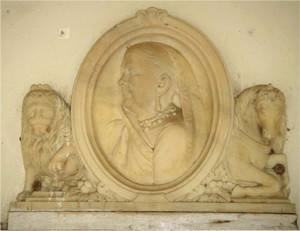
Bai Sakarbai Petit relief at the Hospital office: Family involvement continues
For dogs and cats, there are owner and stray wards. The Maggot ward is usually filled to capacity in the monsoon months with the animals often having to be tied in the corridors for lack of space. The medical department treats animals with ailments such as fever, kidney failure, etc. The surgical department deals with fractures, broken bones and surgical ailments. A modernized operation theater is open for all emergency surgeries. Isolation wards attend to cases of gastroenteritis and distemper. There is also a rabies ward on campus where cases suspected of rabies are isolated. The Hospital has an active ABC (animal birth control) program. Dogs brought in by the Bombay Municipal Corporation (BMC) are sterilized by the center and then returned to the location from where they were picked up.
The cattery Buddy House is home to felines that are no longer able to live on the streets. Adjoining is an aviary where injured birds are kept until they are ready for release. The Hospital also has a ‘kite enclosure’ where injured kites are nursed back to health. The enclosure is designed to give the kites the option of flight once they feel strong enough to leave the campus. The monkey cages house simians that have been rescued or brought by a responsible "bandarwalla” for treatment. Once recovered, they are released in a suitable environment like the Sanjay Gandhi National Park.
Cattle and horse wards attend to bovine and equine patients. Dairy cows, Victoria horses and work animals are often victims of cruelty and are left to die on the roads. Others are awaiting court proceedings against their owners. Many of these animals are brought to the Hospital with severe injuries.
The BSPCA and BSDPHA have an impressive fleet of ambulances which have been donated. All BSDPHA ambulances are equipped with wireless units which allow them to communicate effectively with the campus while in the field. In keeping with the Parsi fascination for good food, the campus kitchen serves fresh food of the highest quality to all patients.
Adoption of abandoned animals is one of the important functions. The BSPCA’s adoption ethic is to find permanent secure homes for the abandoned animals. All potential adopters are put through a stringent procedure before they can adopt an animal. Potential owners are informed about the habits of the animal, i.e. temperament, diet and medical history. All animals are welcome back in case they do not settle into their new home.
The BSPCA, as protector of animals, through its field staff (inspectors), is authorized to enforce the Prevention of Cruelty to Animals Act (PCA), 1960, and can, and does, take people to court. Most people in the city are unaware of this parallel police force, which has the power to arrest and prosecute individuals who perpetrate an act of cruelty on animals. These inspectors are necessary in a city where elephants, horses, cows, snakes, etc are undernourished and overworked. All these animals are exploited for profit. Though they may provide a livelihood to their owners and are essential for their survival, the inhumane treatment of these animals outweighs that consideration.
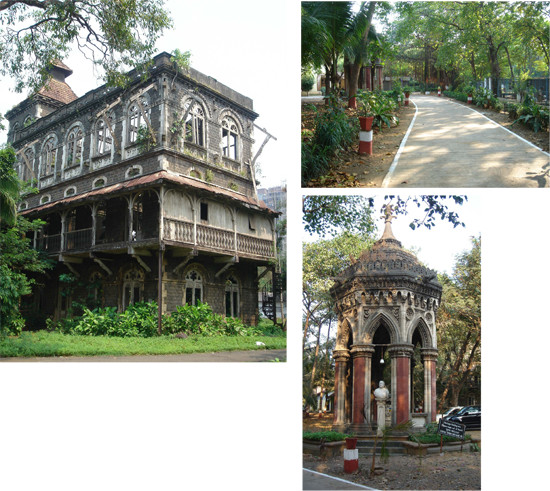
Far left: Heritage structure in need of funds for repairs; campus walk (left); fountain with bust of Bai Sakarbai Petit (below)
Visitors to the Hospital premises include Madhubala, the elephant, late Ramu, the lion, Huskies, from the Russian circus, to name a few. The campus has some permanent residents who call the Hospital home. One of them is Jojo, the pet piggy, complete with his harem. The Hospital is honored to have him. He enjoys long walks and good food. He too is looking for a good, permanent home.
It might seem unlikely that there is enough space for all the ailing and destitute animals in the city on this small piece of land, but the Hospital has the ability to expand when the need arises. There are times when the kennels and wards are filled to capacity and on occasion, we do have to request people to take their animals to a shelter closer to them.
The BSDPHA is always in need of volunteers to help socialize the animals. If you have time and are inclined to spend some hours with a cat or dog that has been abandoned, you may help socialize them and ready them for their new home. If you cannot take an animal home, you can sponsor one at the hospital.
All donations to the Society are tax exempt under Sec 80-G. For further details contact the BSPCA and the BSDPHA, Dr S. S. Rau Road, Parel, Bombay 400012, tel: 91-22- 24137518.
Lassie come home
Can you make room in your life for one of these?
Elsa — is a six-year-old female Doberman. She is intelligent, friendly and well trained. Elsa will be a welcome addition to any home.
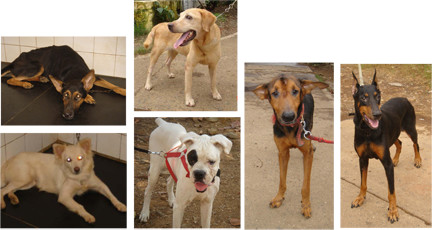
Canines in search of homes
Amber — is a two-year-old amber-eyed Pomeranian who is energetic, loving and friendly. She will make a devoted pet and is well suited to adapt to a family environment.
Daffy — is a five-year-old Doberman-German Shepherd cross. His name is derived from the shape of his ears and is not indicative of his intelligence! Daffy will be a welcome addition to a home or farm.
Beauty — is a six-year-old female Boxer who truly lives up to her name. She should preferably be the only dog in a family, loves children and will be a charming addition to your family.
Jackie — is a two-year-old German Shepherd who will be suitable for a home or farm. Jackie has a loud bark and likes to make himself be heard.
Oliver — is a six-month-old Labrador, who is partially blind. He is a gentle soul with a strong spirit and will make an ideal companion for your family.
To adopt an animal from the BSPCA call 9833034184 or e-mail us at bombayspca@hotmail.com All animals from the BSPCA are sterilized.
Edited from a write-up prepared by two volunteers at the animal welfare institution.
◆ ◆ ◆
From the archive