
Books
‘Dislocation, not relocation’
Yamuna Gently Weeps: A Journey into the Yamuna Pushta Slum Demolitions by Ruzbeh N. Bharucha. Published in 2006 by Sainathann Communication, 425, Gr Fl, Sant Nagar, East of Kailash, New Delhi 110065, tel: (011) 26217737, 26217739. Pp: 295. Price: Rs 700.
Journalist and documentary filmmaker Ruzbeh Bharucha has ably exposed the trauma undergone by more than 40,000 families who were mercilessly thrown out when the Yamuna Pushta slums, one of the oldest and largest in India on a three-kilometer stretch, were demolished in Delhi in early 2004. They were occupied for more than 40 years under the very eyes and patronage of the authorities who later sought to evict the slum dwellers.
The author, present throughout the demolition process, was witness to the heartlessness of those in power. His footage of the 72-hour ordeal suffered by the slum dwellers was edited into a documentary Yamuna Gently Weeps, a film selected for screening at various international human rights film festivals. "Of the 1.5 lakh displaced, 25,000 were resettled. They had to commute four hours daily, spending Rs 40 a day, when they earned Rs 60. Children’s education was disrupted. Honestly, that is de-settlement and dislocation, not relocation. The government perhaps naively assumes that the remaining one lakh people will return to their villages. What is there to return to? We have no fixed plan for development in the villages,” Bharucha was quoted in the Mumbai Mirror of October 1, 2006. To better understand the people and what they were going through, he actually stayed in the area for three months and lived their life. The book followed two years later – bringing to the fore "the hollowness of the system…through interviews with slum dwellers and politicians, eminent town planners, environmentalists and activists, as well as through the eyes of those who lost it all… a heartrending tale of tears, courage, determination…” Reinforcing the author’s direct talk are the 200 photographs that capture the sensitive subject.
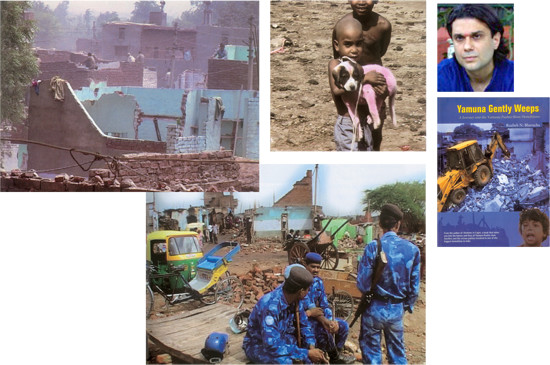
Tales of agony captured by Ruzbeh Bharucha (top right)
Among the political bigwigs expressing their views in this book are Sheila Dikshit, chief minister of Delhi, and Jagmohan, former lieutenant governor of Delhi and erstwhile vice chairman of the Delhi Development Authority (DDA). While Dikshit believes that demolition smacks of political vendetta because it housed a Congress vote bank, Jagmohan insists there was a lot of economic content in what he did but due to vote politics his schemes were not implemented. Former Prime Minister of India V. P. Singh pointed out that the Low Income Group (LIG) people are treated like parasites by the government. To whom do the LIG people belong? India’s super lady cop Dr Kiran Bedi (who happens to be Bharucha’s mother-in-law) is quoted in the book for referring to the demolition as an act of "callous governance” without the requisite vision to rehabilitate the displaced persons in a planned manner.
The eminent persons interviewed by the author claim to be aware of the problems and may have expressed anguish but none of them has suggested a solution to solve these problems. Even K. T. Ravindran, head of the department of Urban Design School of Planning and Architecture, New Delhi only laments that the DDA has altered the land-use provisions of the master plan of Delhi nearly 400 times, changing the land use when the government wants to favor a scheme proposed by the rich.
If people in power have failed to produce solutions, there is no reason why we should also follow their footsteps. This reviewer being an architect with experience in town planning makes a suggestion based on the Delhi Master plan which has envisaged setting aside 2,000 hectares (about eight square miles) of land to house the poor. If two square miles each are reserved along the four borders of the city, and along each border a piece of land 1500x1,500 feet is developed each year, by judiciously using the central square of 500x500 feet for school, hospital, shopping center and temple, and the surrounding area for housing 6,640 tenements of 270 sq feet each, we would be able to absorb the nearly 1,00,000 people migrating to Delhi each year. The DDA could charge Rs 400 as rent for each housing unit for 20 years in lieu of Rs 50,000 spent on its construction. After 20 years the occupant could become the owner of this unit.
"Today everyone wants to remove the poor, not poverty. The popular perception in public minds is that people are happy to live in slums. That is a myth. No mother wants to nurture her child in a slum. Families do not live there out of choice; it is a matter of survival…” the author expresses his sentiments before adding, "The book I hope will let the readers think about the real implication of relocation. In our effort to relocate we seem to have forgotten that those living in slums are our own people. They are not animals. They are not untouchables. They are what you and I could become if fate and opportunity were to leave our side today.”
Faramarz B. Sethna
◆ ◆ ◆
From the archive