
Institutions
A temporary reprieve?
The municipal commissioner has verbally stayed demolition of portions of Bandra’s Nusserwanjee Ruttonjee Tata Agiary, but the notice has not been withdrawn
Despite protests, meetings, media coverage and demonstration, the fate of the front porch of the 122-year-old Nusserwanjee Ruttonjee Tata Agiary and portions of two Catholic church properties in Bandra still hangs in the balance.
While verbal assurances have been given by the Bombay Municipal Corporation (BMC) that no action would be taken to demolish any portions of the structure or compound walls to widen the arterial Hill Road for the present, the notification sanctioning the demolition has not been withdrawn. The BMC notice that demolition would begin on the morning of Saturday, November 25, 2006 at the Agiary also affects St Peter’s and St Andrew’s churches, as well as St Stanislaus School on Hill Road.
In response to the Bandra residents’ outrage, municipal commissioner Johny Joseph has stayed the demolition, for the present. Joseph told The Times of India (TOI) on November 24, "I have received representations from local residents, which we are considering. Our special projects director has already made an on-site visit and I am awaiting his report.”
Lending his voice to the campaign to save the Agiary, industrialist Ratan Tata wrote to Joseph not to proceed with acquisition of the setback land and explore some alternative "so that heritage and religious structures on Hill Road are unaffected and at the same time the traffic flows around the road smoothly.” In the letter dated November 27, he wrote: "The Agiary which was established by Tatas, is 122 years old and has an intricately detailed porch which forms part of the main structure… Acquisition of the area under setback would result in the destruction of the porch, which is the part of the main heritage structure, apart from exposing the religious functions within the Agiary to the public road.”
The Agiary was built by Nusserwanjee Tata in memory of his wife, Bai Jeevanji. According to Parsi historian Marzban Giara, the founder had made provisions for regular maintenance of the Agiary out of his own estate. One of the highlights of the Agiary is the stained glass portrait of Prophet Zarathushtra situated in the main hall (TOI, November 30).
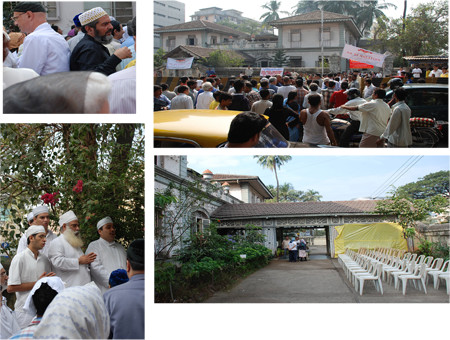
Clockwise from top left: an interfaith affair; protesters blocking the road; the threatened front porch; a prayer for the salvation of the properties
More than a year earlier, in a letter to the municipal commissioner dated August 10, 2005, Prof Khurshed Sheriar, president of The Bandra Parsee Association and the Association’s joint honorary secretaries Sam Choksey and M. F. Mistry had registered their strong protest against the BMC’s plans to take away the front portion of the Agiary for road widening. Among the points they made was: "In the past, part of the front portion of the Agiary compound was given away for road widening on an understanding that no more of our compound would ever be touched during future expansions. On the opposite side of the Agiary there is a lot of scope for road widening, hence that avenue may be explored.”
Choksey revealed that nearly 1,400 signatures had been collected on a memorandum to be sent to the municipal commissioner. Municipal officials told those gathered that the demolition was on hold and that if they take a decision to acquire the land again, the fire temple would be given at least a week’s notice to take legal help, reported Mumbai Mirror on November 28.
However, residents wanted a written assurance that their land would not be acquired. "We are happy at the outcome of the meeting. But we want an assurance in writing,” said Choksey. This was echoed by Mani Patel, civic activist and member of The Bandra Parsee Association: "We need an assurance in public that our Agiary, which is a heritage structure, will not have its compound walls torn down. We met the municipal commissioner…and were given to understand that the issue of realigning the road was being discussed, and then a few days later we got this notice of demolition. Is it not absurd (TOI, November 24)?”
Shyama Kulkarni, chairperson of the H West Ward Citizens’ Trust stressed the need for a permanent solution. "As far as the BMC is concerned, the right hand does not seem to know what the left is doing. What the commissioner says in a meeting is not known at the ward level (TOI, November 25).”
Scenting an opportunity for gaining mileage, several political parties have stepped into the fray. MLA (Member of the Legislative Assembly) and state minister for food and civil supplies Baba Siddique, marching into Joseph’s office along with some Bandra residents, announced: "No matter what happens, we will not allow a single religious structure to be touched. If the BMC is adamant, I would take my case to the state government.”
BJP (Bharatiya Janata Party) leader Gopinath Munde rushed to the site on the night of the agitation. Former chief minister of Goa, Manohar Parrikar, also of the BJP, later visited the heritage structures and expressed disgust at the manner in which commercial structures and illegal stalls had been allowed to proliferate on the road, blocking traffic (TOI, December 1.) Bombay’s "heritage …should be protected against road widening which is being done at the behest of the builders’ lobby,” he asserted.
Raj Thackeray’s outfit, the Maharashtra Navnirman Sena, has joined the voices of dissent and plans to hold an agitation if the BMC goes ahead with the demolition, reported Hindustan Times of November 28. However, residents are not very happy that politicians are getting involved with their protest. "This is a citizens’ initiative. We planned the entire movement and now politicians are trying to hijack it for their benefit,” decried Kulkarni.
In a novel form of protest, St Peter’s Church has decided to reverberate its bells – one big and four small – when the BMC sends its men to widen the nearby road. In earlier times the bells used to be rung simultaneously only during emergencies, reported Mid Day of November 29. "This is nothing short of an emergency,” claimed church priest Father Gerard C. Rodricks. "Whenever the residents hear the bells ring, they should come out of their homes and form a human chain in protest.”
At the protest rally on November 25, where around 1,000 people from all faiths assembled at the Agiary (some protesters even blocked the road), Nariman Bamji, a priest of the Agiary said: "The BMC should concentrate on clearing encroachments instead of targeting religious places.” Concurring with this, Mabel Falcon, a Christian resident from the nearly Chimbai village alleged that land acquired from religious institutions by the BMC will ultimately be taken over by hawkers (TOI, November 26).
Chairman of the State Minorities Commission, Naseem Siddique, asked: "Which came first, the heritage structures or the development plan? The development plan came up in 1965. Instead of trying to protect the centuries-old institutions on Hill Road, the BMC has drawn up a road line which cuts into them.” Criticizing the BMC for trying to acquire the agiary and church properties for road widening, he pointed an accusing finger at various commercial structures which had been allowed to spring up on the road (TOI, November 30). Vice chairman of the Minorities Commission Abraham Mathai felt that an inquiry should be instituted into why the road lines were drawn to cut into minority institutions.
◆ ◆ ◆
From the archive