
Welfare
Reel to real
Involvement with the street children during the making of the movie Salaam Bombay resulted in the creation of Salaam Baalak Trust
"We provide the choices and let these street children choose for themselves... Unless a child owns his development he is not going to be successful,” observes Dinaz Stafford who for the last nearly 20 years has been instrumental in offering non-formal education to the young waifs who have "slipped through the cracks.”
Her association with them commenced during the shooting of Mira Nair’s Salaam Bombay where Stafford, working as assistant director and chief coordinator, helped them learn their lines and enact the scenes for the film. After the release of the film in 1988 "it made sense to carry on this system of non-formal education for street children and help them get rehabilitated in their own environment without institutionalizing them,” she explains. This inspired the founders — Stafford, Zarine Gupta and Saroj Goenka — to set up the Salaam Baalak Trust-Mumbai which now has four centers at Charni Road, Grant Road, Dongri and Kalyan offering "holistic service depending on the individual needs.”

Dinaz Stafford: holistic care
To see a street child grow up to be a security guard, staying on the eighth floor of a low-cost MHADA (Maharashtra Housing and Development Authority) building where the lift may or may not work, Stafford considers "a huge success,” because he is "alive, healthy, not involved as a gangster in any underworld activity or prostitution.” One has to appreciate that "they are operating with the chips against them,” she points out.
"A huge problem” for the volunteers is when a girl studying in the ninth grade wants to stop school and get married to some boy because he addressed her as "darling.” It is difficult to teach them that "delaying gratification will help them later in life.” By the age of 12 these street children "have had some kind of sexual experience,” mentions Stafford referring to the United Nations Office of Drugs and Crime which asked her to create awareness about drug abuse and HIV among this susceptible population. "It is such a stigmatized topic. This is one area that needs to be developed. It needs focus,” she is convinced. In fact the Salaam Baalak night shelters have now started catering to the requirements of children who feel the need for a roof over their head at night because they feel insecure outside.
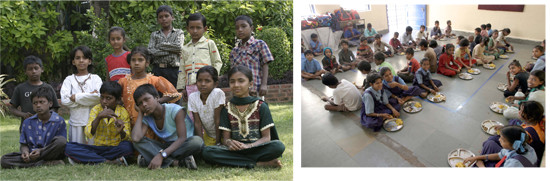
(Left): Well groomed children of a Salaam Baalak class; (above) enjoying a midday meal
In the case of boys, "the danger years start when he hits 15… wants to start earning. He knows that if he is clean, has learnt the social graces, is trustworthy… he becomes employable. It is difficult to tell him to hang on.” Salaam Baalak has introduced the Life Skills program with sponsorship assistance from the Karl Kubel Foundation in Germany that helps a child become a "successful” adult. The interpersonal skills they develop end up making the children helpful and insightful and taking responsibility for their life. Their Mentoring program too is "incredibly productive” where older children are sent to offices like American Express and Brand David in their free time so that they can observe the functioning of high profile individuals and accordingly get inspiration to set their sights and goals in life. The fact that their dropout rates have declined over the years Stafford sees as a very encouraging sign.
Beginning with two centers for children under five, presently the Trust looks after 580 children. In addition to educational support in the form of books, uniforms and stationery to school going children (the majority of whom go to private schools rather than municipal schools) the team has to make provisions for their midday meals, and additionally offers them training in other activities like yoga, drama, judo… When it was realized that children of the Paardhi tribals of Sholapur [who do daamar (coaltar) work before monsoons, sell balloons and lime-chillies at other times, and resort to begging when there is no other income] were not progressing, the Salaam Baalak volunteers introduced the integrated urban-rural development program and identified educational opportunities in their villages, encouraging them to return to their native areas with support from the ministry of women and child welfare. Over the years Salaam Baalak has been able to provide extended services whether to assist a child with a hearing problem or some other medical illness "by accessing help from other resource organizations… The good thing about NGOs is that they have a good networking,” Stafford acknowledges the cooperation among organizations committed to uplifting the needy.
She is equally appreciative of the commitment of her volunteers saying, "If you don’t have a high turnover among volunteers it is because of the satisfaction they get from their work.” Only eight percent of their donations are reserved for administrative costs like accountancy and legal work. While some children in need of assistance are identified by the volunteers, there are others brought in by their parents and yet others pulled in by the Salaam Baalak children who would like the benefits to extend to their friends too.
Working with an annual budget of Rs 24 lakhs, "40 percent of our funding comes from the central government and the rest is from private trusts and individuals,” states Stafford, content that the "money somehow comes when it is needed. We are now looking to develop a small corpus.” She tells us how the proceeds of every Mira Nair film premier screened in Bombay always comes to the Salaam Baalak Trust here while a screening in Delhi diverts funds to a similar trust set up there by Mira, her mother Praveena and Sanjoy Roy. Some corporates give ad hoc assistance too like in the case of Motorola which auctioned a phone and gifted them Rs 47,000 raised from this gesture. And then there are individual donors like one author who earmarked the sales from her book launch to them and others whose contributions, however small, "mean a big deal to us,” smiles Stafford.
Working as a director/producer for about three months in a year when she is totally absorbed with her films Stafford says the earnings there help to fund her volunteer work for the remaining months. When Parsiana interviewed her on July 13, 2007 she was preoccupied as the producer of the film Little Zizou but had taken time off her busy schedule to attend the felicitation of one of her Salaam Baalak girls who had completed her schooling.
Stafford’s schooling was at Cathedral and John Connon, after which she graduated in Arts from St Xavier’s College, did her Masters in child psychology from the University of Richmond and worked in the United States for some time before opting to return to Bombay.
Being single, staying at her parental home and having few needs, it does not take a lot of money to sustain oneself, points out the "child of an intercommunity marriage who was brought up as a Parsi.” She believes that the "community comprises of individuals who are really good people working towards the good of all. The small-minded infighting we have to brush aside.”
Nearly 20 years ago she realized that while there are some who are good with their own children there is another group which is good with others’ children. It made her appreciate that "living in this overpopulated world where so many children are neglected and in need of parental care,” she did not need children of her own. She refers to the "maternal bond” she experiences with some children. "It is strange and uncanny.”
She says she derives "complete fulfillment from doing both – impacting people through reality based films and doing social work which gives me real, long-term satisfaction. I get a lot out of seeing children maximize their potential.”
To assist Salaam Baalak Trust-Mumbai, contact director, Kalyani Nair, c/o PT Welfare Center, Asha Sadan Marg, Umerkhadi, Bombay 400009, tel: 23744148, www.salaamstreetkids.org You can also donate on the GIVEINDIA website on www.giveindia.org
◆ ◆ ◆
From the archive