
10WZC
Stories from the Shahnameh
Sponsored by Curiosity Furniture, Union Press, Cafe Universal, the World Zoroastrian Organisation Trust and Peekay Wines
NAVDAR
King Navdar (also pronounced Navzar) was nowhere near in comparison to his illustrious predecessors. He paid no attention to administration and spent his time in eating, drinking and merry making. So engrossed was he in enjoying himself that he neither attended court nor consulted his ministers, courtiers and chieftains. He had no time to discuss with them matters pertaining to the kingdom. The noblemen of the court were highly aggrieved by this attitude of the king.
Subjects rebel against the king
King Navdar collected heavy taxes from his subjects, especially the farmers, to keep up his hedonistic lifestyle. Moreover, the people did not get justice when they asked for it and hence, fed up with their good-for-nothing King, planned a revolt against him to overthrow him. Sensing trouble, King Navdar called Sam for help.
On receiving the message from his King, the dutiful Sam, who was in Mazandaran, immediately set off for Iran. When he reached the palace, the chieftains and ministers complained to him about the lackadaisical attitude of their King. They pledged their whole- hearted support, and requested him to take over the throne of Iran.
Sam calmed them down and chastised them for having negative thoughts for their King. He explained to them that Kings of Iran are divinely appointed, and as a mere servant of the King was unfit for the exalted throne. However, he assured the people that he would edify the King and make him aware of his responsibilities.
Thereafter Sam went to the King and chastised him. He told him that his subjects were annoyed at his attitude. He still had time to reform before it was too late. He admonished the King about the futility of material pleasures and told him that the only goal in his life should be to ensure the prosperity of his country, his only happiness should be in the happiness of his subjects. King Navdar realised his mistakes and promised to mend his ways. After Sam left, Navdar tried to change his ways, but was not able to win over the goodwill of his ministers and subjects.
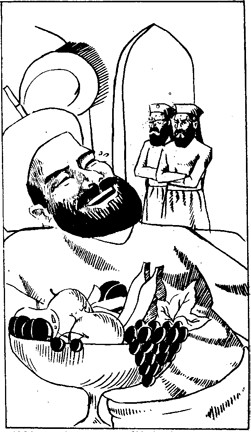
King Navdar spent most of his time in eating, drinking and merry making
Illustration: Gulshan Paghdiwala (née Dalal)
Turan takes advantage
When the news reached the king of Turan that there was widespread discontent among the Iranian people, he was very happy. It was a welcome sign, as he was awaiting an opportunity to avenge the defeat suffered at the hands of King Minocheher.
At that time King Pashang, the grandson of Tur, ruled over Turan. He had three sons Afrasiyab, Agreras and Kasrevaj. Agreras was a noble prince and was against any offensive move by the Turanians towards Iran. He even cautioned his brothers and father that though the King in Iran was weak, he had valiant supporters in Zal, Nariman and Kâran. However Pashang did not heed this advice and ordered Afrasiyab to prepare for a war and asked Agreras to accompany him.
At spring time, the Turanian army consisting of four lac soldiers marched towards Iran. King Navdar came to know of the advancing army only after it had reached the river Jihun (Oxus). He was startled at the approaching danger and immediately dispatched an army of one and a half lac soldiers under the command of Kâran. Both the armies arrived in Tabaristan. The Turanian army was stationed at Arman and the Iranian army at Dehestan.
As Afrasiyab was preparing to send a troop of 30,000 soldiers to Zabulistan under the command of warriors Shamasas and Kharjvan, he received a message that the great paladin Sam had passed away and his son Zal was occupied in making arrangements for the funeral.
Afrasiyab was jubilant on receiving this news as the absence of Zal in the battlefield would give a great advantage to Turan. He sent a messenger to convey this news to his father. Thereafter Afrasiyab sent his warrior Barman to ascertain the strength of the Iranian army. When Barman came in the Iranian camp, he was caught and challenged to a duel by the Iranian warrior Kobad. In the combat that ensued, Kobad put up a valiant fight but was too old in comparison to the young and energetic Barman and was finally killed by him.
The war begins
The death of Kobad sparked off the war. The two armies attacked each other, the Iranian army under Kâran and the Turanian army under Kasrevaj. Kâran wreaked havoc in the enemy fold and Afrasiyab had to come in front to counter his attack. The war raged wildly on the first day with both the armies losing more than 50,000 soldiers.
At the end of the first day King Navdar was upset that he had lost two of his best warriors Sam and Kobad. Kâran cautioned his king that the Iranian army was too weak in comparison to the Turanian army and that Afrasiyab had even ordered a reserve battalion to be brought to the battlefield. On the second day of the war both the armies met again and Afrasiyab vigorously fought against the already weakened Iranian army.
When King Navdar realised that a loss was imminent, he called his two sons Toos and Gastaham and advised them to flee to Pars through Isfahan before daybreak, from there take their families and go to the Alburz mountains via Zadkoh. Navdar’s intention in extricating his family was to save the royal lineage from which could emerge a future King of Iran.
After a break of two days, the two armies once again met in the battlefield. The Iranian army suffered great losses. King Navdar and Kâran decided to flee towards Dehestan and take refuge in a fort there. However as soon as they reached the fort, the Turanian army laid a siege around the Fort.
The evil Afrasiyab thereafter broke the code of war and sent one battalion to Pars to terrorise women and children. When Kâran came to know of this, he was furious. He asked his King’s permission to go and defend Pars, but the King denied him the permission saying that he was needed more at the fort and that Toos and Gastaham were already in Pars and would do the needful.
However Kâran was not able to convince himself to stay by the side of his King when the lives of women and children of his kingdom were in danger. He consulted other warriors Shidas and Keshwad and then decided to go to Pars against the wishes of his King.
Kâran broke out of the fort, but was caught by Barman who was blockading the fort with a Turanian battalion. Kâran fought with the Turanian army, killed Barman and set off towards Pars. When King Navdar came to know that Kâran had left for Pars, he too followed him with 1,200 soldiers. But Afrasiyab came to know of this and taking advantage of a lone Navdar, he followed him and arrested him along with some of his soldiers.
When Afrasiyab came to know that Barman was killed by Kâran, he sent Barman’s father Viseh with an army to pursue Kâran at Pars. A violent battle ensued between Kâran and Viseh. A defeated Viseh fled back to Afrasi-yab.
Mehrab comes to Zal’s rescue
A batallion led by Shamasas and Kharjvan was diverted by Afrasiyab towards Sistan from Jihun. Zal was not aware of this approaching danger as he was out of the city preparing the last resting place for his father near the jungles of Gurabe. Meanwhile Zal’s father-in-law Mehrab was taking care of the affairs of State in Zabulistan. He became aware of the approaching Turanian army and soon realised that he would not be able to take on the 30,000 strong Turanian battallion.
He needed some time till Zal could return back, and so he decided on a stratagem whereby he could divert the Turanian army’s attention. He sent a messenger to Shamasas along with gifts, pledging his allegiance to Afrasiyab and feigning dissatisfaction at Zal’s administration.
His trick worked as he was able to delay the army’s progress. In the meanwhile he sent a message to Zal explaining the situation and asking him to come immediately to Sistan. Zal returned to Sistan and expressed his gratitude to Mehrab for diverting the enemy’s attention. He took on the Turanian army and showered arrows on it.
In the battle that ensued Kharjvan was killed along with another warrior by the name Kalbad. Shamasas was not confident of fighting on his own and so he retreated. While retreating he encountered Kâran’s army which inflicted another terrible blow to the Turanian army.
A temporary agreement
When Afrasiyab became aware of this terrible defeat, he was furious. He ordered the execution of King Navdar, who was in his prison. His wise brother Agreras advised him against killing the King of Iran, as it might invite the wrath of the mighty Iranian warriors. Instead he advised Afrasiyab to marry King Navdar’s daughter Jehânsâz and foster a permanent bond between the two countries.
Agreras’s suggestion made sense to Afrasiyab and he agreed to this proposal. Immediately Agreras went to King Navdar and informed him of what had transpired and asked him whether he was willing to have his daughter married to Afrasiyab. King Navdar requested for some time to think over the proposal. At night, in a dream, he was advised to accept the proposal and further ask Afrasiyab to grant him a favour by having the boundary between Iran and Turan set amicably by shooting of an arrow. The place where the arrow landed, should be the demarcating line between the two countries.
In the morning King Navdar conveyed his decision to Afrasiyab and also put forth his request regarding the setting of the boundary, to which Afrasiyab willingly acceded. Accordingly a very pious archer by the name Erekhsha was selected who shot an arrow putting all his life-force in it. The arrow, shot in the morning from Mount Khshutha traversed in the sky till noon and descended on the banks of Jihun river, where the boundary of the two countries was declared.
A peace treaty was signed and Afrasiyab had to take away his army from the banks of Jihun. Afrasiyab was not at all happy at the outcome of the agreement with King Navdar and blamed his brother Agreras for landing him in this trouble. The arrow which enabled Iran to have a big territory was shot on the roz Tir of the month Tir and this day was celebrated with great festivity in Iran as Jashan-e-Tirangan. This Jashan is celebrated even today to commemorate this event.
King Navdar resumed his throne, but was not at all happy at the turn of events. Firstly he was unhappy about the forceable marriage of his daughter and secondly, he was estranged from his family, especially his two sons Toos and Gastaham. Very soon he got the disturbing news that his daughter had died after giving birth to a baby girl who was named Firangiz. It was predicted that Firangiz would give birth to a son who would be the future sovereign of Iran and Turan.
Afrasiyab breaks the peace again
Afrasiyab was not able to sit still in Turan. He was troubled by the memories of the defeat of his warrior Viseh and decided to avenge it. Since Afrasiyab was not aware of the whereabouts of Kâran he marched his army towards Istakhra. King Navdar was taken by surprise. As he was not prepared for the war, the Iranians were defeated, but Kâran managed to escape. Seeing the purpose of his attack frustrated, a disturbed Afrasiyab turned his ire towards King Navdar who was captured during the war. He had him executed and thereafter also ordered the execution of all Iranian soldiers who were taken prisoner.
Once again the noble Agreras intercepted on their behalf and managed to stall their execution. The soldiers were imprisoned in a place called Sâri in Mazandaran under the supervision of Agreras.
Iran was defeated in the war. Afrasiyab established himself on the Iranian throne. When Gastaham and Toos came to know about the tragic fate of their father, and the occupation of the throne by the evil Afrasiyab , they sought Zal’s help.
Zal promised to help them avenge their father’s death and get back the throne of Iran. He started preparing for an attack on Afrasiyab.
When the Iranian soldiers held prisoners at Sâri became aware of Zal’s decision to launch an attack on Turan they were jubilant. They requested Agreras to release them. Agreras planned a mock warfare after which he would entrust the soldiers to Iran, and informed Zal accordingly. Zal sent Keshwad to pretend an attack on Sâri. As soon as Keshwad reached Sâri, Agreras handed over the prisoners to him. They safely went back to Iran where Zal reinstated them to their respective ranks in the army.
When Afrasiyab found out about the mock warfare he was so furious that with his own hands he killed his brother Agreras for showing sympathy towards the Iranians. To this day Agreras is remembered with gratitude in prayers for his help to the Iranians. After the cruel death of Agreras, Pashang openly disowned Afrasiyab as his son.
ZAV
Zal planned a fresh attack on Afrasiyab, but since the throne of Iran was vacant, he thought it fit to first institute a King on the throne. Zal did not deem Toos and Gastaham fit for the throne, as they lacked royal luster and wisdom. After consulting wise men, he selected an 81-year-old man by the name of Zav, who was a descendant of Tehmurasp, as the next King of Iran. Though Zav himself was old, he rejuvenated Iran in the five years that he ruled as he was a pious and just King.
Once again Iran and Turan were engaged in a war. However, a severe famine struck both the countries due to which the armies of both the countries were famished. Due to the famine, the commanders of both the armies decided to withdraw their forces and accepted the formerly decided demarcation of Jihun river as the boundary line between the two countries.
No sooner did the armies withdraw their forces, the famine receded and there was happiness all around. Everybody believed that God too was happy at the end of the war, and the entire nation thanked God with prayers, followed by festivity. Zav died at the age of 86 leaving a better and more prosperous Iran.
KERSASP
After Zav, his son Kersasp was nominated as the King. He ruled Iran for nine years during which Afrasiyab once again attacked Iran. A war was continually fought under the command of Zal and later Rustom.
Kersasp died after nine years on the throne without leaving any heir, and the Peshdadian dynasty came to an end.
A nationwide search for a worthy King ensued, which finally culminated on the Alburz mountain. A man by the name Kobad who was a descendant of Faridun was established as the King of Iran by Zal. With Kobad started the second of the Iranian dynasties — Kayanian dynasty.
Reprinted from the book Serialized Stories from the Iranian Epic Shahnameh.
◆ ◆ ◆
From the archive