
10WZC
Stories from the Shahnameh
Sponsored by the World Zoroastrian Organisation Trust, Peekay Wines, Curiosity Furniture, Union Press and Cafe Universal
Iran wins the war
Rustam then threatened the king of Mazandaran that if he did not resume his original shape, he would crush the rock to small pieces. On hearing this threat the king immediately resumed his human form. He was a tall, stout, dark, ugly looking man with animal like neck and teeth. King Kae Kaus immediately ordered his executioner to kill him. Thus the evil reign of the king of Mazandaran came to an end. After a long time Mazandaran once again came under the rule of Iranian kings.
King Kae Kaus distributed the treasures from the war among his soldiers. Toos was made the commander-in-chief of the Iranian army. Gudarz, who was the king’s minister, was gifted the province of Esfahan. There were prayers and festivities for two weeks. King Kae Kaus thanked Rustam for his help. Rustam, as per his promise, requested the king to make Aulad, who had helped him find his way to Mazandaran, the king of Mazandaran, to which the good king very willingly agreed.
King Kae Kaus thereafter returned to Iran. He honored Rustam and rewarded him by giving a precious throne, a jewel studded crown, a gold embroidered robe and many other valuable things. Rustam then returned to his native place Nimruz in Zabulistan.
King Kae Kaus And Hamavaran
King Kae Kaus surveys his kingdom
After his victory in Mazandaran, King Kae Kaus decided to survey his territory and went from place to place. He started with the eastern provinces and visited Turan, China and Makran and met their kings who regularly paid him tributes and had accepted his sovereignty.
From there, he went to Barbary whose king had not accepted King Kae Kaus’ sovereignty, and had refused to pay tributes. King Kae Kaus challenged him to a war in which noted paladins like Gudarz, his son Giv, King Kae Kaus’ son Fariburz, Gastaham, Toos and Gurgin were fighting on the Iranian side. Within a short time, the king of Barbary was defeated. He accepted King Kae Kaus’ supremacy and agreed to pay him tributes.
From there, King Kae Kaus visited places in the West near Kohekaf (Caucasus mountains) and then went to Sistan to visit Rustam. There he stayed in the capital city of Nimruz for a month where the royal entourage was feasted and entertained with music and hunting sessions.
The kingdom of Hamavaran was always giving trouble to Iranian kings. When the king was on his visits, the king of Hamavaran once again revolted, this time taking the help of Misar (Egypt) and Sham (Syria). King Kae Kaus along with his soldiers immediately set out to Hamavaran via the shorter sea route. A severe war took place in which the rebels were badly defeated. They sought forgiveness from the king and agreed to pay tributes.
King Kae Kaus marries Sodabeh
King Kae Kaus came to know that the king of Hamavaran had a beautiful daughter, Sodabeh. He wanted to marry her and hence sent a witty and experienced courtier to ask the king of Hamavaran for the hand of his daughter.
On receiving the message, the king of Hamavaran was very distressed because he was too attached to his only daughter to give her in marriage. However, he was afraid of refusing the offer of such a powerful king. Hence he consulted his shrewd daughter, who advised him to accede to the Iranian king’s request. With a heavy heart the king of Hamavaran sent his daughter to Iran for marriage, but soon after started plotting to avenge this unwilling marriage.
King Kae Kaus is trapped
A week after the wedding, the king of Hamavaran invited King Kae Kaus over to his kingdom. The shrewd Sodabeh immediately gauged the intentions of her father and cautioned the king of Iran not to go to Hamavaran, but the guileless king accepted the invitation and went there with his paladins.
King Kae Kaus was received with great pomp and he was offered the best of hospitality for seven days. However, when after seven days King Kae Kaus and his entourage were about to leave for Iran, the army of Barbary launched a pre-planned attack on the king of Hamavaran and took King Kae Kaus, his paladins Gudarz, Giv, Toos, Gurgin and Jangeh and also his soldiers as prisoners and put them up in a remote fort on a mountain.
Thereafter the king of Hamavaran sent some maids to Iran to summon his daughter. When Sodabeh came to know of the plight of her husband, she chided her father on his cowardly conspiracy and asked to have her husband freed immediately, but the king enraged by her scathing remarks, also imprisoned her in the fort.
Turan takes advantage
In Iran, King Kae Kaus’ disappearance created alarm, and this alerted Iran’s enemies. The Turks, Turanians and Arabs attacked Iran and tried to seize the throne. Battles ensued between them. The Arabs were defeated by the Turks, who in return were defeated by the Turanian Afrasiyab. The Turanians took control over Iran, imprisoned its soldiers and started tormenting the women and children. Some soldiers, who had escaped the clutches of Afrasiyab, went to seek Rustam’s help.
Rustam to the rescue
Rustam was distressed on hearing the plight of his people. He immediately swung into action and first decided to look for his king and ensure his safety. He was aware that his king had been to Hamavaran, and so he sent a messenger to its king reprimanding him for deceiving his king, and asked him to immediately release his king or be prepared for a war. At the same time, Rustam kept himself in readiness by summoning his troops.
The king of Hamavaran did not heed Rustam’s warning. On the contrary he insulted the messenger and challenged Rustam to a war. Rustam was enraged at this open challenge. He set out through the shorter sea route and in no time reached Hamavaran. His fury was soon evident when most of Mazandaran’s army was in shambles. The king of Hamavaran was flabbergasted on seeing Rustam’s might. He immediately sent for help from his allies, the kings of Misar and Barbary, who promptly responded by sending their armies.
Rustam was ready to face and disintegrate all the three armies but he was afraid that his defeating the three armies might anger the king of Hamavaran who may retaliate by hurting King Kae Kaus. He immediately sent a messenger, asking King Kae Kaus for the course of action. The king wisely replied that his life and security was not as important as the security of the country and he asked Rustam to wreak havoc in his inimitable style. However, on a cautionary note he advised him to take care of the people of Iran if something untoward happened to him.
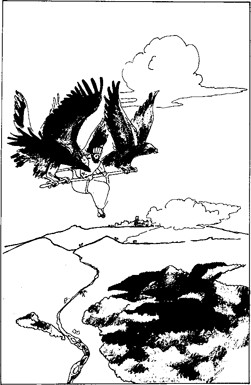
The birds flew in the air taking King Kae Kaus along with them
Illustration: Gulshan Paghdiwala (née Dalal)
King Kae Kaus is freed
Rustam, along with other warriors like his brother Zavareh, once again lashed out on the three combined armies and in no time decimated them. The kings of Sham and Barbary were taken captive. The king of Hamavaran was terrified at this havoc created by the Iranian warriors. He immediately sent for Rustam, asked for his forgiveness and requested him to end the war, promising to release King Kae Kaus with due dignity.
Rustam asked King Kae Kaus whether the enemy king should be forgiven, and the king of Iran in his magnanimity forgave him. The king of Hamavaran and the other two kings also promised to pay regular taxes and offered rich gifts to the king of Iran.
King Kae Kaus And Afrasiyab
King Kae Kaus seeks Roman help
King Kae Kaus could not immediately return to Iran, as the Turanian king Afrasiyab occupied the throne of Iran. King Kae Kaus stayed on in Barbary with his retinue, from where he planned the preparations for a war with Afrasiyab to oust him from Iran. He asked for the help from the Kaisar of Rome requesting him to send an army. The Kaisar immediately relented, and sent his army to join the Iranian army.
After this, King Kae Kaus sent a letter to Afrasiyab asking him to unconditionally vacate the throne of Iran. In the letter he reminded Afrasiyab about the shame he had to face at the hands of Rustam. Afrasiyab was furious on reading this letter as his pride was hurt. He claimed that Iran was equally his as King Faridun was his great-grandfather, and moreover he had freed Iran from the clutches of the Arabs when King Kae Kaus was imprisoned in Hamavaran. Hence he staked a claim to Iran and sent the messenger challenging King Kae Kaus to a war.
King Kae Kaus’s victory
As soon as King Kae Kaus received the defiant message from Afrasiyab, he attacked him with the help of the Roman troops. There were heavy casualties on both sides. The irrepressible Rustam created havoc in the enemy camp. The Turanian soldiers were utterly demoralised on seeing Rustam. Afrasiyab in a lame attempt to boost the morale of his army offered the hand of his daughter, a part of his kingdom and the position of his army’s commander to the soldier who would kill or imprison Rustam.
However, even the magnificent offers of Afrasiyab could not give enough courage to any soldier to go near Rustam. Two-thirds of the Turanian army was decimated. Afrasiyab saw no point in continuing the war and he along with a few soldiers fled Iran. King Kae Kaus returned to Pars and triumphantly re-occupied his throne.
King Kae Kaus Attempts To Fly
Evil tempts King Kae Kaus
King Kae Kaus now had everything he could ask for, so he concentrated his attention on other things. He had a beautiful palace built in the Alburz Mountains using the services of the evil demons as laborers. The complex had two golden, two silvern, two iron and two crystal palaces for the great king with special chambers for armories and residence.
Angra Mainyu, the chief of the evil ones, was angry with the king that he had made his hordes work hard in building the palaces. He was also jealous of the success of King Kae Kaus and he took it upon himself to humiliate him. He ordered his brood of demons to think of a plan to humiliate King Kae Kaus in the eyes of his subjects.
One of the chief demons by the name of Aeshma came up with the idea that since King Kae Kaus was very naive and inquisitive, his faith in God should be shaken and he be tempted to know the secrets of nature. In this way the king will make a fool of himself, lose the trust of his courtiers and subjects and may even lose his Kayanian glory.
This plan of Aeshma was well received and he himself went down to earth in the garb of a court attendant. As is the practice of those who purposely mislead, he at first highly flattered the king and then put in the proposition that he should make more efforts to know about the workings of the laws of nature and movements of the heavenly bodies.
Aeshma misguided the king by saying that he would be able to fathom the secrets of the sky if he tried to fly like the birds. At first, the king did not accept this suggestion as it shook his firm belief in God and His wisdom. However, after some persuasion and listening to the plan laid down by Aeshma, he started giving thought to the crazy idea and started making preparations for his attempt to fly.
The flight and fall of King Kae Kaus
As per the first steps to the preparations he started inquiring about the height of the sky and the distance of the stars and the sun from earth. Thereafter, he asked his attendants to get for him fledglings from the nest of the huge bird by the name Okab (eagle). These fledglings were fed and made strong so that they would be able to bear his weight.
A wooden throne was then made and plated with gold. Spears were tied to this throne in such a way that the birds could carry the throne. He selected four of the strongest birds, tied each of the four corners of the throne to a bird, sat on the throne and then the birds were made to fly, taking King Kae Kaus along with them high up in the sky.
The birds flew in the air for a long time, but finally they got tired and fell from great heights onto the ground somewhere near Amul in Mazandaran bordering towards China. It was indeed a miracle that the king survived. Firdausi says that God, in His wisdom, wanted him to live because Siya-vakhsh was yet to be born.
Reprinted from the book Serialized Stories from the Iranian Epic Shahnameh.
◆ ◆ ◆
From the archive