
10WZC
Stories from the Shahnameh
Sponsored by Peekay Wines, Curiosity Furniture, Union Press, Cafe Universal, and the World Zoroastrian Organisation Trust
MINOCHEHER
The birth of Minocheher was heralded with great celebration throughout Iran. So happy was Faridun at Minocheher’s birth that he prayed to God requesting Him to restore his eyesight to enable him to see his great-grandson, and the all merciful God restored his eyesight. Minocheher was brought up with great love and care. He was educated in a manner befitting a prince and trained in all the arts of warfare.
Tur and Selam are terrified
In due course, Minocheher grew up and started preparing for the war against his grand uncles. With him were great warriors like Kâran, son of Kaveh, Shiroy, Shapur, Kobad, Keshwad, Nariman, Sam, Kersasp and Sarv. When Selam and Tur came to know about the preparation for a war in the opposite camp, they realized that their doomsday was drawing near.
They were well aware that they were no match for the mighty Iranian army with its powerful warriors. In a last ditch attempt to save themselves they conveyed their apologies for their past misconduct and asked for forgiveness. They stated in their message that with maturing they realized the grievousness of the sin they committed of murdering their brother and were repentant for the same. However, they maintained their innocence and pleaded forgiveness, as according to them, the demon of envy had blinded them in their youth.
They also reasoned that the events leading to their brother’s murder may even have been predestined and they were mere instruments of fate in fulfilling the destiny. They requested their father to forgive their folly and condone their cruel action. They further requested for a chance to atone for their past mistakes by serving Minocheher, who be sent to them. With this message they sent many precious gifts to Faridun.
Faridun realized the evil intentions of his sons in inviting Minocheher. He replied to them saying he would surely send Minocheher. However, he will meet them not in the palace, but on the battlefield, and accompanying him would be trusted warriors and wise men.
Selam and Tur waited outside the city gates in pitched tents hoping that their father would once again come into their words and send Minocheher. However when the messenger conveyed the news sent by Faridun, they were terrified and started preparing for the war. They opted for the offensive and started marching towards Iran with an enormous army. When Faridun came to know that his sons had already launched an attack, he instructed Minocheher to counter their attack.
The War begins
Minocheher marched forth with his soldiers and warriors to meet the army of his grandfather’s brothers. His army was under the command of the brave Kâran. The right wing of the army was under Sam and Kekobad and the left wing under Kersasp. Minocheher was in command at the center of the army.
Shiroy, a Turkish warrior initiated the attack from the Turanian side. Kâran took the brunt of his attack, but before he could respond, Shiroy shot a spear in his direction. Sam rushed to Kâran’s rescue and saved him. Shiroy penetrated the Iranian army and challenged the Iranian warriors to fight him. Kersasp took up the challenge and in no time smashed the head of Shiroy with his gurz. With the death of Shiroy, there was pandemonium in the Turanian camp.
Death of Tur
Selam and Tur decided to resort to their devious tactic of Shab-e-khun, that is, launching a surprise attack at night, an unacceptable warfare practice in those times. Selam and Tur did not come out on the field the following day which surprised Minocheher. Inquiring through his spies, he came to know about their covert plan and prepared for the night attack by entrusting the defense of his camp at night to Kâran along with 30,000 soldiers armed with daggers.
When Tur attacked at night with one lakh soldiers hoping to surprise his opponents, he himself was taken by surprise on seeing Kâran and his men ready for confrontation. Tur’s soldiers had not anticipated any resistance. Moreover they were ill-equipped with only bows and arrows at their disposal, and hence were easily defeated by the Iranians. Tur decided to retreat, but it was too late. He was surrounded on one side by Minocheher and on the other side by Kâran. In no time Minocheher killed Tur with his spear.
The next day Minocheher sent a message to Faridun informing him of Tur’s death and apologised for the unprincipled battle at night, but justified it as a means of defense against his crafty opponents. Minocheher sent the severed head of Tur to Faridun in the same way as Tur had sent the severed head of Irach to his father.
The Fort of Allana
When Selam got the news of Tur’s death, he was shattered. He lost all hopes of winning the war and decided to flee. Minocheher was aware of an almost invincible naval fortress by the name of Allana, which was always well stocked. Minocheher realised that Selam would take refuge there and so he ordered Kâran to plan an attack on the fort. Kâran devised a ploy to gain access into the almost impenetrable fortress. However, he implemented his plan only after seeking Minocheher’s permission.
As per his plan, Kâran retrieved from Tur’s lifeless body his finger-ring, took the Iranian flag, selected 6,000 of his able and experienced soldiers and set off to lay a siege around the fort. At the fort Kâran feigned to be Tur’s messenger and showed the gate-keeper Tur’s ring as a proof of his identity. He said that he was sent by Tur to help protect this fortress. The gate-keeper, unaware of Tur’s death, allowed Kâran to come in.
At night time, as per the plan, Kâran signaled Shiroy by raising the Iranian flag. Shiroy came into the fortress with his men and within no time took possession of the fort. However, Selam was not inside the fort as he had changed his decision and instead gone to seek help from Zohak’s son Kakui.
Kâran, after capturing the fort, went back to Minocheher to give him the good tidings of victory and found his King engaged in a battle against Kakui, who had joined the war at Selam’s behest, with an army of one lakh soldiers. Selam too was engaged in this battle.
In the course of this battle Kakui was killed by Minocheher. Now Selam was all alone to fend for himself. He rushed towards the fort of Hukht Kang which was the stronghold of Kakui. Minocheher caught up with him in time and with a stroke of his mighty sword severed Selam’s head from his body.
Iran’s victory
The Turanian army was now like a shepherdless herd. They sent a wise man from amongst them to request Minocheher to end the war as they themselves were not even soldiers, but agriculturists and artisans who were forced to fight in the war. The soldiers accepted Minocheher’s sovereignty and with that Minocheher ended the war. He rewarded all his soldiers and warriors as per their merits.
Minocheher wrote a letter to Faridun informing him about his victory, Selam’s death and intimating him of his arrival. Faridun was very happy at the turn of events. He personally went to welcome Minocheher at the gates of Gilân.
Minocheher was entrusted to the care of Sam and Faridun immersed himself in the preparations for coronation. In due time Minocheher was coronated as the King of Iran and soon after that Faridun passed away peacefully, his life’s mission accomplished. He was ceremoniously placed in a dakhma (a place for consigning dead bodies of Zoroastrians) specially made for him. The entire nation mourned Faridun’s death for seven days. On the eighth day Minocheher resumed his regal duties and pledged to reign justly as per the laws laid down by his great grandfather Faridun.
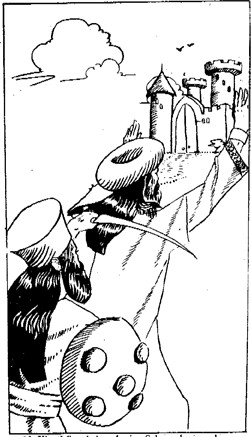
King Minocheher chasing Selam who is rushing towards the fort of Hukht Kang
Illustration: Gulshan Paghdiwala (née Dalal)
Marriage of Zal
Sam, the King of Jabulistan and a very respected advisor of King Minocheher, had a son by the name Zal who was in love with princess Rodabeh, who was the daughter of King Mehrab of Kabul. Mehrab was a descendant of Zohak, and was now under Zal’s suzerainty.
When Zal informed his father about his love for the princess from Kabul, he declined at first. Later he consulted astrologers who saw a great future for the couple and a very promising progeny for the two. Thereafter Sam gave his consent for the marriage.
However, before Sam could inform King Minocheher of his son’s wedding, the King came to know of this marriage and was very much annoyed. He was concerned that the peace brought between Iran and Turan at the cost of a war may be shattered by this alliance. He also feared that the evil of Zohak crushed by Faridun with great difficulty may resurface through the progeny of this marriage.
King Minocheher immediately sent his son Navdar to summon Sam. When Sam came to the King, hoping to give him the news of his son’s marriage, he was instead reprimanded for having consented to the marriage and ordered to launch an attack on Mehrab. Sam considered it prudent not to argue with the furious King and he immediately set off with an army towards Kabul.
When Zal came to know of the King’s orders of declaring a war on Mehrab, he was shocked and surprised. He intercepted his father on his way and pleaded with him to request the King to reconsider his decision, since if Mehrab was attacked than Zal himself would be guilty for his predicament.
Sam sympathised with his son and understood his dilemma. He immediately dispatched a letter to the King with Zal. In the letter Sam recounted his faithfulness to the Iranian kings and his services to the Iranian people like the killing of an Azdâh who resided in the Kashf river. He requested King Minocheher to reconsider Zal’s case with sympathy and revert his orders for the war. He also informed the King about the prognosis of the astrologers as to the outcome of the marriage.
Zal set off towards Kargasar like a man possessed, not waiting for food, drink or rest. When he reached the palace, he was given a royal welcome. He gave his father’s letter to the King, who, after going through the letter agreed to the request of averting the war.
The King said that he held Sam in high esteem and did not like to hurt him. He gave Zal the permission for the wedding and told him to stay in the palace and called him again the following day. In the meanwhile, King Minocheher ordered his astrologers to check the outcome of the marriage between Zal and Rodabeh.
The astrologers consulted the star charts and gave a very positive forecast. They reported that the union would bear one of the greatest heroes the world would ever know, who would sincerely serve his motherland Iran throughout his life, and would be a great asset to it. Minocheher was greatly pleased with the prognosis, nevertheless he told his astrologers to keep this information to themselves, and ordered his wise men to test the intelligence of Zal.
The next day when Zal presented himself before the King, he was made to sit amongst learned men and asked the following six questions:
In Iran, which 12 trees, each having 30 branches, are always the same?
Which are the two swift horses, one white and the other black, who are running behind each other, but never able to catch up with the other ?
Thirty riders are riding past the King, but when counted they number only 29. Who are they?
Who is the angry man in a lush jungle along a river, who with a hatchet slashes at every shrub and plant in sight without heeding their pleas.
A bird makes its nest alternatively on two trees. The tree with the nest, becomes lush green and blossoms, whereas the other tree withers away. What do the trees and the bird represent?
On a mountain there is a fortified city from which its subjects come down and reside in tall houses built in jungles. They forget their former city till it totally disappears out of sight. After its disappearance, the people regret losing sight of it. Which is that city?
Zal attentively listened to the six questions posed by the wise men, pondered awhile and replied:
The twelve trees signify the twelve full moon days and the thirty branches signify the thirty days in a month.
The two horses are night and day which always follow each other but never catch up.
The riders signify the days in the lunar month which sometime seem to be 29 and sometime revert back to 30.
The lush jungle is the world and the angry man is Time who heeds no one’s pleas and indiscriminately inflicts blows on one and all.
The two trees signify the two hemispheres of the earth, and the bird signifies the sun. In the hemisphere where there is sun, the trees are in bloom and there is sunshine and prosperity. The hemisphere where the sun is absent experiences winter.
The fortified city on the mountain is the spiritual world and the jungle is this material world. Men come from the former to the latter, but soon lose sight of it due to their attachments in this world, and later repent for having lost it.
King Minocheher was very pleased with Zal’s answers and so were the learned men. The King showered Zal with precious gifts in appreciation. Everybody spent the rest of the day and night in celebration. The following morning King Minocheher requested Zal to spend one more day with him, to which Zal agreed.
On that day Zal impressed the King by his prowess on the horse. The King was highly pleased with him. He sent him back the following day with a letter to Sam asking him not to go ahead with the war but instead start preparations for his son’s marriage. Shortly thereafter Zal and Rodabeh were married with the blessings of King Minocheher.
After some time a child was born to Zal and Rodabeh who was named Rustom. Even his birth amazed the world, as he was a gigantic baby. He grew up to be a fearless and courageous boy. The stories of his accomplishments are legend.
When he was just 10, he defeated an almost invincible Afghan chieftain by the name Kakke Kohzad whom even his father, grandfather and great grandfather were not able to subdue. In a fierce duel Rustom overpowered Kohzad single-handedly and won fame and acclaim from all including King Minocheher, who was very proud of this brave young warrior. He honored Rustom by giving him a place on a golden throne next to him and bestowing him with gifts of gold and land.
King Minocheher, during his long reign, built a dam on the river Euphrates for providing better irrigational facilities to his subjects. After a long and fruitful reign of 120 years, the King realized that the time for a change of power was approaching. He handed over the reins of the kingdom to his son Navdar, and admonished him to rule justly. He advised him to take guidance from Sam, Zal and Rustom whenever in need. Soon afterwards King Minocheher passed away peacefully.
Reprinted from the book Serialized Stories from the Iranian Epic Shahnameh.
◆ ◆ ◆
From the archive