
10WZC
Stories from the Shahnameh
Sponsored by The World Zoroastrian Organisation Trust, Peekay Wines, Curiosity Furniture, Union Press and Cafe Universal
FARIDUN
Ascension to the throne
We have read about Faridun’s birth, upbringing and his battle against Zohak. After imprisoning Zohak in Mount Demavand, Faridun shifted Iran’s capital from Baet-ul-Mukaddas to Varena. He ascended the throne on roz Hormazd of mah Meher and fifteen days thereafter celebrated a thanksgiving Jashan on roz Meher of mah Meher. This Jashan, known as the Jashan-e-Mehrangān, is celebrated even today to commemorate the end of Zohak’s rule and Faridun’s ascension to the throne.
After Faridun ascended the throne, he proclaimed his divine appointment to his subjects and assured them full justice. In his reign, people regained their lost confidence and resumed work in their hereditary professions. They started going out of their houses, which they had stopped on account of fear of being captured by Zohak’s soldiers. King Faridun asked the farmers to resume cultivation of their fertile fields which had been lying fallow all these years.
Faridun’s mother Faranak was overjoyed at his son’s ascension to the throne. She thanked Ahura Mazda by offering prayers and burning incense on fire. She fed the poor and the needy and did so much charity from the money she had saved that there was no beggar left in her town.
After becoming the king, Faridun married Arnavaz and Shernaz whom he had freed from Zohak’s clutches and who had helped him to defeat Zohak. Faridun had three sons, two elder ones borne by Shernaz and the youngest by Arnavaz. Faridun did not give names to any of the three sons because they were too beloved to him.
Brides for the princes
When Faridun was 50 years old, he decided to have his sons married. He ordered his trusted officer Jandal to look for three sisters who would be suitable as their brides. They should be very beautiful and so beloved of their father that they too, like his sons, should not have been named. Jandal searched far and wide in entire Iran, but nowhere did he find three sisters as specified by Faridun. Then Jandal came to know that King Sarv of Yaman (Arabia Felix) had three beautiful daughters who were not yet named.
Jandal immediately set off for Yaman, met the King and presented him valuable gifts. When Jandal forwarded Faridun’s proposal to the king, he was not very happy as he loved his daughters too dearly to part with them. He requested Jandal to give him some time to think over the proposal.
The following day King Sarv consulted the wise men of his court as to how he could refuse the proposal, without offending the great King of Iran. The wise men conferred and said that, if King Sarv rejected the proposal outright, King Faridun may declare a war. If King Sarv did not want a war, he should accept the proposal and ask for costly gifts, so that King Faridun himself may take back the proposal.
King Sarv did not like the suggestions made by his courtiers, so he himself devised a devious plan. The following day, he summoned Jandal and told him that King Faridun’s proposal was acceptable by him with the condition that he be allowed to test the princes before allowing them to marry his daughters. Jandal agreed to the proposal and returned to Iran, delighted that his mission was successful.
Jandal returned to Varena and told King Faridun that the brides were found and the proposal accepted. The King was very happy and he prepared his sons to go to Yaman. Through Jandal he informed them that King Sarv will organise a banquet for them, in which they will be tested. The king will make his daughters sit with the princes, but not in order. The eldest would be sitting besides the youngest and the middle sister would be seated the last. If the king asked them whether the sisters were sitting in the correct order, as per their age, they should give an appropriate answer and correct the seating order. Thus Faridun prepared his princes for their adventure.
The princes set off for Yaman
With words of advice and counsel and a few Nirangs from their father, the princes set off for Yaman with an entourage of soldiers bearing costly gifts. The princes reached Yaman where a banquet was organised for them. In the banquet questions were asked to the princes regarding the seating order of the princesses, which they answered to the King’s satisfaction. The King had to give a half-hearted consent for the marriage, even though he resented the thought of being separated from his daughters.
As a last attempt, to stall the proposed marriages, the King devised a treacherous plan. He organised another banquet in the princes’ honour and had them intoxicated by making them drink a lot of wine. Inebriated, the princes went to sleep in the banquet hall. The King then executed the rest of his plan by creating sub-zero temperatures and blowing cold winds by his magical powers, so that the princes would freeze to death.
The princes were not as inebriated as the King had thought. They came back to sobriety and soon realised that they were trapped by the sorcery of the King. They chanted Nirangs given to them by their father, which broke the magic spell of the King. After all his ploys come to naught, the King finally had his daughters married to the princes and sent them to Iran with lots of gifts, jewels and precious stones.
Faridun tests his princes
When the princes were on their way to Iran with their brides, King Faridun decided to test their valour. He assumed the form of an Azdāh (a dragon with the head of a serpent) hissing fire and stood before his sons.
The eldest son retreated considering it futile to even try to fight such a mighty animal. The second son showed readiness to fight the Azdāh. He strung an arrow to his bow, but when the Azdāh charged towards him, he too kept aside his valour, and withdrew. The youngest son however, drew his sword, charged towards the Azdāh and challenged it. The Azdāh fled at this brave confrontation.
King Faridun returned to his palace and arranged for a warm welcome for his newly wed sons and their brides. After welcoming them, he disclosed that it was he who had assumed the form of an Azdāh to test their valour. He praised all the three sons for their respective reactions to the situation, but in his heart of hearts he appreciated the courage of the youngest.
Thereafter he named his three sons on the basis of their reactions to the Azdāh. He named his eldest son Selam for his no-fight practical approach. The second son was named Tur for his moderate bravery, and for the heroism and courage shown by the youngest, he named him Irach. He named their brides Arzui, Māh-āzādeh-kuhi and Sahi respectively.
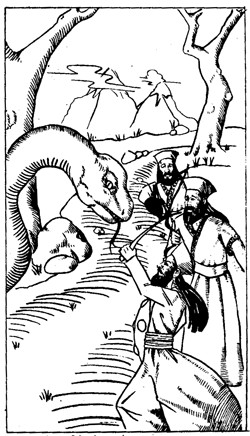
Reactions of the three princes of King Faridun on seeing the Azdāh
Illustration: Gulshan Paghdiwala (née Dalal)
Division of the Kingdom
King Faridun realised that he was getting old. He decided to divide his empire amongst his three sons. However, before that, as per the practice, he consulted their horoscopes and was pained to learn that the future of his youngest son Irach was full of calamity and despair. So he decided to keep Irach with himself and made him the king of Iran.
To the elder Selam, he gave the territories of Rome and Western Iran and to the second son Tur he gave the eastern regions of Turkestan and China. He then sent off his elder sons to their respective kingdoms.
The elder sons were not satisfied with the way their father had distributed the territory among the three brothers. They felt that he had been partial to the youngest son, and so the two elder brothers Selam and Tur conspired against Irach. They sent a message to their father complaining that he had been partial in dividing the kingdom and demanded that either he change his decision or be ready for a war.
Faridun was very hurt by this message from his own sons. He replied that he had been totally impartial in his dealings and explained that he had even consulted wise men and astrologers before taking his decision. He conveyed that he had no grudge against any of his sons and had always treated them equally. He advised them not to be greedy or else they would never be happy. He ended his reply by stating that if this response did not satisfy them, then he was ready for a war.
Irach is misunderstood
When Faridun showed the message of the elder sons to Irach, he was hurt at the attitude of his brothers. He dearly loved his brothers and did not like the idea of having a war with them. He told his father that he did not mind even giving up his share of the kingdom if that averted a war. He insisted on personally going to meet his brothers to calm their anger and pacify their bitterness.
Faridun was hesitant to send the innocent and gullible Irach to his treacherous brothers, but when Irach adamantly insisted on going, he reluctantly relented. He gave him a letter to be delivered to his elder brothers. In the letter he had stated that the younger brother should be regarded with care and affection as he was even willing to forsake his kingdom to maintain peace among the brothers.
With an escort of a few soldiers Irach set off to meet his brothers. When he arrived, he was received by his brothers’ soldiers as per the protocol. On seeing him, the soldiers admired and praised his noble countenance. They were heard saying, "He looks so noble and majestic that he alone is fit to be the king of Iran.” Tur and Selam overheard this remark, which enraged them even further. They became all the more envious of their brother.
Enmity between Iran and Turan
When the three brothers met in the palace, the elder brothers treated the younger one with disdain, rebuked him for being father’s pet and blamed him for the discrimination meted out to them by their father. Irach, very naively tried to pacify them by saying that if they wanted his kingdom he was ready to give it to them. He was willing to do anything to maintain peace.
The selfless, calm and compassionate manner of Irach was too much for the unscrupulous brothers to tolerate. In a fit of anger Tur rose from his seat, took a chair and hit Irach hard on the head. Irach pleaded for mercy, but Tur, burning with revenge, took out a dagger and stabbed him in the heart. Then he mercilessly severed Irach’s head from his body, put it on a salver, covered it with a cloth and sent it back to their father with the message, "This was the head on which you bestowed the crown. Now you may give him the crown or the throne.”
The ruthless act of murdering Irach sowed the seeds of enmity between Iran and Turan which would attain epic proportions and last for centuries.
A heart-shattering blow
In Iran, Faridun was eagerly awaiting his son’s return. When he saw the army approaching he was filled with joy. But when he saw the mournful faces of the soldiers and could not locate Irach, he became apprehensive and feared that something terribly wrong might have happened.
The soldiers handed Faridun the salver. On removing the cloth, he was horrified at seeing the severed head of his son. The grief was too much for this noble old king to bear. He went into a state of shock and wept so bitterly that he lost his eyesight. In anguish he burnt down his son’s palace so that it may not keep reminding him of his beloved son. The entire nation mourned the loss of their noble young King.
Irach’s death shattered Faridun completely. He lost all interest in life, but soon gathered himself, only for one purpose. To teach a lesson to his elder sons and avenge the cruel death of his innocent youngest son. With great joy he received the news that Irach’s Queen was to shortly bear a child.
Faridun was disappointed when the Queen gave birth to a baby girl. Nevertheless the noble King soon overcame the disappointment and patiently started the upbringing of the child with great care. He named her Paricheher and forgot his sorrow in the love of this child in whom he saw his own son Irach.
Faridun was hoping that after Paricheher grew up and got married, her child would be groomed as the next King of Iran and would avenge the death of his grandfather. In due course of time Paricheher was married to Faridun’s brother’s son Pashang, and after some time she bore a charming baby boy who was named Minocheher.
Reprinted from the book Serialized Stories from the Iranian Epic Shahnameh.
◆ ◆ ◆
From the archive