
10WZC
Stories from the Shahnameh
Sponsored by Peekay Wines, Curiosity Furniture, Union Press, Cafe Universal and the World Zoroastrian Organisation Trust
King Kae Kaus repents
The senior paladins, especially Gudarz who was the seniormost, strongly reprimanded the king for creating problems for the entire nation. This was the third time that he did not heed their advice and landed everybody into trouble.
King Kae Kaus himself was feeling sorry for his behavior and passed his days in great remorse. For 40 days he continuously prayed to God asking for forgiveness for his arrogant thoughts and foolish behavior and only after that did he resume his throne. The senior courtiers and paladins forgave him and peace once again reigned in Iran.
Sohrab And Rustam
Gazdam’s letter to Kaus
All was going well for King Kae Kaus when he received a letter from Gazdam, the caretaker of the fort of Sapid, which was on the border between Iran and Turan. A young lad of 14 by the name of Sohrab, who hailed from Turkistan, had come with the army from Turan. He was creating havoc and was unstoppable. His facial features resembled Rustam and he seemed to be of the family of Nariman.
Hazir, son of Gudarz, who was the custodian of the fort, was defeated and imprisoned by Sohrab within the blink of an eye. Gazdam requested instant help from the king, dispatched a messenger at night through a secret route and he himself with his family fled the fort at night. The next morning Sohrab entered the fort without any difficulty or opposition.
When King Kae Kaus received Gazdam’s message, he realised the urgency of the situation and immediately called a conference of his trusted warriors Toos, Keshvad, Gudarz, Giv, Gurgin, Behram and Farhad and apprised them of the situation. It was unanimously decided at the conference that Rustam was the only person who could contain the might of Sohrab and save the Iranians, and so they selected Giv to be sent urgently to Zabulistan to summon Rustam.
King Kae Kaus sends for Rustam
King Kae Kaus prepared a hasty letter and dispatched it to Rustam. In the letter, he first lauded the services of Rustam and his family to Iran, and then requested him to urgently come to the aid of his country. He dispatched Giv and advised him to come back immediately with Rustam without even waiting to rest. Giv immediately set off for Zabulistan and did not wait anywhere on the way either for eating or resting.
On reaching Zabulistan, he gave the urgent message of summons, but Rustam was not willing to go immediately, as he believed that he was not a servant of the king to go at his beck and call. He asked Giv to wait till he was ready. Three days passed during which Giv repeatedly reminded Rustam that the fury of the king would know no bounds if they were late, but Rustam was in no mood to relent. Finally, on the fourth day, they set off for Iran.
King Kae Kaus insults Rustam
As soon as Giv and Rustam reached the palace, they went to see the king. However the king was fuming with anger because of the long delay. He fired Rustam by saying, "Who do you think you are that you disobey the king’s orders and place your own whims before the interests of the country?” Then, in a fit of anger he ordered Toos to take Giv and Rustam to the gallows and hang them.
Rustam’s scathing reply
This insult was too much for the great Rustam. As he was fuming with rage, Toos approached him to pacify him and take him away from the temperamental king. However, a furious Rustam jerked away the great warrior Toos, who was hurled aside like a small child.
Rustam reminded the king in no uncertain terms that he was alive and on the throne only because of him. He told the king, "Don’t think you are my master or provider — God alone is my provider. My horse Rakhsh is my throne, my mace is my seal and my helmet is my crown, I don’t need anything else.” He hastily he left the palace telling the other paladins to fend for themselves and their country as he was leaving Iran forever.
The paladins were very upset with their king for insulting and infuriating the great Rustam. They once again approached the senior paladin Gudarz for a solution to this problem. The aged warrior went to the king and reproached him for being rude to Rustam, who had several times saved the king from certain death.
Gudarz told the king that he would now be responsible for Iran’s plight as Gazdam had clearly indicated in his letter that no paladin except Rustam would be capable of taking on the might of Sohrab. He once again chided the king for losing his cool instead of handling the situation delicately and wisely.
The reconciliation
King Kae Kaus once again realized his folly. He agreed with Gudarz and sent an apology to Rustam. Some of the paladins along with Gudarz carried the king’s message to Rustam and asked him to forgive the king who, though ill tempered, was good at heart and had a noble disposition. Rustam was also told that by leaving Iran he was not punishing the king, but the entire nation, as it would be the people who would have to bear the brunt of the attack of the Turanians. Rustam however was very firm. He maintained that he was not a servant of the king and the king had no business to treat him so rudely.
When Rustam was not convinced, Gudarz tried another stratagem to convince him. He tried to appeal to the vanity of Rustam by telling him that the king, soldiers and people of Iran were thinking that he had left Iran because he was afraid to face the young paladin of Turkistan. All the soldiers and paladins think that if the great Rustam was not ready to face this young paladin they stand no chance before him, and so all were deciding to desert the war and flee. This argument touched a chord in Rustam’s heart and after some further persuasion he agreed to return to Iran.
As soon as the King Kae Kaus received the message that Rustam had agreed to come back to Iran, he was jubilant. He made elaborate preparations for receiving Rustam, and when he finally arrived, the king greeted him with profuse apologies. He asked forgiveness for his rudeness and blamed his natural disposition for his uncouth behavior and fits of anger. Thereafter both the king and Rustam accepted each other’s respective superior positions and the king declared a feast to commemorate the reconciliation.
March towards the fort of Sapid
Immediately the following day, the Iranian soldiers along with Rustam and other paladins marched towards the fort of Sapid which Sohrab had captured and where the Turanian army was stationed.
When Homan, the Turanian commander, and Sohrab saw that the Iranian army was approaching from the fort, Homan was distressed and tense, but Sohrab was confident of himself and his ability to fight against any warrior. He was also excited at the prospect of meeting his father Rustam.
Death of Zindeh-razam
The Iranian army was stationed some distance away from the fort of Sapid. At dusk, Rustam decided to go to the fort in disguise to take stock of the situation in the enemy camp and get any information possible. He hid in a dark corner and spotted Sohrab sitting calmly discussing the stratagems of war. He was flanked on one side by the Turanian commanders Barman and Homan and on the other side was his maternal uncle Zindeh-razam, who was the prince of Samangan. He was specially sent by Tehmina, the mother of Sohrab to identify Rustam and facilitate the meeting between the father and the son.
Zindeh-razam saw some movement in the distant corner where Rustam was hiding so he went to investigate. Rustam was not able to identify Zindeh-razam in the darkness. Zindeh-razam too saw the silhouette of Rustam but failed to identify him, and tried to raise an alarm. Rustam immediately silenced him and dealt a powerful blow on his neck, rendering him lifeless. Thus was gone the only link who would have identified the father to the son.
When Sohrab realised that Zindeh-razam had not returned for a long time, he sent an attendant, who returned with the tragic news of the death of Zindeh-razam. Sohrab was grieved at this loss and immediately realized that an intruder had entered the palace. He told his men to prepare for war and decided to launch an attack the following day.
Rustam returned to his camp and gave the news of war preparations in the enemy camp to King Kae Kaus. He even described the grandeur of Sohrab to the king and other Iranian paladins and asked them to be prepared to face an attack any time from the Turanians.
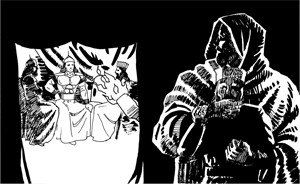
Rustam kills Zindeh-razam in the darkness
Illustration: Gulshan Paghdiwala (née Dalal)
Sohrab takes stock
The following day, Sohrab mounted his black horse and climbed to a strategic point from where he could take stock of the Iranian army. He called Hazir, the commander of the fort of Sapid whom he had imprisoned, and asked him to identify the different tents with the hope that he may get some clue to the identity of Rustam. Hazir properly identified the tents of all other paladins, but when he came to the tent of Rustam, he lied that the tent was that of a newly recruited warrior from China. Hazir’s intention was to protect Rustam — the greatest asset of the Iranian army, from any unsuspecting attack by the enemies. Sohrab was dejected that he could not get any information about Rustam.
Thereafter, Sohrab sped off alone towards the Iranian camp and went straight to King Kae Kaus’s tent where he challenged the king to send any of his warriors to fight him. King Kae Kaus was terrified by the gigantic looks of Sohrab and immediately sent Toos to summon Rustam to take on this great warrior. On receiving the urgent message in his tent, Rustam immediately prepared himself and set off for the battlefield.
Sohrab meets Rustam
Both the great warriors — Sohrab and Rustam — came face to face with each other, and decided to go to a secluded place for a duel. While on the way, Sohrab felt affection towards Rustam and asked him whether he was Rustam. In order to put him off guard Rustam replied that he was a very small warrior in comparison to the great Rustam.
The two great warriors went to a secluded place and started their duel, first with spears and swords and then with mace and bows and arrows. The duels between the two were so fierce that their weapons got worn out and their horses became tired, but none proved superior to the other. Finally, at dusk they stopped the duel for the day and decided to meet again the next day for a weaponless duel.
Rustam had never ever faced such stiff competition before. He was feeling frail and weak. He was dejected to such an extent that he even sent a message to King Kae Kaus not to continue the war in the event of his death, because no one in Iran would be able to match the strength of Sohrab.
On the other hand, Sohrab was feeling guilty about the duel firstly because of the age difference and secondly because he was feeling a strange attachment towards Rustam. He dreaded the possibility of actually fighting against his own father.
Reprinted from the book Serialized Stories from the Iranian Epic Shahnameh.
◆ ◆ ◆
From the archive