
In Memoriam
Cradling culture
Died: Dr Jamshed Jehangirji Bhabha, 92, creator and chairman of the National Centre for the Performing Arts (NCPA) and chairman of many Tata trusts, on May 30, 2007 at Bombay’s Breach Candy Hospital.
Commending Bhabha’s "passion, dedication and tenacity,” at a public condolence meeting convened at the Jamshed Bhabha Theatre on June 20, 2007, NCPA vice chairman K. N. Suntook referred to the "lessons and experiences imbibed” during his nearly 20 years of association with this "great Renaissance man… a visionary (who) was so many things to so many people in so many ways.”
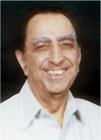
Dr Jamshed Bhabha: patron of arts
"He was not a person with a mission but a mission himself,” observed NCPA executive director Vijaya Mehta commenting on his "guts, ability and fire.” Acknowledging that she had learnt from him "a sense of values…about culture, human relationships,” she told the audience how two months ago the chairman "wanted all of us to come together and accept a memento of our association with him.” The NCPA is not just a complex with theaters but encompasses endowments, friends, international contacts, she alluded to his pioneering role, reiterating, "he made our lives richer.”
The NCPA was established with a grant of Rs 40 crore from the Sir Dorabji Tata Trust on a government allotted plot of reclaimed land at Nariman Point because Bhabha was keen that Bombay have a hub akin to the Kennedy Centre. The NCPA Experimental Theatre promoted avant garde stage productions. Subsequently his vision of an auditorium where 1,000 people could hear the sounds of Indian instruments without electronic amplification led to the development of the Tata Theatre. The summit of his career was believed to be the 1,109-seater Jamshed Bhabha Theatre with its unique acoustic and visual facilities which opened in 1999 to provide a platform for national and international artistes. In the building of the theaters he would personally attend to every detail be it a grand piano or a small dimmer. Both Jamshed and his predeceased brother, the legendary scientist Dr Homi Bhabha, enjoyed the distinction of having theaters in Bombay named after them. Their grandfather, Dr Hormusji Bhabha, the first Indian inspector general of education in British India was the brother of Meherbai Dorabji Tata and their mother Meherbai was the granddaughter of Sir Dinshaw Petit, first baronet.
On the Tata firmament Bhabha had assumed multiple roles: as chairman emeritus of Tata McGraw-Hill Publishing Company Limited; as director of Tata Industries Private Limited, Indian Hotels Company Limited and Associated Building Company Limited; as chairman of the J. N. Tata Endowment for Higher Education of Indians, Lady Tata Memorial Tust and Lady Meherbai D. Tata Education Trust; managing trustee of Sir Dorabji Tata Trust; trustee of Jamsetji Tata Trust, J. R. D. Tata Trust and J. R. D. and Thelma J. Tata Trust, Tata Education Trust, Tata Social Welfare Trust, R. D. Tata Trust; member of the council of management of the Tata Institute of Fundamental Research; governing council member of the Tata Memorial Centre for Cancer Research and Treatment. "What he’s left behind …is an image of a person — dedicated, pursuing his passion diligently and seeing (his dreams) come to fruition,” stated Ratan Tata, chairman of the Tata Group. He related to the audience his first meeting with Bhabha 45 years ago and referred to his early days in Jamshedpur when Bhabha "was one holy terror (who would)… raise his voice… demand adherence to certain standards…But beneath that surface was a very kind man who always had time for people, irrespective of their stature.”
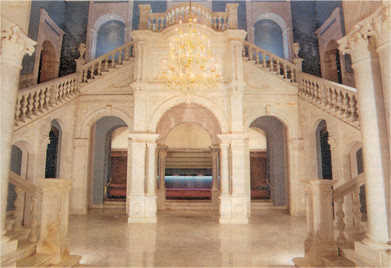
Impressive archways at the Jamshed Bhabha Theatre in Bombay
The conductor of The Paranjoti Academy Chorus Coomi Wadia recalled their first meeting in 1967 when she was very young and inexperienced. Always keen to promote art and music, after enquiring about their plans for the choir he then went on to reveal his dream of building NCPA which he made come true despite all obstacles. "The driving force behind an excellent team…he had meticulous ways of achieving perfection,” she said, remembering how initially he would come backstage to congratulate them after a performance. Later he felt comfortable to offer both criticisms and appreciation, and towards the end he would summon her before a performance to give his blessings. His frail body and failing health notwithstanding, "he grew in our eyes as a titan,” she noted in her speech.
"It was amazing to see him conduct meetings at the age of 92,” admired Ashok Chavan, minister for industry, mining and cultural affairs, Government of Maharashtra, who recalled participating in the NCPA meetings where the program for the year would be chalked out and the administrative and management issues discussed. Giving him credit for "nurturing art and culture in the city,” Chavan remarked at the condolence meeting that Bhabha’s vision, hard work and personal touch helped NCPA run successfully all these years.
Cinestar Anupam Kher spoke on behalf of the art fraternity although he had personally never met Bhabha. For an artiste, "your bio data is not complete if you have not performed at the NCPA,” remarked Kher describing "the kind of awe, warmth at this theater…the excitement before, the jubilation after…I haven’t seen even in better equipped theaters…In this theater you bend down in respect. I don’t think this place has compromised in any way in principles… I hope this legacy continues because of one person, Dr Bhabha.”
A musical ode for the patron of arts was organized at the condolence meeting with renditions of Kabir’s Doha by Ashwini Bhide and his favorite piece, Bach’s Air on G String, by members of the Symphony Orchestra of India.
President emeritus of the National Society of the Friends of the Trees, the nature lover was the driving force behind most flower exhibitions held in the city and loved to share his discoveries in the world of flowers, mentions the Afternoon Despatch and Courier (ADC) of June 2, 2007. As per his wish, after his cremation his ashes were scattered at the NCPA gardens. His wife Betty having predeceased him and the couple having no issue, his friends, colleagues and admirers had gathered to pay their respect to the culture czar.
Bombay born, Bhabha had studied at the Cathedral and John Connon School before graduating in arts from the University of Cambridge. The doctorate of literature, honoris causa, was conferred on him by the Tata Institute of Social Sciences in 1996 where he had served as governing board member. He had been conferred honors as Knight Commander of the Order of Merit of the Italian Republic as also of the Federal Republic of Germany, and as commander of the Order of the Crown, Belgium. He was appointed by UNESCO to the first 15-member administrative council of the International Fund for the Promotion of Culture, notes his bio data. He was trustee too of the J. H. Bhabha Memorial Trust and the Homi Bhabha Memorial Trust.
"He had the art of pursuing his objectives without necessarily carrying (with him) everybody who expected to be consulted,” revealed R. M. Lala who had worked with Bhabha for 20 years on the Dorabji Tata Trust in his tribute in the ADC of June 8, 2007. The building of the Tata Central Archives was initiated by him too, Lala gives him credit. Having worked closely with J. R. D. Tata for over 50 years Bhabha is known to have picked up his managerial style from him. Meticulous in all that he did, he believed, "Perfection lies in the trifles but perfection is not trifle.” Over 15 years ago Lala recalled confronting an editor of a Tata house journal: "In 24 pages of the last issue you have eight photos of Dr Bhabha. Who taught you journalism?” Undaunted, the editor replied, "People ask me whether I am a follower of Shirdi Sai Baba, Satya Sai Baba or Meher Baba but I say I am a follower of Jamshed Baba (Bhabha)!”
As the former governor of Maharashtra Dr P. C. Alexander had written in his condolence note, Bhabha "was not only a builder of institutions but was himself a great institution.”
◆ ◆ ◆
From the archive