
Philanthrophy
His magnificent obsession
Dr Jamshed Bhabha devoted his life and fortune to furthering the performing arts in India
Theater and film personality Vijaya Mehta was at home when she received a call in late 1997 from Jamshed Bhabha to come to the National Centre for the Performing Arts (NCPA). Perplexed by the request, she went only to find the nearly constructed 1,109 seater Jamshed Bhabha Theatre (JBT) on fire. She and an associate stood in silence on either side of the art patron not knowing what to say. The JBT had been Bhabha’s grand, pet project. Then he turned to them and said, "Tomorrow tell people to come for reconstruction!” She narrated the incident at a panel discussion titled "Legacy and the value of patronage to the arts” on May 16, 2018 at the JBT to celebrate the inaugural of the Dr Jamshed Bhabha Memorial Exhibition in the opulent Theatre’s foyer. Photos of the family are on display in an exhibition curated by Asavari Honavar.
The NCPA director Khushroo Suntook told the august gathering he was holidaying in Mahableshwar when the fire occurred. On insisting he would return, Bhabha instructed, "I’m ordering you not to interrupt your holiday!” Immersed in the project, Bhabha would inquire, "How can we improve it (JBT)? He looked forward, had no regrets.” He believed "the means (to reconstruct) will follow.”
The NCPA director Khushroo Suntook told the august gathering he was holidaying in Mahableshwar when the fire occurred. On insisting he would return, Bhabha instructed, "I’m ordering you not to interrupt your holiday!” Immersed in the project, Bhabha would inquire, "How can we improve it (JBT)? He looked forward, had no regrets.” He believed "the means (to reconstruct) will follow.”
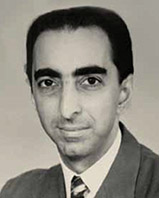
Dr Jamshed Bhabha
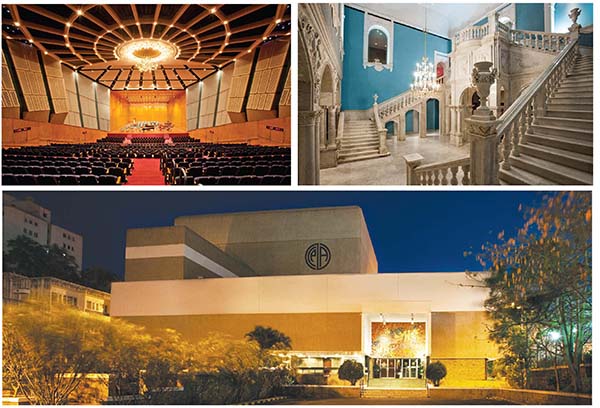
1st row: Jamshed Bhabha Theatre; 2nd row: overview of the National
Centre for the Performing Arts complex All photos: NCPA
That determination "defines the man,” said columnist and writer Anil Dharker who moderated the distinguished panelists comprising Mehta, Suntook, filmmaker Shyam Benegal, poet and artist Arundhathi Subramaniam and Prince of Wales Museum director general and secretary, board of trustees, Sabyasachi Mukherjee. Dharker said Bhabha contributed "more to propagating the arts and culture than anyone else in India,” post Independence.
When Suntook first suggested a symphony orchestra be formed, Bhabha derided the idea but subsequently added it was "worth considering.” Though the NCPA was "consistently short of funds... his optimism was remarkable,” said Suntook. Several years back when there was "no money to pay salaries,” he approached Bhabha. "How much do you need?” Bhabha inquired and when told the figure [around Rs 35,00,000 ($ 51,489) at that time], signed a cheque for the amount.
Suntook also recalled another time when at a fundraising dinner someone asked Bhabha caustically whether he would donate more than five lakhs. Bhabha replied he would give a crore and inquired, "Now will you match it?” The other party slunk off. Suntook mentioned that Bhabha had a designated seat at the JBT and once commented, "Strategically, it’s not a good seat.” Pointing to the grand, central chandelier atop, he noted. "If it falls, it will fall on me!” Suntook’s seat was next to his.
Though Bhabha had left his considerable estate to the NCPA, due to the formalities and complications it took "eight years after he died” to realize the monies. "We were in a soup,” Suntook recalled. At least from the interest received during that time, cosmetic and then technical upliftment was undertaken.
Noting Bhabha "bequeathed his whole fortune,” Dharker inquired, "Why is there such a shortage of benefactors in India?” The government does not assist the NCPA and similar organizations, as in other countries. Suntook recalled what a UK cultural secretary had stated, "Culture matters,” and for every pound Britain spent on culture, they earned four. "We have such great culture in our country” which could be promoted to garner income. We are "not asking for money from the government but tax breaks,” he emphasized.
Mukherjee noted that "Not a single penny comes from government” for managing the Museum. He moaned that culture was never equated with other priorities such as education, technology, agriculture. "The people of Bombay” support the premier, national institution.
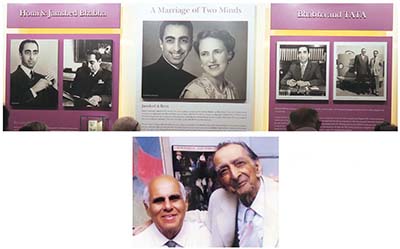
Top: exhibits in the foyer including above: Khushroo Suntook (l) with Bhabha
When Mukherjee joined the Museum as an intern in 1990 one of his first assignments was to greet Bhabha, the Musuem chairman. When he arrived, Mukherjee was told where to stand, how to shake hands and to speak only when spoken to. He was briefed that Bhabha may give "a vague smile,” which was a good sign, or he may not smile. He received "a vague smile,” narrated Mukherjee.
At the meeting when talk of a conservation center for the Museum was mooted, Bhabha asked who was qualified to run it. When the answer was nobody, he pointed to Mukherjee and said, "Send him abroad for training.”
Benegal first met Bhabha when he applied for a Dr Homi Bhabha Fellowship (Homi, a nuclear scientist was Jamshed’s brother) which he was granted. He asked Jamshed if he could go abroad using the grant money. "Go abroad if you want” but we "will not give you more,” replied Jamshed. What should Benegal do if there was any money left over? "Simply pocket it,” replied the art patron! Benegal likened the Bhabhas to the Italian Medici family that propogated the arts during the Renaissance.
Subramaniam, who looked after the literature section at the NCPA, said Jamshed had an "autocratic manner.” For one meeting, he told her where to sit and how to sip her tea. "His single preoccupation was the NCPA.” She mentioned how at one time literature was considered dowdy. "Now we have literary festivals in every part of the county.” She wanted the media to focus more on beauty, truth, wisdom. Suntook said he had recently attended an awards ceremony for journalists where 39 different categories of reporting were listed. "Not one was for culture.” Dharker suggested the NCPA should institute such an award.
◆ ◆ ◆
From the archive