
Cover Story
Bhabha’s brilliance
A hundred years after he was born Dr Homi Bhabha’s contribution to nuclear science and the arts is recalled and commemorated
"Scientist, engineer, master-builder and administrator, steeped in humanities, in art and music, Homi was a truly complete man.” J. R. D. Tata’s description of Dr Homi J. Bhabha sums up the multifaceted qualities of the great scientist who is best remembered as the father of the nuclear program in India. Born in Bombay over a century ago on October 30, 1909 to Jehangir and Meherbai, Bhabha’s life was tragically cut short on January 24, 1966 at the age of 56 in an airplane crash on Mont Blanc in the Swiss Alps while he was en route to Geneva to attend an international conference on nuclear energy.
Bhabha’s centenary year was marked by a number of commemorative events organized by the institutions he had helped to found, the publication of a new biography containing rare pictures and letters, and the minting of a special coin. It was suggested that the government posthumously confer on him the nation’s highest civilian award, the Bharat Ratna.
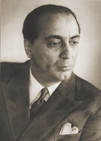
Dr Homi Bhabha: dynamic visionary
The Tata Institute of Fundamental Research (TIFR) hosted a three-day Bhabha Fellowship Conclave from November 20-22, 2009 featuring panel discussions on sciences, humanities, the media and the performing arts. Since the Institute founded by the visionary scientist in 1945 with funding from the Sir Dorab Tata Trust had completed over 40 years of awarding the Homi Bhabha Fellowships, participation from the fellows lent the conclave a wide range of interest for audiences. Another initiative by TIFR is the setting up of a permanent exhibition on its Colaba campus sketching Bhabha’s journey from his childhood to the legacies he has left behind. Titled "The visionary and the vision,” the display comprises rare pictures and instruments culled from TIFR’s archives as well as Bhabha’s own collection of paintings and sculptures.
"We felt it’s a good opportunity to create an in-depth exhibition which gives people an idea about Bhabha’s life, his scientific achievements, his understanding of India’s social condition, his visionary and historic contribution to nation-building in which research, education and technology go together. It is dedicated to the people of India for their constant support to fundamental research,” stated Spenta R. Wadia, convener of TIFR’s Endowment Fund and chairperson of the department of theoretical physics. Conceptualized by the Endowment Fund, the exhibition is supported by a grant from the Jamsetji Tata Trust.
Addressing a gathering of scientists and artists at the three-day Bhabha Centenary Symposium at the TIFR, noted materials chemist C. N. R. Rao averred that Bhabha should be posthumously conferred the Bharat Ratna. According to him, this colossus who had unparalleled and unlimited vision for the country was far more deserving of the honor than "lesser-known cinema actors and musicians.” His views were seconded by Govind Swarup, former director of the National Centre for Radio Astrophysics at TIFR, who said that modern Indian science is dependent only on Bhabha and his contributions.
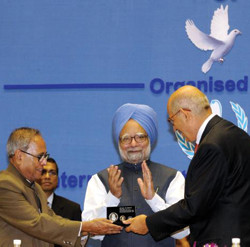
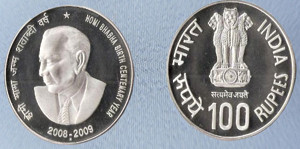
At the release of the 100-rupee coin on Bhabha on September 29, 2009 (from left): Finance Minister Pranab Mukherjee, Prime Minister Dr Manmohan Singh and Director General, International Atomic Energy Agency Dr Mohamed ElBaradei
What was it that made Bhabha’s life so remarkable? Almost single-handedly he laid the foundation of India’s huge atomic energy establishment, nurturing and expanding it with his dynamic vision. This program has now acquired global stature, capable of designing and testing nuclear weapons and aspiring to meet the nation’s growing demands for nuclear energy.
As a boy Bhabha’s life was both sheltered and emotionally secure. His keen and inquisitive mind was first recognized by a medical specialist who reassured his worried parents that the lad slept so little because his hyperactive brain kept him awake at nights. Cultural influences and exposure to music and books in his formative years honed his artistic talents. A sense of nationalism was inculcated in the boy when he came into contact with leaders like Mahatma Gandhi, Vallabhbhai Patel, Jawaharlal Nehru and also the British because of his family’s close ties with the Tatas who were associated with these personages.
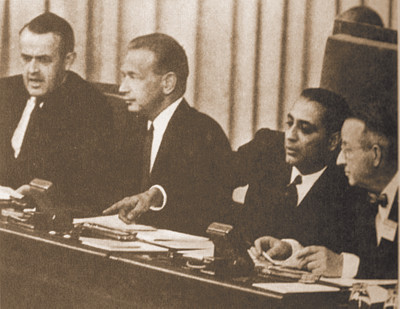
Bhabha (2nd from r) presiding over the first UN International Conference on Peaceful Uses of Atomic Energy in Geneva in 1955
By the time he passed his Senior Cambridge exam in 1924 at the age of 15, Bhabha had grasped the complexities of Albert Einstein’s Theory of Relativity as well as the intricacies of classical painting. His native genius bloomed in Cambridge — then deemed the fount of nuclear physics — where he went in 1927 to continue his studies. Bhabha obtained his PhD in 1934 at the age of 25, specializing in cosmic rays. While at Cambridge he met Niels Bohr, James Franck and Enrico Fermi, some of the greatest physicists of the time. He also interacted with W. B. Lewis who as chairman of the Canadian nuclear energy program was later instrumental in the building of Cirus, India’s heavy water reactor located in Trombay.
World War II broke out while Bhabha was on a short vacation in India and in 1940 he decided not to return to Britain. Joining the Indian Institute of Science in Bangalore as reader in theoretical physics under Nobel laureate C. V. Raman, Bhabha realized the mighty potential of nuclear energy. He dreamt of an institute for nuclear physics in the country and applied to the Tata trusts for a financial grant to that end. Writing with remarkable foresight to Sir Dorabji Tata in 1944 Bhabha asserted, "When nuclear energy has been successfully applied to power production in, say, a couple of decades from now, India will not have to look abroad for its experts but will find them ready at hand.” His persevering efforts culminated in the establishing of the TIFR on December 19, 1945. Bhabha was appointed its first director.
With Indian independence following a couple of years later, Nehru, the nation’s first prime minister with whom Bhabha enjoyed a close rapport, entrusted the scientist with total authority over all nuclear related affairs and programs. In April 1948, at Bhabha’s behest, Nehru introduced the Atomic Energy Act in the Constituent Assembly, creating the Indian Atomic Energy Commission (IAEC). The Atomic Energy Establishment, Trombay (AEET) was established in 1954 and later in that year the Department of Atomic Energy (DAE) came into being with Bhabha as its secretary. To this day, the DAE remains answerable only to the prime minister. In 1967, the year following Bhabha’s untimely death, the then Prime Minister Indira Gandhi renamed AEET as the Bhabha Atomic Research Centre (BARC) in his memory.
Bhabha inducted and supported many of the scientists who successfully developed and tested the country’s nuclear capability such as Dr Homi Sethna, P. K. Iyengar, Vasudev Iyer and Raja Ramanna, all of whom were appointed by him in 1949. Bhabha’s younger friend from his Bangalore days, Vikram Sarabhai, who succeeded him as Atomic Energy Commission (AEC) chairman, was more interested in space research, not so much the exploration of space as using space technology to solve problems on the ground. He discussed with Bhabha the need to leapfrog into the latest developments, skipping the intermediate steps. Bhabha readily accepted his suggestion and a space research division was established under DAE in 1961 with Sarabhai in charge. Thus began India’s space program with the DAE’s backing. After Bhabha’s death Sarabhai took over as AEC chairman, looking after both space research and the atomic energy program.
A capable and inspiring leader, Bhabha had an aversion to bureaucratic red tape. He set about creating a science and technology friendly administration to empower scientists in the administrative process. With his diplomatic skills and clout in the corridors of power he adamantly implemented a new administrative culture in the institutions under him. As secretary to the government of India he was a top bureaucrat and as chairman of AEC he had the status of cabinet minister, but he did not like the colonial form of functioning. His aim was "government support without government control.”
Bhabha’s rationale for this was: "The type of administration required for the growth of science and technology is quite different from (that) required for the operation of industrial enterprises, and both of these are again quite different from the type of administration required for such matters as the preservation of law and order, administration of justice, finance and so on. It is my personal view, which is shared by many eminent foreign scientists, that the general absence of the proper administrative set-up for science is a bigger obstacle to the rapid growth of science and technology than the paucity of scientists and technologists because a majority of scientists and technologists we have are made less effective through the lack of the right type of administrative support. The administration of scientific research and development is an even more subtle matter than the administration of industrial enterprises, and I am convinced that it cannot be done on the basis of borrowed knowledge. It must necessarily be done... by scientists and technologists themselves.”
In his eponymous book Homi Jehangir Bhabha, Chintamani Deshmukh mentions that as a boss Bhabha was protective of those who worked with him. This enabled him to recruit good talent and, more importantly, retain it. Once he took a decision and assigned a specific responsibility to someone Bhabha would not only not interfere but would give the person full freedom and extend every support. Those who produced excellent work were promoted, disregarding seniority rankings. It was possible for Bhabha to accomplish such feats within the DAE as he enjoyed Nehru’s confidence. Scientists were provided with excellent working conditions, residential accommodation near the workplace, special transport and good medical care. Bhabha created an ambience in which they could grapple with challenging problems, providing them with the means to do so. They were given freedom, comforts and opportunities for further progress. Despite his inborn arrogance, the visionary scientist remained "a caring, benevolent aristocrat.”
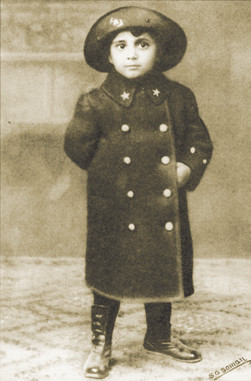
A childhood picture of Homi
In 1941 the Sir Dorab Tata Trust established Tata Memorial Hospital and ran it for a few years, but cancer treatment being expensive, government aid was required. In 1957 the Hospital was handed over to the government of India and placed under the ministry of health. The devoted doctors and surgeons who had been nurtured there met Bhabha and pointed out that in the US the AEC ran a number of cancer research centers as radiation therapy needed isotopes which came under its jurisdiction. With the Prime Minister’s approval Bhabha took the Tata Memorial Hospital under the DAE’s wing in 1963 and as AEC chairman served on its board. In 1966 the Tata Memorial Hospital and Indian Cancer Research Centre merged. The institution was named Tata Memorial Centre with the AEC chairman as the ex officio chairman of the governing council.
Since his student days Bhabha’s love for western classical music was well established, but his exquisite taste in art manifested later, in the lush gardens he laid out around the atomic institutions he built and the superb paintings that decorated their walls. Bhabha’s all-round personality as a lover of music, gifted artist, brilliant engineer and outstanding scientist inspired Raman to term him "the modern equivalent of Leonardo da Vinci.” In 1934, Bhabha wrote in a letter to a friend: "Art, music, poetry and everything else that I do have this one purpose — increasing the intensity of my consciousness and life.” The Homi Bhabha Fellowships Council, inaugurated in 1967, has tried to reflect his wide-ranging tastes.
Being both artist and patron of art, Bhabha participated in the All India Art Conference in 1948 held at the Asiatic Society to promote fine arts in the country along with eminent artists including the Russian artist Svetoslav Roerich who had made India his home. Bhabha was also involved with the activities of the Progressive Artists’ Group in Bombay formed under the initiative of Francis Newton Souza in 1947. Other founding members included S. H. Raza, K. H. Ara and M. F. Husain. V. S. Gaitonde, Bhabha’s personal favorite, joined the group later.
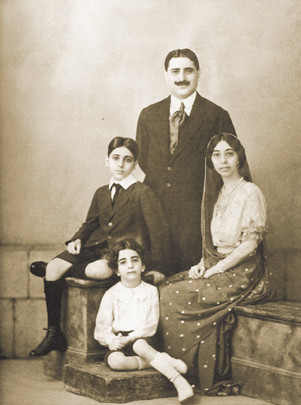
Jehangir and Meherbai Bhabha with sons Homi (left) and Jamshed
Younger sibling Jamshed J. Bhabha recalled: "My brother had been successful in getting the then Prime Minister Nehru to sanction as much as one percent of the TIFR budget for buying art.” When Bhabha died in 1966 art aficionado and promoter Rudolf van Leyden said: "India’s art world is orphaned... Bhabha collected for the Institute one of the finest and most representative collections of contemporary Indian art. The paintings and sculptures bought by him not only adorn the gardens, the vestibules and the corridors, but also the individual study chambers and the seminar rooms.”
Bhabha would often visit Kekoo Gandhy’s framing shop, Chemould, particularly before an exhibition, talk to the artists, have the paintings held up for him to examine and then suggest the most suitable type of frame. Husain had a special relationship with Bhabha who inaugurated the maestro’s first exhibition at Gandhy’s Chemould Gallery. In 1961 Bhabha drew a fine pencil portrait of Husain. "I sat for him for an hour or so in his house,” the artist recalled with pride.
Bhabha’s love for trees and gardens was legendary. When he visited gardens in any part of the world, he made sketches and took photographs. His favorites were the French and English gardens of 18th century and India’s Mughal Gardens, though he was also familiar with Italian, Japanese and Persian ones. Landscaping was not a luxury; he felt the garden was an essential component of site development. S. D. Vaidya, superintendent parks and gardens, AEET recalls: "His sensitive mind perceived the trees as living sculptures, giving a character of their own to the place where they stood ungrudgingly for generations.” Bhabha could not bear the cutting down of trees and in one instance the road alignment had to be changed to save a century old mango tree on the AEET grounds. In fact, when that campus was being developed, Bhabha planned to convert the Trombay Hills into a National Botanical Garden. However, after his death, the project was dropped.
Rose cultivation in Bombay was pioneered by Bhabha. Earlier it had been believed that conditions in the city would not be conducive, but by 1960 there were about 750 named varieties growing successfully in the AEET’s Rose Garden. In 2010, during his centenary year, a new variety of white rose, the Dr Homi Bhabha Rose, was created in his honor.
In their recently published book A Masterful Spirit — Homi J. Bhabha 1909-1966 authors Indira Chowdhury and Ananya Dasgupta (see "Bringing Bhabha to life,” Books, pg 35) have described what a "huge shock” it was to people when Bhabha paid Rs 3,000 to acquire a mural of Einstein created by renowned artist Jacob Epstein. In those days Rs 3,000 was a huge sum of money indeed! Again, in 1962, when Bhabha commissioned Husain to create a mural for the TIFR, it was considered a "very bold” decision, the authors say. The 40 ft by 10 ft mural adorns the wall just outside the library.
A 10-rupee coin issued in February 2010 to mark the scientist’s birth centenary seems to have got the year wrong, according to Bombay based numismatist Shamji Vinchhi. The coin is inscribed "Homi Bhabha Centenary Year 2008-2009.” Vinchhi claims he has never before seen a coin minted mentioning a financial year. Memorial coins are usually issued with the birth and death dates of the individual and the Bhabha commemorative coin should have read "Born: 1909; Died: 1966.”
There has been some carping about the gov-ernment’s perfunctory attitude to the birth centenary of one of India’s exceptionally great sons. Mercifully, the Indian scientific community rallied round to commemorate the life and times of its own towering leader with the TIFR and the Indian Academy of Science holding a combined festival of science and arts. Three areas of Bhabha’s luminous legacy that were reiterated are his belief that nuclear energy would give India electricity, prestige, development and, "if absolutely necessary,” nuclear weapons. Secondly, to remember that Bhabha fought relentlessly against safeguards that would have cramped India’s nuclear program, that under no circumstances would he accept the proposal that the international agency should control India’s nuclear fuel and other resources. And finally, no one was more aware of the nuclear threat posed by China and possible counter-measures than he was. He argued that either India must have the right to match China’s imminent nuclear weapons program or those not wanting India to go nuclear must guarantee the country’s security.
In his personal life, Bhabha remained a bachelor. When a journalist once asked him about his single status he responded that he was "married to his creativity.”
◆ ◆ ◆
From the archive