
Politics and Policy
Searching for solutions
An informal meeting of the Federation of Parsi Zoroastrian Anjumans of India office bearers and others discuss community issues
Tapping the legacies of well-off Parsis may yield larger returns than pursuing the property of defunct anjumans, stated Parsi Zoroastrian Anjuman of Secun-derabad and Hyderabad trustee Jehangir Bisney at a core committee meeting of the Federation of Parsi Zoroastrian Anjumans of India (FPZAI) on August 5, 2006 at the Bombay Parsi Punchayet (BPP) boardroom.
The fractious half-day meet which saw angry words being exchanged between some of the 14 delegates present and Ahmedabad Parsi Panchayat president and Federation vice president Areez Khambatta may prove a harbinger of things to come at the all-India body’s annual general meeting to be held in Bombay on September 23 and 24, 2006.
BPP executive secretary Cawas Panthaki informed the gathering that efforts to hire professionals to assist in reclaiming properties or monies of defunct anjumans was unsuccessful as the monetary returns expected by the selected candidates were too high.
Guidelines are to be drawn up to determine what percent of the revenues realized from defunct anjumans assets should go to the anjuman that does the follow up as versus the Federation.
Iranian Zoroastrians do not classify as nomadic Iranian Indians and thus cannot claim the reservation offered to this category, noted Federation joint honorary secretary Keki Gandhi and former BPP trustee and Satara representative Jamsheed Kanga.
BPP trustee Dinshaw Mehta mentioned that the Parukh Dharamshalla run by the BPP for the elderly had for the first time no waiting list.
The new senior citizens home donated and built by billionaire businessman and philanthropist Pallon Mistry on the B. D. Petit Parsee General Hospital grounds is slated to open shortly (August 25, 2006), said BPP trustee Dinshaw Tamboly.
The Delhi Parsi Anjuman (DPA) president and Federation north zone vice president Lt Gen (Retd.) Adi M Sethna has been reappointed for an unprecedented third three-year term to the National Commission for Minorities. He was unable to attend the core committee meeting on account of his ill health, noted BPP chairman Minoo Shroff.
Flying and deep sea diving are the occupations sought by many community youth today, noted Shroff and Tamboly.
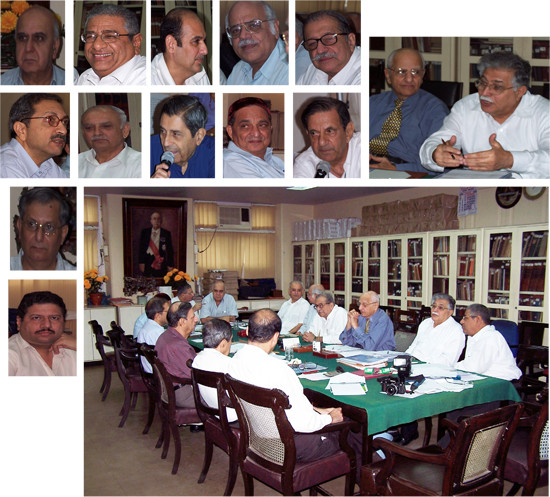
Top first row (from left): Dinshaw Tamboly, Dinshaw Mehta, Jehangir Bisney, Rustom Cursetji and Areez Khambatta. Second row (from left): Farrokh Rustomji, Bahadur Postwalla, Bomi Heerjee, Merwan Irani and Jamsheed Kanga. (Below): Minoo Shroff (left) and Keki Gandhi; (Above) Mehli Colah and (top) Cawas Panthaki. Meeting in progress at the BPP boardroom (alongside)
Defunct anjumans
The efforts of the BPP to employ professionals to realize income from properties of defunct anjumans have not materialized, noted Shroff.
Panthaki stated that around 10 prospective candidates were met of which two were willing to join. But when they were issued the appointment letters, the candidates demanded Rs 3,000 a day as expenses when they were on tour. This was in addition to a salary of Rs 25,000 a month. The BPP could not afford such costs, noted Panthaki.
Shroff noted the former BPP chief executive officer Rustom Anklesaria had tried to rope in retired mamlatdars, but "it didn’t work.”
Shroff and Gandhi had visited anjumans in Madhya Pradesh just prior to the current meeting. While some anjumans were receptive others were suspicious of the Federation’s motive. "They thought we were going to gulp (their assets),” said Shroff. "When we asked them what was going to happen after them (when the anjuman became defunct or only one or two people remained) they had no reply,” he added. An incentive system to encourage neighboring anjumans to look after the property of dwindling or defunct anjumans in their vicinity was found "too complex.”
"We’ll have to try another approach,” said Shroff. He noted the crucial role Sohrab Katpitia, the former chief executive officer of the Surat Parsi Panchayat, played in initiating the Federation’s defunct anjuman project and suggested on account of his advanced age and physical ailments he be used "as a resource” person.
"He is carrying a backlog of resentment,” noted Kanga referring to the brickbats thrown at Katpitia at the Bombay Federation meet in September 2005 by Khambatta and others from Gujarat and the World Alliance of Parsi Irani Zarthoshtis (WAPIZ) camp.
Gandhi suggested a modus operandi whereby the concerned anjuman should take up one property and find out in whose names the assets stand in the municipal and district registers. "If there is a name (of an anjuman or a Parsi) then approach the closest anjuman to act… if the trustees are not eager, the Federation can hold an intervening brief.”
If an agreement to sell the property at a low price has been negotiated to by any local party, an application contesting the sale can be made to the charity commissioner or the local equivalent by the Federation or an anjuman.
If the contract to sell is with a builder "he may come forward and offer more” to avoid time consuming and expensive litigation. The Federation/anjuman could then accept the money and withdraw the application. The money realized would "come to the Federation which is turn would go to the BPP in the individual anjuman’s khata (account),” said Gandhi.
The amount could be used for the benefit of the local Parsi residents if any. "If no one is there, an appeal to the charity commissioner for a cy pres declaration (whereby the funds can be used for a purpose closest to what the original donor envisioned) can be made.”
Gandhi was narrating one of two incidents in which the Federation had intervened successfully when Khambatta walked into the meeting at 10.30 a.m. The meeting scheduled to start at 10 a.m. began at 10.10. "I’ve not come late,” Khambata stated, "I’ve come directly from the airport.” He said he has sent a lawyer’s notice questioning the legality of holding the meeting to which he received "no reply. I would like to know how this (core) committee is formed. I’m a vice president (of the Federation) but I was not taken into consultation.”
Kanga intervened, "this is a meeting of civilized people. You can’t go on (disrupting the proceedings)… you can record your objection.”
"We’ll deal with your notice” in due course, said Gandhi. "Everyone has accepted our authority,” to call the meeting, countered Shroff.
Khambatta alleged: "First of all you’re not even (BPP) trustees.”
"Who told you that?” retorted Shroff.
Khambatta was referring to a case filed by WAPIZ members claiming the four BPP trustees, who had resigned on differences over allocation of two donor flats and other issues with Mehta, could not legally withdraw their resignations and hence could not function as trustees.
Mehta cautioned Khambatta stating the matter was "sub judice” and the present core committee was "only an advisory body.”
When Khambatta asked Mehta if he was aware of the formation of such a Federation committee, Mehta replied he "was not aware it was formed.” (The concept of a core committee had been mooted by the late DPA president and Federation north zone vice president Shiavax Nargolwala prior to the hosting of the 1978 World Zoroastrian Congress – editors.)
Shroff termed the objection "irrelevant” as the committee was not passing any resolutions and the discussions were "not binding.”
A comment by Kanga on the subject was dismissed by Khambatta with the remark "You’re a bachcha (child).”
Shroff: "Respect a man who has been a collector and a trustee of the BPP.” Kanga was also a municipal commissioner of Bombay.
Gandhi recommended that Kham-batta write a note to the Federation stating his objections. "As far as the meeting is concerned, we invited people to discuss informally (community issues). The suggestion was made by people round the table.” Khambatta asked his "objections be noted.” Shroff noted people had come from as far away as Calcutta for the half-day meet. "Let’s not waste their time.” Khambatta: "My ears are with you.” Gandhi: "Let your heart also be with us.”
Gandhi then proceeded with his report on the defunct anjumans when Khambatta interjected the report should have been circulated prior to the meeting. He then asked Gandhi for a copy of the report. Gandhi said he did not have a copy.
"There are plenty of xerox machines” to print copies, observed Khambatta.
"Everyone will get a copy at the same time,” replied Gandhi.
Khambatta: "Note my objection.”
Gandhi said two lakh rupees had been realized from a property in Khandwa following a compromise with the parties concerned.
Khambatta: "When was that?”
Gandhi: "I don’t know. At least five years ago.”
Khambatta: "For Cambay?” a reference to another matter.
Gandhi: "I don’t have the date.”
Shroff: "This is not a question of arithmetic,” referring to the figures Khambatta asked for.
Kanga to Khambatta: "You’re fond of your own voice. Don’t interrupt.”
An irritated Khambatta retorted, "Let it (the discussion) come in Parsiana, your favorite publication.” He also referred to the photos being carried in the magazine of the Federation delegates and claimed that he was not given similar treatment.
Kanga: "One bad apple” spoils everything. "Please tell him to shut up.”
Khambatta: "You shut up.”
Farrokh Rustomji, honorary treasurer of the Federation "Let him (Keki) finish what he is reading.”
Gandhi then explained extracting money from properties of defunct anjumans is "a slow going process.” The two earlier instances may have taken place "10 or 20 years ago in the time of (former Surat Parsi Panchayat presidents Maneck) Gyara or (Dr Sam) Bhacca.” Gandhi clarified the purpose of presenting the report at the meeting was "for suggestions. These are not accounts.”
Gandhi referred to the discussions Shroff and he had with the anjumans in Madhya Pradesh and the need to find solutions. "Who asked you to go?” demanded Khambatta, "You went gaam né batlava (to show the world you worked).”
Indore Parsi Zoroastrian president Bomi Heerjee asked Gandhi what response he had received form the Bhopal Anjuman. "They were very polite,” said Gandhi. They asked "why have you come? They were very frank. They said you came 17 to 18 years ago” and no progress has been made since.
They alleged the BPP trustees were "big people living in an ivory tower,” said Gandhi. Like Pravin Mahajan, they felt like poor relatives whose needs had been spurned (Mahajan shot and killed his brother Pramod, one of the leaders of the Bharatiya Janata Party).
"If I came 17 years ago and I’ve done nothing how many times have you phoned me (to remind me of the work)? We’re all busy,” countered Gandhi.
Bisney asked what benefit did a neighboring anjuman gain from assisting in preserving or disposing of the properties of defunct or dwindling anjumans.
Gandhi replied that aside from reimbursing all expenses, 20 to 30 percent of the income realized could be used by the anjuman that did the work after applying for a cy pres doctrine. The remaining 70 percent could be used on an all-India basis.
Shroff suggested the Federation adopt guidelines for individual anjumans to follow.
Referring to Bisney’s query on the benefits accruing to the concerned anjumans, Khambatta noted, "It’s a mean mentality. It should be nipped in the bud. We discussed in the past this dagaa bazi (treachery).”
Bisney: "We’ve heard enough of your nonsense in (the Federation’s) Thana (meet).”
Kanga: "We’re talking of Parsipanu” and look at the way we are conducting ourselves.
Shroff: "Khambatta says he is a flavorist (referring to Khambata’s oft repeated remark when asked a question he was not competent to reply to).”
Khambatta: "We’re wasting time.”
Gandhi: "What is your practical suggestion?”
Khambatta repeated his suggestion made at earlier Federation meetings to hire professionals to do the job.
Shroff: "We discussed this in the meeting before you came.”
Khambatta: "Instead of talking about professionalism,” we should think of helping the community. "People are not true to themselves. In business you can do what you like” but not in social work.
Kanga: "Are you trying to be obnoxious? Talk politely. Politeness is required from gentlemen.”
Khambatta: "If someone fingers me” I hit back. "I don’t want your advice.”
Kanga: "You project yourself as a world leader (a reference to Khambatta’s position in WAPIZ). We can’t be bullied by loud voices.”
Shroff turning to BPP trustee Burjor Antia: "Burjorji how can we move faster? There is so much selfishness…”
Antia attributed the present maladies to a "lack of love for the community.” He noted that community property was sometimes usurped by the trustees themselves. In Rajkot he noted with "the passage of time, local Parsis thought they were owners of the property. They took monies. In India litigation takes 10 to 12 years.” Lawyers were called in and efforts were made to try and recover money at "even less than market rates.”
In Madhya Pradesh a beneficiary of some property resided in Australia. "He came (to India) but did not make an affidavit… it takes time… schemes are filed… every region should take over protected properties,” added Antia.
Rustomji suggested anjumans can file Right to Information applications for details of properties. He believed the authorities were bound to provide answers. But Gandhi cautioned that people not conversant with the issues and the risks involved should not intervene. Otherwise the state "can acquire” the property, warned Bisney.
Thana Parsi Zoroastrian Anjuman president and Federation west zone A vice president Rustom Cursetji suggested apart from guidelines, a cell of experts should be set up, and a percentage of the earnings should be set aside for the doer anjuman.
Khambatta reiterated his proposal to "manage those properties through professionals who go everywhere and appoint local lawyers. He suggested law firms such as Mulla and Mulla or Crawford Bayley who have an all-India network of lawyers could appoint lawyers in moffusil areas.
Kanga asked Khambatta if he could spare any professionals from his business organization.
"I can give you salesmen,” said Khambatta.
Bahadur Postwalla, trustee of the Calcutta Zoroastrian Community’s Religious and Charity Fund inquired if the vice presidents of the Federation had any authority to do things. Gandhi responded that as they were elected by the anjumans of the area they would be of standing. They could call for zonal meetings to be held.
"People have not taken the position of the vice president very seriously,” noted Shroff. They "need humility,” stated Kanga. "They should trust each other. (In the past) we never had anyone shouting,” said Shroff.
"This (BPP) boardroom has had more shouting,” than elsewhere countered Khambatta. "Can’t we get a muzzle” or something to shut him up, asked Kanga? "Short of physically putting him down what do you expect me to do?” asked Shroff.
Antia interceded to note that Mulla and Mulla and Crawford Bayley did not have legal contacts in the moffusil areas. He felt what Bisney was "doing is ideal… everyone must help the Federation.”
Senior citizens homes
The elderly suffer from two major medical problems, noted Tamboly who along with his wife Bachi, manages two senior citizens centers in Navsari on behalf of the World Zoroastrian Organisation (WZO). They tend to fall and fracture their bones and they face gastro-intestinal problems, often due to excessive eating. The Navsari centers prepare 700 chapatis daily for the 60 or so residents. "We have to be able to shift them to hospital quickly. Our centers in Navsari are five minutes away from the hospital.”
Most fatalities occur "in the first few months… they can’t accept that their children have put them in an institution. Some of them stop eating.”
Merwan Irani, president of the Iranian Zoroastrian Anjuman, suggested two flats in each baug as and when they became vacant be set aside for a senior citizen center. But the delegates pointed out this would not be practical as a professionally managed set-up was required.
Kanga referred to the Cama Convalescent Home in Bandra while Mehta referred to the Bhabha sanatorium also in Bandra as places where senior citizens centers could be started. Tamboly noted the Leelavati Hospital was the closest medical center to the two institutions.
A new center for the elderly donated and built by Pallon Mistry on the grounds of the B. D. Petit Parsee General Hospital would have around 58 beds, said Tamboly. The ground floor residents would be accommodated free of charge, the first floor would be subsidized and the second floor would consist of flatlets, he noted. A jashan would be held on August 25 and the center would become operational thereafter.
Shroff noted the Parsi population in Bombay had shifted northward to the suburbs and centers should also be considered in those areas. Masina Hospital was suggested as one such place. They already have a ward for elderly Parsis.
The Petit Sanatorium near Kemp’s Corner could also be so utilized but at present there was some litigation with the residents, noted Mehta.
Tamboly wanted to know if the Parukh Dharamshalla run by the BPP could be enlarged but Mehta said this was not possible, the floor space index being fully consumed.
Further Mehta noted that surprisingly the Parukh Dharamshalla presently had "no waiting list… anyone can get place,” if required. This was a new and puzzling development. With all the facilities offered why has the waiting list depleted?
The money anjumans may recover from the properties of defunct anjumans, after years of effort may pale in comparison to the returns that can be earned by looking after the well-to-do elderly who live alone, pointed out Bisney.
"People die without a will,” noted Bisney. "Many are not even aware of the assets they have.” Often share certificates and fixed deposit receipts remain in cupboards and drawers without the owners being conscious of their worth. "The holdings are often in a single name because the person trusts nobody… sometimes the money goes to (domestic) servants,” said Bisney who in the course of his practice as a chartered accountant has observed several cases of lost legacies.
When asked why they did not put their holdings in joint names or named family members in their wills, they often replied, "my relatives never looked after me.”
These people could be induced to leave the money to the local anjumans.
"Many families are (very) rich,” said Heerjee. "If we ask them ‘tell us where the money is going’ they get suspicious.”
Gandhi felt the professional care givers such as existed in the Calcutta anjuman scheme could reach out to these people.
Bisney stressed the need for "confidants,” people such as lawyers or accountants whom the individuals or families trusted, to intercede on behalf of the local community charities.
Heerjee noted that the demographics was working against the community in terms of earning power as well. The ideal ratio in developing countries prior to World War II was around nine earning members for one dependent, a 9 to 1 ratio, he noted. In the community the average ratio was 1.8 to 1. "This is a major problem in the small anjumans. There is no one to look after the aged in the entire catchment area of Madhya Pradesh.”
Kanga suggested that just as organizations like Dignity Dialogue had senior citizens assist the Bombay Municipal Corporation in overseeing neighborhood services and problems, so also community organization like the Delhi based PARZOR, the newly formed Parsi Resource Group (PRG), WAPIZ (though he was not sure if they had a social welfare wing) could assist the BPP or other associations in looking after the elderly and participate in community activities.
Shroff mentioned the Liaison Committee for Organization of Parsi Charities and Social Services as a "possible organization to assist.” Gandhi noted that the erstwhile Polson butter company "had a policy of only hiring retired people.” Aside from being able, they "worked for half the salary.”
Kanga noted in the US people who had retired and subsequently took up employment "worked longer hours” than others.
Youth: heights and depths
The shift in professions by those applying for scholarships and monetary assistance was noted by the delegates. In the past those who opted to learn flying largely remained unemployed, observed Shroff. But now with the boom in the world economies, pilots were in great demand. Accordingly applications for loans and scholarships for learning to fly have increased, he said. A course can cost upto five lakh rupees and private flying training costs extra.
Tamboly noted that deep sea diving was another big draw with several Parsis taking up the option. He noted that the WZO trust for employment had disbursed five crore rupees in loans to around 500 individuals. Seven crores had accrued back to the fund. Each individual received loans of around two to three lakhs and 50 to 60 applications were pending. Tamboly noted WZO spent around 10 lakh rupees a year "to encourage youth in sports.”
The need for trusts to work together was noted by Heerjee who added "there is a lot of mistrust amongst trusts.” Antia remarked that when the BPP called a meeting of various Parsi trusts in Bombay at the Seth Cawasji Behramji Banaji Atash Behram hall one Sunday morning only two trust representations showed up. Kanga said the Holiday Programme for Youth (HPY) was "the best thing they (the BPP) have done.” He wanted other anjumans to have similar programs with the HPY organizers serving as catalysts and consultants. Gandhi noted that Poona had a month long summer program for youngsters.
The recent efforts by the World Zarathushti Chamber of Commerce to train entrepreneurs was referred to with Shroff commenting "these were all young people except me.”
The BPP Review should "showcase all the people we have helped,” noted Shroff. He stated he had expressed his desire that the Review not feature the trustees so much as the work the BPP was doing for the community.
Kanga claimed the journal was "a waste of paper… showcase your achievement instead of your photos.”
Matrimonial
Referring to the opt repeated refrain of "find a girl for me,” Gandhi said he in turn would ask "Why do you expect other people to find a girl for you?” He suggested boys should visit the small towns and seek out suitable brides for themselves.
Khambatta cautioned that any man wandering into a small town maybe mistaken for a "Romeo” and attacked by the irate locals.
Postwalla noted that potential matches "did not want to come to Calcutta.” "The demands of the girls are very high,” said Panthaki. They do not want to live with the in-laws whom some view as unwanted "furniture.”
Postwalla wondered if any study had been done to gauge the percentage of men and women "who would agree to an arranged marriage.”
While this information was not available, Panthaki bemoaned the fact that people who gave their names for inclusion in the BPP matrimonial lists, did not keep the BPP abreast of their marital status. One applicant whose name was on the list had married, divorced and remarried without informing the trust. Only when her name was proposed for a match, the BPP became aware of her status.
Iran
The Indian government notifications giving Iranian Indians nomadic status applies only to Muslims who have migrated to India in recent times, noted Gandhi and Kanga. Kanga said he had checked with the Maharashtra state’s social welfare department secretary who conveyed the information to him. Mehta advised the Federation/BPP to "meet (chief minister) Vilasrao” Deshmukh and request him to "make it applicable to Zoroastrians.” But as Irani Zoroastrians came around 100 years ago, it was unlikely the state would accommodate them in the category, delegates noted. By being classified nomads, the individuals are entitled to certain reservations, quotas and other privileges.
Mobeds
Kanga noted in Satara "we have a paramobed. He came 10 years ago from Tarapore.” The Federation’s paramobed scheme was abandoned many years ago after the Allahabad anjuman complained of the quality of the persons sent, observed Gandhi. Also there were no volunteers forthcoming.
Khambatta noted, "Mobeds don’t want to go to the moffusil areas.”
Tamboly pointed out that Navsari had two paramobeds but as they were viewed as an economic threat to the regular mobeds, the local priests objected to their presence.
Tamboly informed the committee that the PRG had registered 556 mobeds in Bombay, Nagpur, Navsari, Poona, Secunderabad, Surat, Thana, Udvada, Valsad, Vapi and other towns. Mobeds over the age of 65 will receive a stipend of Rs 2,000 a month, said Tamboly. (The PRG founder Jimmy Mistry had stated that the older mobeds who were infirm and restricted in the amount of work they could do, needed assistance the most.)
Each mobed’s family was insured for two lakh rupees, added Tamboly. He observed that though mobeds had mediclaim insurance coverage they applied to trusts for funds when hospitalized. When asked why, they replied, "Who is going to fill up all the (mediclaim) forms?”
The M. F. Cama Athornan Institute has only two students, noted Tamboly. The Dadar Madressa has 27. Kanga noted the Cama trustees had turned down a proposal to start a Montessori school on the premises while Shroff observed a proposal for a management institute had similarly been refused.
Khambatta said that WAPIZ had started a mobed scheme whereby Rs 15,000 a month was paid to them and Rs 500 a day for everyday they worked out of town. Sometimes mobeds cannot go on leave for 20 years because no substitute is available, said Khambata. (The Mhow anjuman had requested a mobed from WAPIZ but none had been forthcoming, Mhow president Dr Behram Masani had lamented at the last Federation meeting in March 2006.)
As the meeting drew to a close around 2.15 p.m. Kanga urged Khambatta to function in a democratic manner, a reference to the scuttling of the proposed world body by small anjumans. Kham-batta replied that in the September annual general meeting of the Federation, democratic functioning would be demonstrated. (The smaller anjumans which represent around 20 to 30 percent of the Parsi population and favor WAPIZ have numerically more votes than the larger anjumans who constitute over 70 percent of the Parsi population).
Khambatta again clashed with Gandhi over the holding of the core committee meeting noting the sole purpose was to avoid holding the annual general meeting of the Federation. Following the heated exchange a vote of thanks was proposed.
For those who believe the recent meetings of the Federations have been stormy, the September 2006 meeting in Bombay may prove to be the mother of all Federation meetings!
Those attending the meeting were: Areez Khambatta from Ahmedabad; Minoo Shroff, Dinshaw Mehta, Dinshaw Tamboly, Burjor Antia, Mehli Colah and Cawas Panthaki from Bombay; Bahadur Postwalla from Calcutta; Keki Gandhi from Delhi; Bomi Heerjee from Indore; Merwan Irani from the Iranian Zoroastrian Anjuman; Farrokh Rustomji from the Sir J. J. Trust; Jamsheed Kanga from Satara; Jehangir Bisney from Secunderabad-Hyderabad; Rustom Cursetji from Thana. The Press was represented by Parsiana.
◆ ◆ ◆
From the archive