
Cover Story
Our interests have grown
The new Air Chief Marshal Fali H. Major talks of the Indian Air Force's new role in a changing world
The palatial Air Force officers’ mess Akash was a temporary abode for Air Chief Marshal Fali H. Major and his wife Zareen. Until their grand home at 23, Akbar Road was ready, the affable couple resided at the mess close to the historic India Gate.
The other armed forces, whose officers’ quarters were located away from the center of Delhi were envious of Akash’s prime location, Major noted humorously. The tastefully decorated hall in the apartment occupied by the Majors had the new Air Force chief’s ubiquitous golf clubs leaning against a wall.
The chief’s be-saried wife, Zareen, chatted amicably about her interests while her husband readied himself for the evening function hosted by the Delhi Parsi Anjuman to felicitate the couple at their agiary-dharamshala-hall complex on Bahadurshah Zafar Marg on April 22, 2007.
Her time was occupied by the Air Force Wives’ Welfare Association, she noted. The organization looks to the well-being of widows, the education of children, awarding of scholarships, running special schools for children with disabilities. "The files keep piling up,” she notes with a smile.
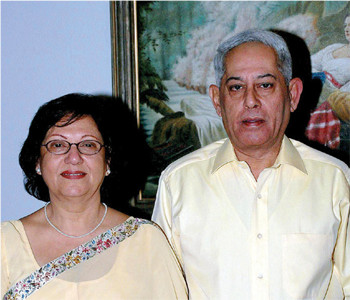
Above: Zareen and Fali Major.
The welfare activity has "recently picked up,” noted her husband. They now have "a large corpus for scholarships.” Housing loans for widows are "waived off,” as required.
A sound economic basis for both the armed forces and the country has made the Indian Air Force (IAF) the fourth largest in the world, says Major, and "the most powerful in the region,” excluding China.
The IAF was shortly going to make "the largest aviation purchase in the history of the world,” the chief noted. All acquisitions require the manufacturer to source 30 percent of the deal locally. Technology also has to be transferred, he added.
The IAF is going global. Joint military exercises have taken place in France, Australia and Hawaii. As Indian economic ties with other countries enlarge, so also the IAF has to increase its reach, though not for offensive purposes. "Our interests have grown,” said the grey haired serviceman. Previously India was preoccupied with Pakistan and China; "we never bothered beyond that,” he said.
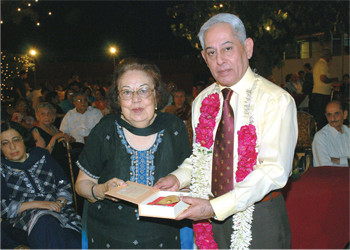
Above: Khorshed Adi Sethna presenting the Delhi Parsi Anjuman momento to Major
The IAF’s focus is to be technology intensive, notes the chief. Capability based equipment was the requirement, rather than just numbers. Aerial refueling permits aircraft to remain in flight for long hauls. "We have to be able to fight in all spectrums of warfare,” Major says. No air force can afford to be 100 percent hi-tech though, he cautions. Sixty to 70 percent of the force can be hi-tech, 10 percent low-tech and the rest medium.
In his message issued when taking charge of his new office, Major observed, "We are embarked upon an appropriate but comprehensive modernization, ever mindful of the costs to a nation with many priorities. We will work to enhance the strategic reach of all facets of air power; towards networking and integration of space, to ensure that we can exercise effective influence wherever our national interests lie…
"Improving technology has made the IAF more effective and its growing utility in peace and warlike situations has led to an increase in its roles and tasks. In its 75th year, the IAF is...(a) versatile and battle-tested force, with strategic capabilities and is professionally amongst the best in the world.”
The 59-year-old Major will hold the post of Air Chief Marshal till the age of 62. Born on May 29, 1947 in Secunderabad, he studied at Wesley High School in the city and was commissioned in the IAF at the age of 20. He is a graduate of the National Defence College and Army War College, notes his bio data. He has flown 7,000 hours on various helicopter models and as Wing Commander commanded the IAF’s first Mi-17 Squadron "which operated at the Siachen Glacier — the world’s highest battlefield,” notes the write-up. As a Group Captain he led a squadron of Mi-17 "into battle during the operations of the Indian Peace Keeping Force in Sri Lanka.”
As the Air Force Station Commander at Sarsawa he led the daring rescue of 11 passengers from a cable car above a valley at a resort in Himachal Pradesh. For this act of gallantry, he was awarded the Shaurya Chakra. The Federation of Parsi Zoroastrian Anjumans of India also awarded him the Col Adi Tarapore Memorial Award in 1995 for his courageous feat. It took Major and his crew two days to winch out the survivors individually from the cable car to the helicopter which had to hover precariously close to the cables. Major personally participated, motivated and led his crew through the nailbiting suspense of the operation (as Major noted in the course of a brief chat with Parsiana in 1995, "Unless you lead from the front, you lead no one.”)
Major held a number of important staff and field appointments and "for his leadership, successful accomplishment of tasks and distinguished service of a very high order...was awarded the Ati Vishist Seva Mandal in January 2002,” notes the bio data. He was promoted to the rank of Vice Air Marshal in February 2002 and two years later "directed the relief, rescue and rehabilitation operations of the Indian Armed Forces, in India and abroad, in the aftermath of the tsunami.” In September 2005 he was appointed as Air Officer Commanding-in-Chief, Eastern Air Command. "That tenure saw the successful conduct of three major international air exercises with the United States Air Force, Republic of Singapore Air Force and the French Air Force,” states the write-up.
He was awarded the Param Vishisht Seva Medal by the President of India on January 26, 2006. He took over as the Chief of Air Staff on March 31, 2007. The only other Zoroastrian to have held the top post was Air Chief Marshal Aspi Engineer (1960-64).
The Air Force offers a very good life style, says Major. Starting Pilot Officers can earn around Rs 20,000 a month, avail of 60 days leave, subsidized accommodation, medical assistance, free travel allowance, canteen facilities and other benefits. But despite the obvious advantages of joining the services, many youngsters are opting for other more lucrative careers.
The Majors’ son Zubin opted to join Jet Airways instead of the IAF and is presently based in Madras. Their daughter Tooshna is married to Homi Keki Gandhi of New Delhi. An attractive job offer from a Dubai bank lured the couple and their two children to Dubai. "Tooshna and the children love Dubai,” says Major.
He refers to an article in Time magazine which states that if a person successfully recruits a candidate for the US armed forces he is paid $ 25,000! And an article in the weekly India Today (April 23, 2007) noted, "Last year, 220 IAF officers, most of them highly trained pilots and engineers desperately sought by the booming civil aviation sector, applied for premature retirement. Only 87 were allowed to quit. It seems the army, which has around 34,000 officers, may follow suit. Only a fraction of the officers who have applied for discharge will be relieved to avoid creating an unacceptable void in the force. ”
Major believes the IAF still offers great opportunity. "There are no quotas, no reservations… it’s 100 percent pure merit…I am an example” of the secular aspect of the armed forces and the merit based policies, he notes. In 2001-2002 of the seven sectors, four had Parsi commanders-in-chief. Now there were none. The IAF recommends three or four names to the government for nominating the Air Chief Marshal. "The Air Force has no say,” he notes.
Addressing the gathering of Delhi Parsis that evening Major said it was "a matter of great pride” when the government of India gave him the responsibility to head the IAF. He said he was grateful to his predecessors and that he "intends taking the Air Force to higher levels.”
While on various postings — "we have been to every corner of this country — we do meet up” with Parsis says Major. But in some places such as Ladakh and Shillong, Parsis "nathi (are not there),” notes Zareen. "In smaller places (the community) is doing fairly well,” says Major. Like many other Parsis he believes the community needs to venture out. "Don’t think of only staying in Bombay. The community needs to wake up.”
The Majors intend to settle in Bangalore after Fali’s retirement. "We have a place there. We belong to Bangalore,” says Zareen. And his retirement plans? "To play golf.”
◆ ◆ ◆
From the archive